George hits the big time
p. 12 · Read in the full issue
Business
By Arthur McCutchan
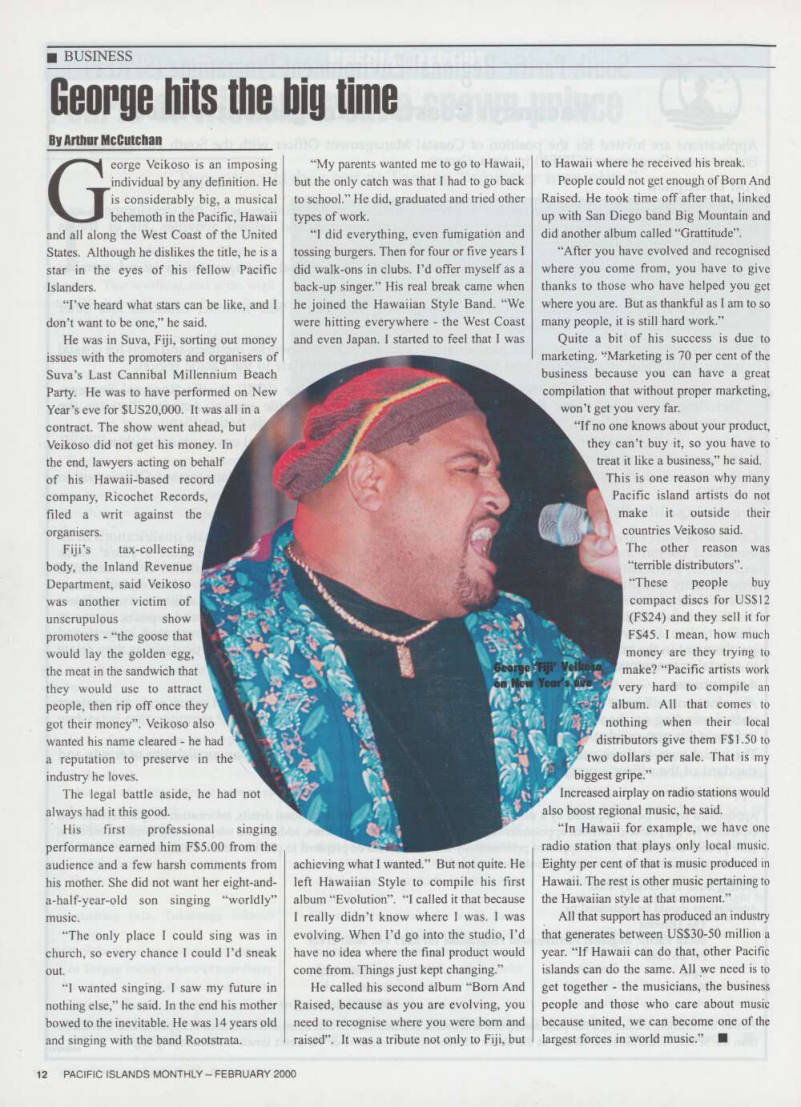
George Veikoso is an imposing individual by any definition. He is considerably big, a musical behemoth in the Pacific, Hawaii and all along the West Coast of the United States. Although he dislikes the title, he is a star in the eyes of his fellow Pacific Islanders.
“I’ve heard what stars can be like, and I don’t want to be one,” he said.
He was in Suva, Fiji, sorting out money issues with the promoters and organisers of Suva’s Last Cannibal Millennium Beach Party. He was to have performed on New Year’s eve for SUS2O,OOO. It was all ina i contract. The show went ahead, but Veikoso did not get his money. In JM the end, lawyers acting on behalf of his Hawaii-based record company, Ricochet Records, filed a writ against the M I
organisers.
Fiji’s tax-collecting B
body, the Inland Revenue Department, said Veikoso was another victim of unscrupulous show J*\ promoters - “the goose that would lay the golden egg, ■BbeylQpv the meat in the sandwich that they would use to attract people, then rip off once they got their money”. Veikoso also wanted his name cleared - he had a reputation to preserve in the industry he loves.
The legal battle aside, he had not always had it this good.
His first professional singing
performance earned him F 55.00 from the audience and a few harsh comments from his mother. She did not want her eight-and
a-half-year-old son singing “worldly”
music.
“The only place I could sing was in church, so every chance I could I’d sneak out.
“I wanted singing. I saw my future in nothing else,” he said. In the end his mother bowed to the inevitable. He was 14 years old and singing with the band Rootstrata.
“My parents wanted me to go to Hawaii, but the only catch was that I had to go back to school.” He did, graduated and tried other types of work.
“I did everything, even fumigation and tossing burgers. Then for four or five years I did walk-ons in clubs. I’d offer myself as a back-up singer.” His real break came when he joined the Hawaiian Style Band. “We were hitting everywhere - the West Coast and even Japan. I started to feel that I was
achieving what I wanted.” But not quite. He left Hawaiian Style to compile his first album “Evolution”. “I called it that because I really didn’t know where I was. 1 was evolving. When I’d go into the studio, I’d have no idea where the final product would
come from. Things just kept changing.”
He called his second album “Bom And Raised, because as you are evolving, you need to recognise where you were bom and raised”. It was a tribute not only to Fiji, but
to Hawaii where he received his break.
People could not get enough of Bom And Raised. He took time off after that, linked up with San Diego band Big Mountain and did another album called “Grattitude”.
“After you have evolved and recognised where you come from, you have to give thanks to those who have helped you get where you are. But as thankful as lamto so many people, it is still hard work.”
Quite a bit of his success is due to marketing. “Marketing is 70 per cent of the business because you can have a great compilation that without proper marketing, k won’t get you very far.
“If no one knows about your product, they can’t buy it, so you have to treat it like a business,” he said. ||X' Bl This is one reason why many r Pacific island artists do not Tu. / pip! make it outside their countries Veikoso said.
The other reason was “terrible distributors”.
“These people buy , fe compact discs for USSI2 I (FS24) and they sell it for 'T ■ FS4S. I mean, how much ■ money are they trying to BMPW make? “Pacific artists work very hard to compile an album. All that comes to nothing when their local B distributors give them F$ 1.50 to fcMjry two dollars per sale. That is my I gw biggest gripe.”
Increased airplay on radio stations would also boost regional music, he said.
“In Hawaii for example, we have one radio station that plays only local music.
Eighty per cent of that is music produced in Hawaii. The rest is other music pertaining to the Hawaiian style at that moment.”
All that support has produced an industry that generates between US$3O-50 million a year. “If Hawaii can do that, other Pacific islands can do the same. All we need is to get together - the musicians, the business people and those who care about music because united, we can become one of the largest forces in world music.” ■
on Hew Year's eve