Tonga's king favours youngest son for PM
pp. 8-9 · Read in the full issue
Special Report
By Michael Field
Tonga has a new prime minister - only their fourth in 51 years. Some call that stability, but the arrival of Prime Minister ‘Ulukalala Lavaka Ata, third and youngest son of King Taufa’ahau Tupou IV, is a continuation of the inertia and poverty of the last decade.
His appointment also reveals disarray in the Royal Family as the 81-year-old king nears the end of his reign. His successor, the notoriously irritable 52-year-old Crown Prince Tupuoto’a, has no heir, and is in conflict with his sister.
Princess Salote Mafile’o Pilolevu, who has shown a great dedication in making a personal fortune on Tonga’s name. Tupuoto’a, who recently reminded top officials that the punishment for barratry or mutiny was death, seems to have wanted to shake up Tonga. He quit as foreign minister two years ago.
Elections for prime minister are unheard of in the near absolute monarchy of Tonga. The king is the only vote involved. Baron Vaea of Houma was appointed to the life-term post in 1991, taking over from the king’s brother, Prince Fatafehi Tu’ipelehake, who had been prime minister for 26 years. Vaea, a wartime pilot, ends his office with 56 years service to the government, the last six reluctantly and wearily performed. It has only recently been revealed
that he in fact resigned in 1995 but was left to languish in office while the king tried to sort out his family. Tupuoto’a was the obvious replacement prime minister; after all his father, before he became king, was premier for 16 years. But with his sister making personal millions on her satellite operation which is based on using the sovereign assets of the state, Tupuoto’a quit two years ago as foreign minister and set out to get into the telecommunications business too.
Palace rumour says the king tried to get him to take up the premiership but Tupuoto’a, for all his other faults, has no patience for inefficiency and ineptitude. He wanted to end the king’s right to make life-time appointments to cabinet; passing that right over the Legislative Assembly itself.
The tension had dragged on until January 3, 2000, with the sudden decree that Lavaka Ata, 41, foreign minister, would become premier. He would also be Minister for Agriculture, Fisheries and Marine. A former naval officer, Lavaka Ata, 41, is known for his austere conservatism and his intense commitment to the Wesleyan Church - the official church of the kingdom - where he is a lay preacher. He is strongly opposed to the democratic movement which has grown in Tonga in the last decade.
He is married to Vaea’s eldest daughter, Nanasipau’u. This accentuates the concentration of power and wealth in Tonga.
Pilolevu, 48, not only controls Tonga Sat, which controls the satellite slots Tonga has claimed as a nation, she is also the principal in a Hong Kong company, Pacific Asia Global Holdings Ltd, which is negotiating further satellite deals with China.
Nepotism may have lost its flavour elsewhere but not with Tonga. Its chief operations manager-trade, is 22-year-old BA graduate Lupepau’u Tuita, Pilolevu’s daughter.
“It is my first job, and even though I am working for my mother 1 still have to regard her as the boss and I can define that line. Outside the office it is back to normal, but it is my first real job, and I hope that I will not get fired.”
Another daughter recently received a 21st birthday gift from the increasingly influential Tokaikilo Fellowship, an extreme Methodist group. They gave the young woman Tsloo,ooo of their members funds.
Last year Pilolevu, who according to the US Forbes magazine has made a personal US$25 million out of Tonga Sat, was instrumental in Tonga’s move to dump Taiwan and recognise China. The king had opened Taiwan’s lavish new T 52.5 million embassy built on Tupouto’a’s land. He came up with the design concept and said it should be “something that should last for at least 100 years”, and he made a tidy commission on the deal. Then Pilolevu, with compelling business in China, organised a switch.
“I believe that God invented us to do this work otherwise we could have become just another foreigner knocking on doors in Beijing for years without having a chance to meet the leaders of China,” she said at the time.
“I look upon this new relationship with China as a means of spreading the Lord’s words to China. When China opens its doors to Christian evangelists, Tonga should be right there by the door.” Tonga Sat was formed after Tonga startled the international satellite market by claiming seven key equatorial satellite slots.
Although it did not need the slots itself it has, in partnership with other companies, used Russian
Continued next page
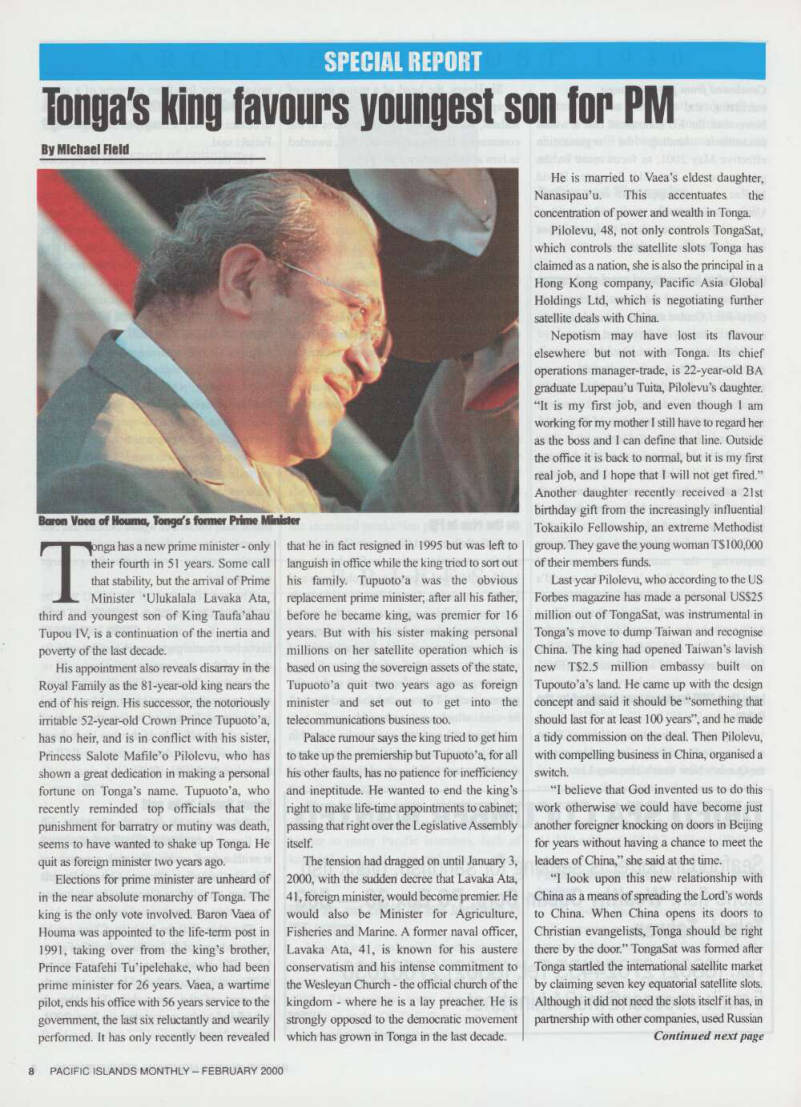
Baron Vaea of Houma, Tonga's former Prime Minister
Continued from previous page
satellites to fill what is now four slots.
Just under a year later Anna Tupou, marketing manager of the Pacific Asia Global Holdings Ltd, has denied they had changed from Taiwan to China purely for the advantage of Tonga Sat: “That is not true, we already had a relationship with China, APSTAR is Tonga’s number one client, and China is the major shareholder in APSTAR,” she told Matangi Tonga magazine. “We already have China as a client but we want to further enhance that because the whole world is at China’s door step, because of its huge market. Volume is the key to telecommunications.”
Tonga Sat wants to cash in on China’s acceptance into the World Trade Organisation which will force an opening of the telecommunications market there. They are now looking at a deal with the Chinese government owned company China Orient which can provide satellites while Tonga has the slots to fill. Meanwhile Tupouto’a is crashing around back home trying to bust up Cable & Wireless Pic’s (C&W) monopoly on international phone traffic out of Tonga and the C&W Internet Exchange in Hong Kong. It is also available to Fiji, Solomon Islands, Vanuatu and Tonga and reputedly offers those four countries cheaper Internet access.
Tupouto’a ([email protected]) has become a telecoms and internet authority and he believes he smells a rat. “The trouble with C&W, is that their interest is in making Fiji the hub of telecommunications for the Pacific,” he emailed Matangi Tonga. The resulting costs to Tonga were a rip-off, he said. He singled out Noble ‘Akau’ola for the blunder. That noble is now dead, but in his day was Police Minister and the kingdom’s hangman - and active at that too.
“It is a monument to the limited knowledge and negotiation powers of the late ‘Akau’ola, and in that sense, when Mark Anthony says in his eulogy for Julius Caesar that the evil that men do live on after them etc., he might care to have mentioned incompetence and stupidity as well,” the Crown Prince said.
“What truly worries me is, what precisely were the crowd of degree’d bureaucrats who constantly accompanied the late Hangman (‘Akau’ola) to London and Hong Kong (to attend the Hong Kong Sevens at the invitation of Cable and Wireless) doing when the extremely unequal terms of the Cable and Wires agreement were so readily agreed to?”
He is seeking to set up a rival international carrier out of Tonga, but has to await approval of a government that seemingly is hostile to him. In two recent terms as Prince Regent he made his hostility toward them more than apparent too. He sacked one non-performing board, something that has never happened before in Tonga, and cancelled the pension of civil servants who had reached retirement age but were still working.
Inertia in government had given people in positions of power “a false sense of security”
that they could not be made to answer for their actions. “Mutiny is when the lower orders rebel against higher authority,” he said referring to the ditference between civilian law and military law. “However, when those in authority wilfully behave in a highly irresponsible manner, it is termed a barratry. It is significant, furthermore, that both carry the death sentence. “While I do not advocate the death sentence in this case, I do with to point out the seriousness of harm that is caused by misconduct at high levels.” Perhaps that is why he not prime minister after all. ■