Subjects of the secretary-general
pp. 48-49 · Read in the full issue
Life in the First UN Run Territory. West New Guinea 1962-63
By John Saltftrd
In Kosovo and East Timor, the power vacuum left by the departure of former rulers is being filled by temporary United Nations administrations.
Even today, this solution is rarely sanctioned by the international community that has an understandable reluctance to become so directly involved in a country’s affairs.
In the case of East Timor, the aim is to re-build the infrastructure destroyed by the departing Indonesians, so that it can be then be handed over to an independent, democratic government.
In Kosovo, the result is less certain, but it seems inconceivable that a return to Serb rule is planned. For those who must run these international regimes, some may look back to the first ever UN administration as a useful example to follow. It took place in West New Guinea and lasted for seven months between October 1962 and May 1963.
Little was known about West New Guinea at the time, and even today it rarely attracts international attention. But for a brief period in the early 1960’5, it became a potential flash point of the Cold War.
The territory had been a Dutch colony, but it was claimed by Indonesia which embarked upon a massive Soviet backed, arms build up. Under threat of invasion and pressure from President Kennedy, the Dutch agreed to hand over power to a temporary UN administration (UNTEA), on condition that the Papuan people of the territory would be allowed to exercise self-determination within six years.
However, as a major concession to Jakarta, the UN was free to transfer power to Indonesia, before self-determination took place On the face of it, UNTEA was a great success. War was avoided, and there were no major outbreaks of violence during the administration.
As one senior UN adviser wrote afterwards, the “peaceful and constitutional,” authority of UNTEA; “set a precedent that should not be overlooked; occasions could well arise where the establishment of an interregnum could provide a stable administration for a period of vacuum in a state’s political life. UNTEA should serve as a model for the future.”
What he did not mention however, is that by taking part in this exercise, the UN was instrumental in the handing over of a nation from one colonial authority to another far more repressive, without any consultation with the Papuans themselves.
From the start, UNTEA was weakened throughout its administration by the presence of Indonesian troops who were permitted to operate along side the UN’s own security force.
In practice, this meant that the administration could only function with the
Continued next page
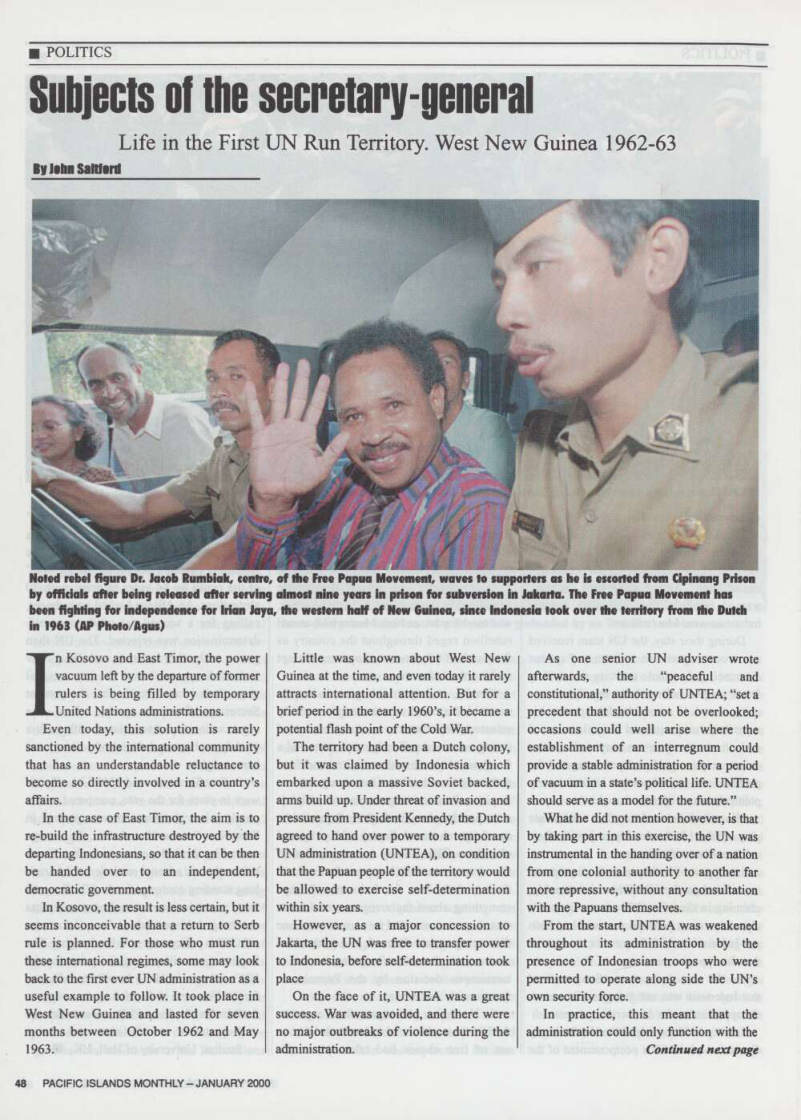
Noted rebel figure Dr. Jacob Rumbiak, centre, of the Free Papua Movement, waves to supporters as he is escorted from Cipinang Prison by officials after being released after serving almost nine years in prison for subversion in Jakarta. The Free Papua Movement has been fighting for independence for lrian Jaya, the western half of New Guinea, since Indonesia took over the territory from the Dutch in 1963 (AP Photo/Agus)
Continued from previous page
co-operation of Jakarta. These troops were then free to intimidate and terrorise the Papuans, either directly, or with militias - a tactic they were to adopt again in 1999 East Timor. Commenting upon this situation, the UN Chief of Police described how the soldiers viewed Papuan “disrespect” for the Indonesian flag: “the Indonesian troops regard themselves as a conquering army, and having fought for possession of this Territory they do not intend to stand by idly and watch Papuans insult their National flag.”
As part of their intimidation of the local population, the Indonesians also coerced some Papuans into demonstrating against the UN for an early transition of power to Jakarta.
A senior UN administrator describing one such demonstration wrote: “as there were not enough for a reasonable sized procession, the organisers pushed anybody they could find into it and beat up those who refused. It was not however, a very enthusiastic procession ... Armed Indonesian soldiers had been urging them on from behind up to this point. The procession carried no banners and most of them did not know what it was about.”
Despite these crude tactics, UN officials knew perfectly well that the vast majority of politically aware Papuans had no desire to be ruled by Indonesia, a country with which
they had no real ethnic, cultural or historical affinity at all.
One senior administrator wrote, “I have yet to meet any thinking, sober, generally responsible Papuan who sees good in the coming link with Indonesia.”
A second conceded; “There can be no serious honest doubt that nationalist feelings and resentment against the Indonesians is
quite general.”
To guard against this, another commented; “we have sufficient forces to control the situation - a whiff of grapeshot can easily control the situation if that is what UNTEA wants.” Besides, he added, “the Papuans still have a pathetic trust in UNTEA, which they regard as their last hope.”
This cynicism by a senior official of the UN seems shocking, but it illustrates the harsh reality of the organisation’s role in West New Guinea. Although it was obligated under an international agreement to prepare the Papuans for self determination, its real function was simply to offer the Dutch a minimum face saving opportunity to get out, and let Indonesia in.
The whole thing had been set up by Washington to out-manoeuvre the Russians, who had hoped that a war over New Guinea would drive Jakarta into the arms of the Soviet Bloc. It was big power politics, and the political and human rights of the Papuans were of no consequence. In
President Kennedy words, the territory was after all, just “a few thousand square miles of cannibal land.”
Indonesia’s increasing presence in the territory made the last part of UNTEA’s rule little more than a pretence. The British Ambassador in Jakarta wrote that by the end, over 1,600 Indonesian officials were occupying the senior administrative positions and some 15,000 Indonesian troops were already present to “maintain law and order.”
Indeed, he declared; ‘the Indonesian contingent commander and the head of the Indonesian Mission had virtually been running the internal affairs of the territory for several months past.’
In fact the UN were only too relieved to wash their hands of the whole affair as soon as possible, and before the Papuans realised their betrayal. “The Papuans,” one UN administrator warned, “would need to be let down slowly, if they were not to explode.”
Perceptively he added, “that there will ultimately be quite serious resistance to the Indonesians is, I think certain. Therefore, from the point of view of expediency it behoves the UNTEA to depart as soon as the Indonesians are in fact thick enough on the ground.”
In the end, this is exactly what happened.
On 1 May 1963, Jakarta took over and the UN withdrew. Five years later, a handful returned to witness one thousand hand picked Papuans declare their unanimous loyalty to Indonesia.
This bizarre performance was presented to the world as the Papuans’ long awaited exercise of self -determination. In November 1969, the UN General Assembly “took note” of the result, and West New Guinea was then conveniently forgotten.
UNTEA is a useful example of how a UN administration can be used to diffuse potential sources of conflict. But in doing so, it was complicit in endorsing the deceit and double standard that permeated every aspect of the Indonesian take over of West New Guinea.
Whether it can ever be justifiable for the UN to deliberately sacrifice a particular population in such a way, is something today’s international administrators’ should consider before applauding the success of
Untea. ■
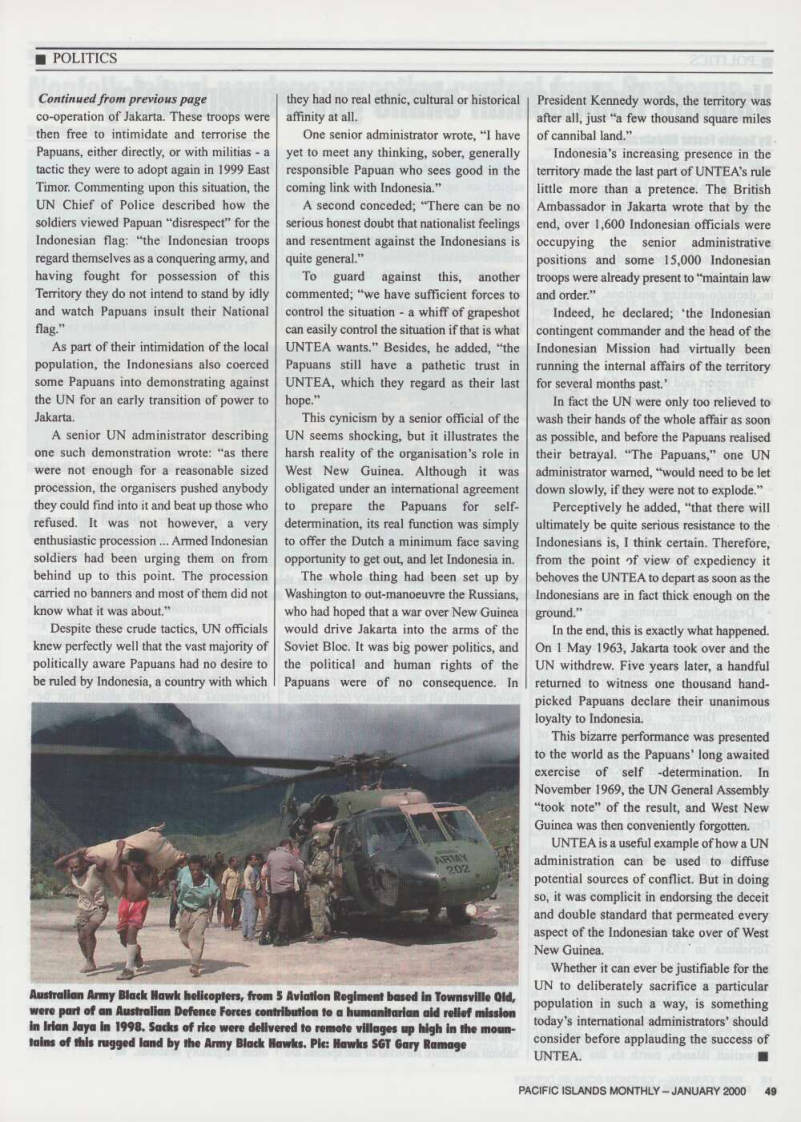
Australian Amy Black Hawk helicopters, from 5 Aviation Regiment based in Townsville Old, were part of an Australian Defence Forces contribution to a humanitarian aid relief mission in lrian jaya in 1998. Sacks of rice were delivered to remote villages up high in the moun tains of this ragged land by the Army Black Hawks. Pic: Hawks SGI Gary Ramage