A lesson from the past for the UN in East timer
pp. 46-47 · Read in the full issue
Politics
By John Saltford
Recently declassified United Nations documents shed new light on an episode from the J96o’s that should serve as a warning to the organisation today.
The UN’s recent monitoring exercise in East Timor took place exactly thirty years after a similar exercise in Indonesian controlled West New Guinea (now known as Irian Jaya) ended in violence and failure.
The Papuan people of West New Guinea had been promised independence by their Dutch rulers, but Indonesia claimed the territory and threatened to invade.
To avoid this, the Netherlands signed an agreement in 1962 transferring control to the UN on condition that the people would have self-determination within six years. In reality, this was little more than a face saving device for the Dutch.
Within seven months, without any consultation with the Papuans, the UN had pulled out leaving Indonesia in charge.
Even during the brief UN administration, Indonesian troops were permitted to operate as part of the international security force. As a consequence, the international administrators could only function with the co-operation of Jakarta. In a situation echoed today in East Timor, the Indonesian military was then free to intimidate the population and organise pro-Jakarta militias throughout the whole UN period.
In confidential reports, senior UN
administrators expressed cynicism and
despondency about their mission. One remarked that the Papuans had a misplaced and ‘pathetic trust’ in the UN to safeguard
their rights.
A second observed, T have yet to meet
any thinking, sober, generally responsible
Papuan who sees any good in the coming link with Indonesia. ’ Another advised that if there is local unrest; ‘we have sufficient forces to control the situation - a whiff of grapeshot can easily control things if that is what the UN wants.’ With regard to their long term commitment to the Papuan people, one newly arrived senior UN official predicted; ‘That there will ultimately be quite serious resistance to the Indonesians
is, I think certain, therefore from the point of view of expediency it behoves the UN to depart as soon as the Indonesians are in fact thick enough on the ground.’ In East Timor, only the bravery of UN officials in the territory prevented a complete evacuation in the face of Indonesian military violence.
By the time the UN returned in 1968 to prepare for the promised ‘act of free choice,’ the Papuans had already experienced five years of Indonesian rule. Economic mismanagement and military brutality ensured that opposition to Jakarta was
widespread.
An American diplomat visiting the territory noted that; ‘The Indonesians have tried everything from bombing them with B 26’s, to shelling and mortaring them, but a continuous state of semi-rebellion persists.’
Jakarta however, was determined that this opposition would play no part in the ‘act of free choice.’ To ensure this, they declared that a referendum was impractical because
of the ‘primitiveness’ of the people.
Amazingly, Ortiz Sanz, head of the UN mission, agreed with them. Instead, he proposed a ‘mixed’ system that would allow direct voting in towns, while other areas relied on some form of ‘collective consultation.’ This, he advised the authorities, ‘represents the minimum requirement to satisfy world public opinion.’ Jakarta was unimpressed and replied that ‘collective consultation’ would be adopted throughout the whole territory.
In March, Dutch concern at Indonesian intimidation of Papuans prompted them to secretly ask the UN to send in a security force, but this was rejected. At this point, the UN should have pulled out, declaring that they could no longer be associated with such an openly undemocratic process. This might have encouraged Suharto to think again. At the very least it would have denied him the legitimacy that UN participation gave.
Continued next page
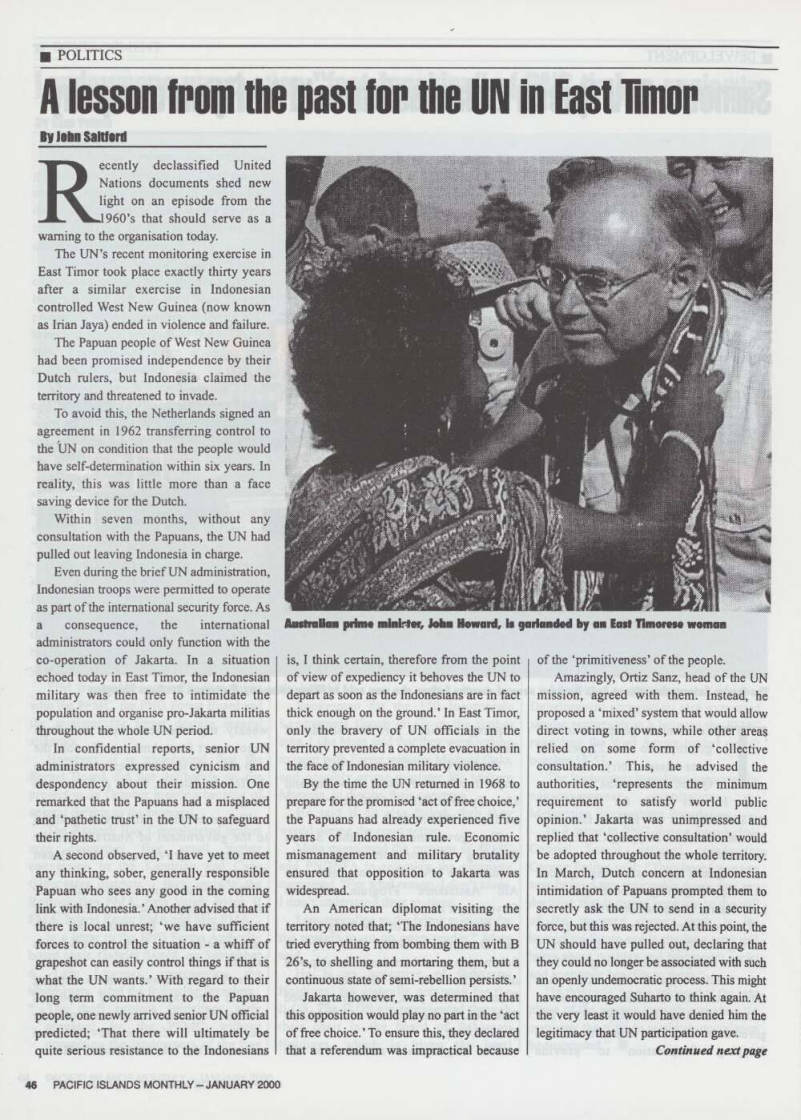
Australian prime minister, John Howard, it garlanded by an East Timorese woman
Continued from previous page
Instead, Sanz and his team remained while the Indonesians began selecting ‘peoples’ representatives’ for the ‘collective consultation.’ At the same time, Suharto warned publicly that any vote against Indonesia would be ‘treason.’
During their stay, the UN team received numerous petitions from Papuans denouncing the whole exercise and calling for a proper referendum, but Sanz was unimpressed. In a confidential report to his superiors, he questioned the relevance of such views; ‘as you are very well aware, only a very insignificant percentage of the population is capable or has interest in any political actions or even thoughts.’
His attitude seemed to reflect a deliberate ploy by the UN leadership to justify their collaboration with Jakarta.
In support of it, they were even prepared to mislead to the UN General Assembly, claiming in the official Secretary General’s report that most petitions received had been pro-Indonesian. UN documents now prove that the opposite was true.
As the vote drew closer, Sanz realised that Indonesia was not going to allow even the appearance of a democratic process.
In May 1969, he cabled the UN Secretary General to plead for a postponement of the
vote until the political freedoms and Human rights situation improved - he was told no.
In June, he tried to arrange a meeting with Suharto, in what he described would be a ‘last chance’ to create democratic conditions in the territory. Suharto however, was too busy to see him. Meanwhile, armed rebellion raged throughout the country as thousands of tribesmen rose up in an attempt to drive the Indonesians out.
Finally, in July and August, Indonesia assembled around one thousand carefully selected ‘representatives’ for a series of
voting ceremonies. Foreign diplomats and a
few journalists were then invited and food and music was laid on. Once everyone was in place, Indonesian generals and officials were paraded shoulder high by Papuans in a carefully rehearsed display of loyalty and obedience. Then one by one, a selection of the ‘representatives’ came forward to declare their love for Indonesia. It says something about the arrogance of Jakarta that they saw no need to permit even one dissenting voice. Instead, the authorities announced that the final result was a unanimous decision by the Papuans to remain with Indonesia.
In November of that year, Sanz’ report to the UN General Assembly concluded that an act of free choice had taken place; ‘in
accordance with Indonesian practice,’ despite Jakarta’s failure to protect the rights and freedoms of the Papuan people. The Assembly passed a resolution ‘taking note’ of the result by 84 votes to none, with 30 abstentions. An African backed amendment, calling for a second act of Papuan self determination was rejected. The UN then got on with other business and West New Guinea disappeared from the international stage. It is inconceivable that the present Secretary General would allow the organisation to be associated with such a crudely orchestrated denial of political and
human rights.
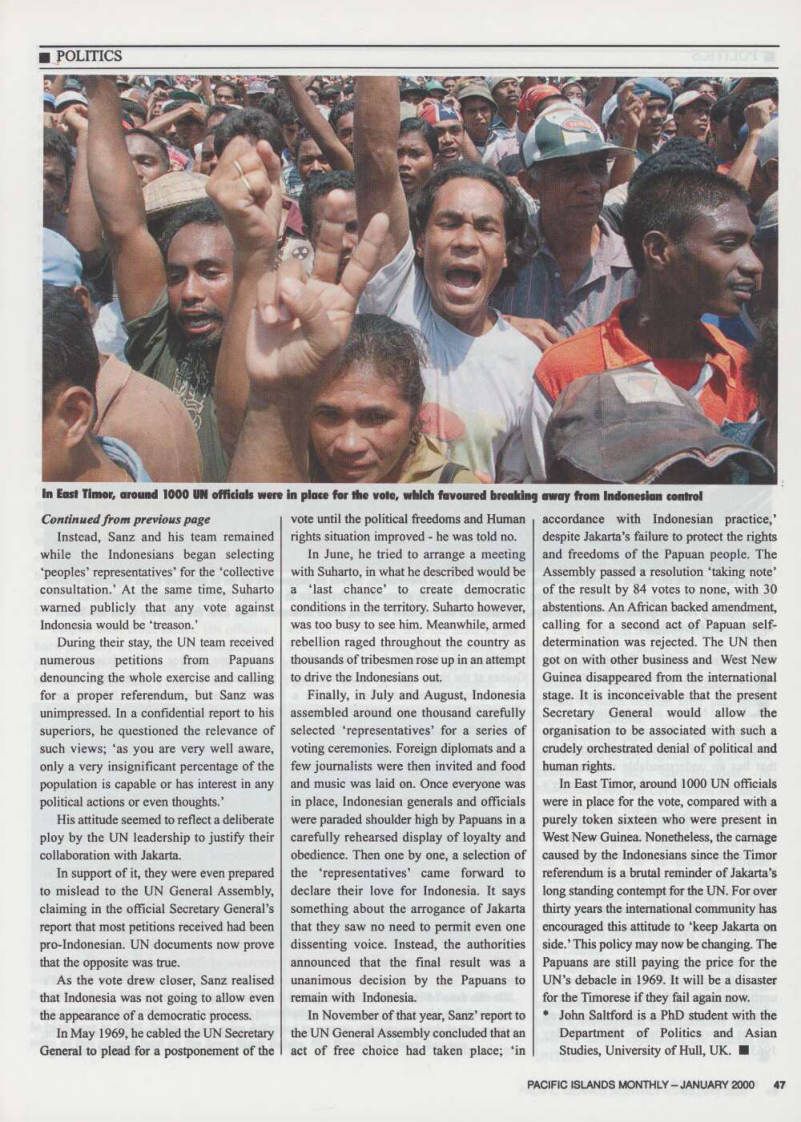
In East Timor, around 1000 UN officials were in place for the vote, compared with a purely token sixteen who were present in West New Guinea. Nonetheless, the carnage caused by the Indonesians since the Timor referendum is a brutal reminder of Jakarta’s long standing contempt for the UN. For over thirty years the international community has encouraged this attitude to ‘keep Jakarta on side.’ This policy may now be changing. The Papuans are still paying the price for the UN’s debacle in 1969. It will be a disaster for the Timorese if they fail again now. * John Saltford is a PhD student with the Department of Politics and Asian Studies, University of Hull, UK. ■
In East Timor, around 1000 UN officials were in place for the vole, which favoured breaking away from Indonesian control