World War II relics stolen amidst lax PNG enforcement
pp. 49-50 · Read in the full issue
By Sam Vulum
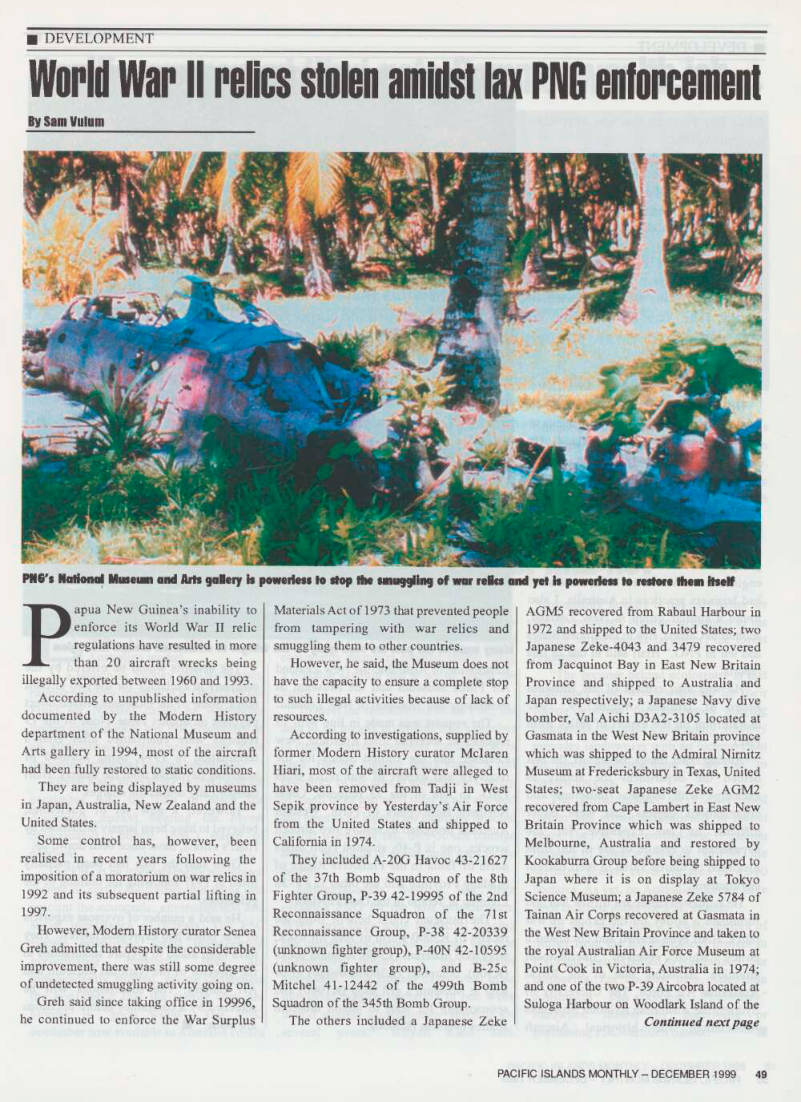
Papua New Guinea’s inability to enforce its World War II relic regulations have resulted in more than 20 aircraft wrecks being illegally exported between 1960 and 1993.
According to unpublished information documented by the Modern History department of the National Museum and Arts gallery in 1994, most of the aircraft had been fully restored to static conditions.
They are being displayed by museums
in Japan, Australia, New Zealand and the United States.
Some control has, however, been realised in recent years following the imposition of a moratorium on war relics in 1992 and its subsequent partial lifting in 1997.
However, Modem History curator Senea Greh admitted that despite the considerable improvement, there was still some degree
of undetected smuggling activity going on.
Greh said since taking office in 19996, he continued to enforce the War Surplus
Materials Act of 1973 that prevented people from tampering with war relics and smuggling them to other countries.
However, he said, the Museum does not have the capacity to ensure a complete stop to such illegal activities because of lack of resources.
According to investigations, supplied by
former Modern History curator Mclaren Hiari, most of the aircraft were alleged to have been removed from Tadji in West Sepik province by Yesterday’s Air Force from the United States and shipped to California in 1974.
They included A-20G Havoc 43-21627 of the 37th Bomb Squadron of the Bth Fighter Group, P-39 42-19995 of the 2nd Reconnaissance Squadron of the 71st Reconnaissance Group, P-38 42-20339 (unknown fighter group), P-40N 42-10595 (unknown fighter group), and B-25c Mitchel 41-12442 of the 499th Bomb Squadron of the 345th Bomb Group.
The others included a Japanese Zeke
AGMS recovered from Rabaul Harbour in 1972 and shipped to the United States; two Japanese Zeke-4043 and 3479 recovered from Jacquinot Bay in East New Britain Province and shipped to Australia and
Japan respectively; a Japanese Navy dive
bomber, Val Aichi D3A2-3105 located at Gasmata in the West New Britain province which was shipped to the Admiral Nirnitz Museum at Fredericksbury in Texas, United States; two-seat Japanese Zeke AGM2 recovered from Cape Lambert in East New Britain Province which was shipped to Melbourne, Australia and restored by
Kookaburra Group before being shipped to
Japan where it is on display at Tokyo Science Museum; a Japanese Zeke 5784 of Tainan Air Corps recovered at Gasmata in the West New Britain Province and taken to the royal Australian Air Force Museum at Point Cook in Victoria, Australia in 1974; and one of the two P-39 Aircobra located at Suloga Harbour on Woodlark Island of the
Continued next page
PNG's Notional Museum and Arts gallery is powerless to restore them itself
Continued from previous page
Milne Bay Province that was shipped to Australia in 1982.
Hiari also cited several other cases which occurred even after 1982. He noted the alleged smuggling of eight Japanese
Nakajima plane engines from Wewak to
Australia in early 1992. Each of the engines was worth KlO,OOO on the world market.
He said lack of interest shown by the Museum, the East Sepik provincial government and the national government resulted in the loss of KBO,OOO. Hiari also reported that in the same year, the other P -39 Aircobra at Suloga Harbour on Woodlark Island in the Milne Bay province was smuggled to Australia.
He said in early 1993, two P-40 fuselages were shipped from Popondetta to Lae and then to New Zealand. He attempted to investigate the illegal activities and came up with some astounding revelations.
“I found the contacts of the three major dealers in Queensland with the help of Australian customs. I’ve also uncovered the group which had exported eight Nakajima engines from Wewak in 1992, conducted bad business practices in Australia. I also found a similar group in New Zealand, another in Canada, five in the United States and ten in PNG,” Hiari said in one of this reports.
He was also critical of the Museum Board of Trustees’ August 19, 1992 moratorium on the export of relics from
Png.
Among other things, he argued, the ban denied the department the ability to exchange with overseas museums and organisations objects that were either difficult or too expensive for the department to restore or are of too little historical or tourist value in their current environment.
He requested the board lift the ban and formulate a policy on the export of war relics. Hiari even drafted and circulated a policy which received international attention, including that of the Royal Australian Air Force, The University of Sydney, the Australian Aviation Museums Association, the historical Aircraft
Restoration of Australia, the New Zealand Air Force Museum and the Museum of technology and Transport of New Zealand.
The request was made in line with 13 requests he received from Australia, New Zealand, and the United States for the recovery and export of war relics from PNG. In one of the 13 requests, Great Northern Helicopters of Perth, Western Australia proposed to restore two aircraft wrecks, one is P-40, situated eight miles north of Tauta in the Finisterre Range of Madang Province and the other is a P-38 Lighting at Terapo in the Gulf Province.
The museum could benefit from the receipt of K3OOO worth of fork lift truck, workshop materials (k 500), Aviation books (K 500), computer (K 3000), badges to be sold at Museum’s gift shop (K 1000) and sponsorship for staff to attend museum studies overseas (K 5000).
The benefits would be offered by the company in exchange for the two aircraft relics. Some of the museums offered direct payment on market value. None of the 13 requests were entertained after Hiari’s termination in 1994, being accused of receiving payments from the dealers. Hiari categorically denied the charges.
However, a new set of guidelines, believed to have been largely influenced by Hiari’s efforts, have since been drawn up.
Greh said the ban had been partially lifted in 1997 following the drafting of the guidelines.
He said a number of overseas exporters of war relics had expressed interest. They have been asked to prepare submissions to the director of the National Museum and Art Gallery. The submissions will be screened by a committee before decisions are made. ■
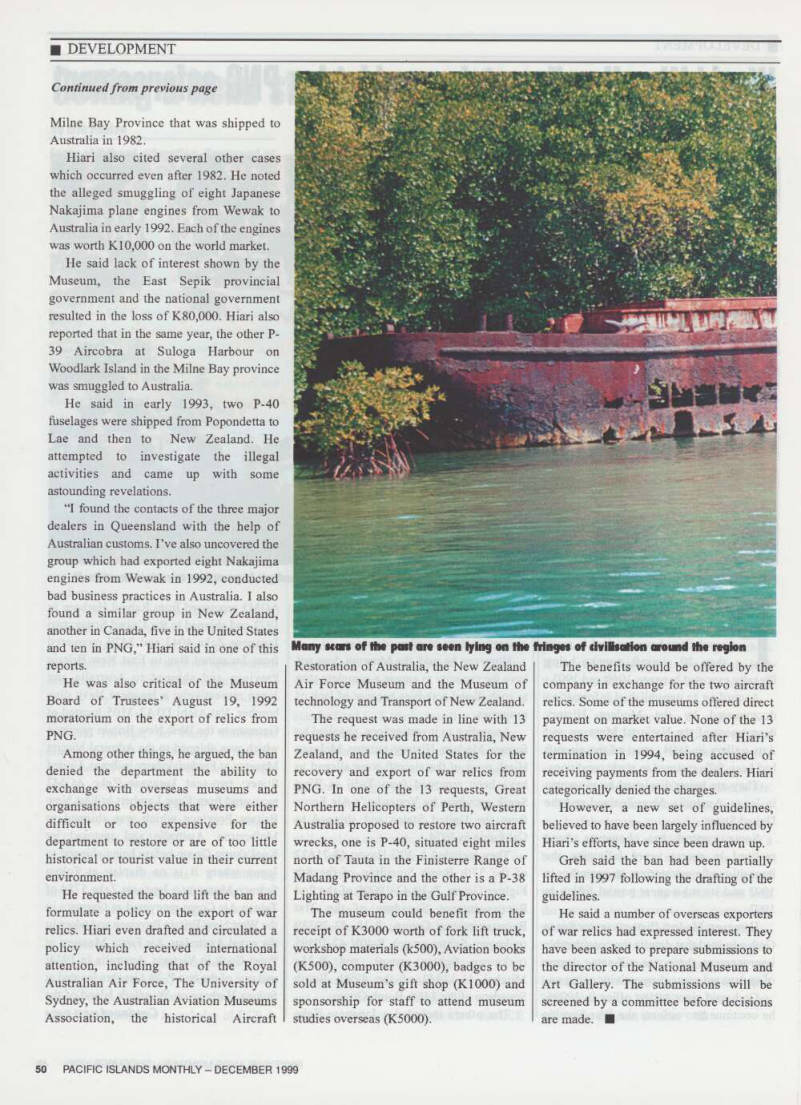
Many s[?]s of the past an seen lying on the fringes of civilis[?]tion around the region