Getting a head start
p. 48 · Read in the full issue
By Erin Phelan
Early childhood education discussed at Pacific Summit for Children Let’s start at the beginning.
Research throughout the world has shown that early childhood education directly correlates with a child’s development, learning capacity and chances to succeed in life. In fact, research has shown that foetuses that have listened to music, or heard their mothers read stories have proven to be more successful later on in life.
With all this research to support the viability of early childhood education policies, one must wonder; why is this not standard practice in the Pacific? This is a question that has come up several times during UNICEF’s Pacific Summit for Children. Child advocates - governmental, non-governmental and community leaders from 13 Pacific Islands countries gathered in Fiji for one week to discuss fundamental human rights for children, define success stories in the region and work on areas that need attention.
Topics on the agenda included health, nutrition, child protection and education. In a workshop session, participants brainstormed ways to improve upon current situations in their individual countries. One area of key interest is in early childhood education.
Vasu Tuivaga, an Early Childhood
Education (ECE) specialist at the University
of the South Pacific, has been working in this area for over thirty years.
According to Tuivaga, Fiji’s Ministry of
Education has had regulation pertaining to ECE since the mid-19605.
There have been problems since then with financial constraints - a continuing strife - but over the years the Ministry in Fiji has funded advisers, training programs and has shown a commitment towards ECE.
However, governments still need to be convinced of the importance of early childhood education, Tuivaga said.
Moreover, the general awareness raising is required. Widespread knowledge of ECE is
not common but is a desired goal, so that communities can leam the impact had on a child who is exposed to learning at a young age.
Not many Pacific Island governments have been actively involved in the promotion of ECE and, according to Tuivaga, things aren’t moving as quickly as though should in the region. There is a need for improved coordination between ministries and departments of education and the national
preschool associations.
Tuivaga has developed a framework for a standardized ECE curriculum that is ready to be shipped out to Pacific Island Countries where four out of five countries do not have an ECE policy in place. It looks at children aged zero to eight years old.
An early intervention booklet has been written in conjunction that combines philosophies and methodologies which have been taken from workshops conducted on ECE in the region.
The problem: funding.
In the active discussion that followed the presentation on Early Childhood Education, calls were made to lobby governments to include ECE in their policy making.
Tuivaga said that often governments do not commit resources because they haven’t seen local data supporting the view that ECE
improves children’s lives.
When asked if ECE wasn’t taking over from parent’s responsibilities for raising children, Tuivaga was adamant in her reply: “These are changing times with working parents. ECE is working with families so that they can know what to do from home - this isn’t just looking at passing exams.’’
“This is the holistic approach, the health, physical and emotional well-being of a child.
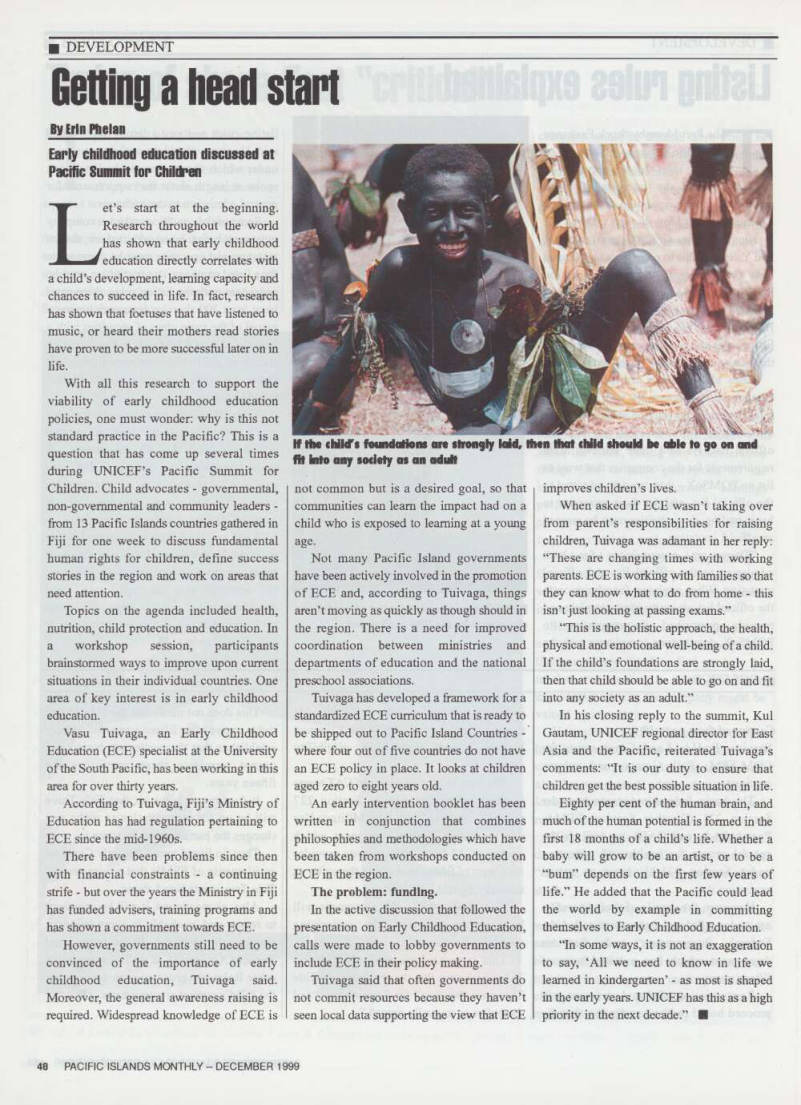
If the child’s foundations are strongly laid, then that child should be able to go on and fit into any society as an adult.”
In his closing reply to the summit, Kul Gautam, UNICEF regional director for East Asia and the Pacific, reiterated Tuivaga’s comments: “It is our duty to ensure that children get the best possible situation in life.
Eighty per cent of the human brain, and much of the human potential is formed in the first 18 months of a child’s life. Whether a baby will grow to be an artist, or to be a “bum” depends on the first few years of life.” He added that the Pacific could lead the world by example in committing themselves to Early Childhood Education.
“In some ways, it is not an exaggeration to say, ‘All we need to know in life we learned in kindergarten’ - as most is shaped in the early years. UNICEF has this as a high priority in the next decade.” ■
If the child's foundations are strongly laid, then that child should be able to go on and fit into any society as an adult