Klana's Song of Exile praised
pp. 44-45 · Read in the full issue
Development
By Ed Rampell
Pulitzer Prize winner, Alice Walker, says she rarely attends public readings and hasn’t “been to one in years” (other than her own).
But the author of The Color Purple (the movie adaptation directed by Steven Spielberg was nominated for a Best Picture Oscar), made it a point to go to Kiana
Davenport’s August 3 reading at Berkeley’s
Black Oak Books shop.
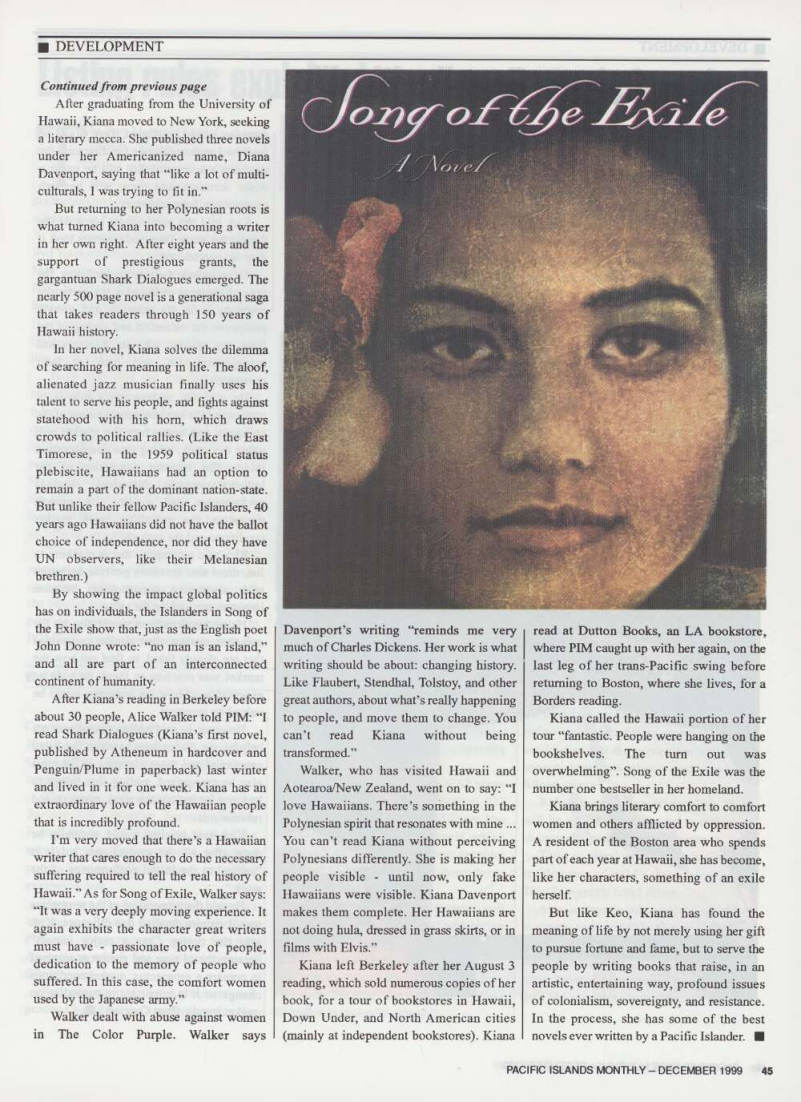
Walker, a Bay Area resident and fan and friend of the Hawaiian novelist, brought Kiana a colourful bouquet of tropical flowers and sat in the front row of the crowded reading for Davenport’s new Ballantine Publishing Group book Song of the Exile.
In her emotional reading, the striking looking, sarong-clad six foot hapa haole (part Hawaiian and Caucasian), adorned by Polynesian tattoos and indigenous jewels.
concentrated on passages dealing with Sunny Sung’s sex slavery at the hands of Imperial Japanese soldiers. Kiana’s epic novel, follows the two Hawaiians Sunny and her beloved jazzman Keo Meahuna as they are buffeted by war across decades and continents, from Honolulu to occupied Paris to Shanghai to Rabaul, where much of the story is set in a Japanese POW camp.
The saga culminates with Kanaka Maoli
(indigenous Hawaiian) resistance to
statehood in 1959. Kiana Davenport was born in 1940 and raised in Kalihi, Honolulu’s Harlem. Her Alabama father and Hawaiian mother had six children.
Kiana held numerous odd jobs, working at the Dole Cannery (now a mall with shops, restaurants, banquet halls, and a multiplex cinema), picking coffee beans, and as a fashion model and fiction teacher.
Continued next page
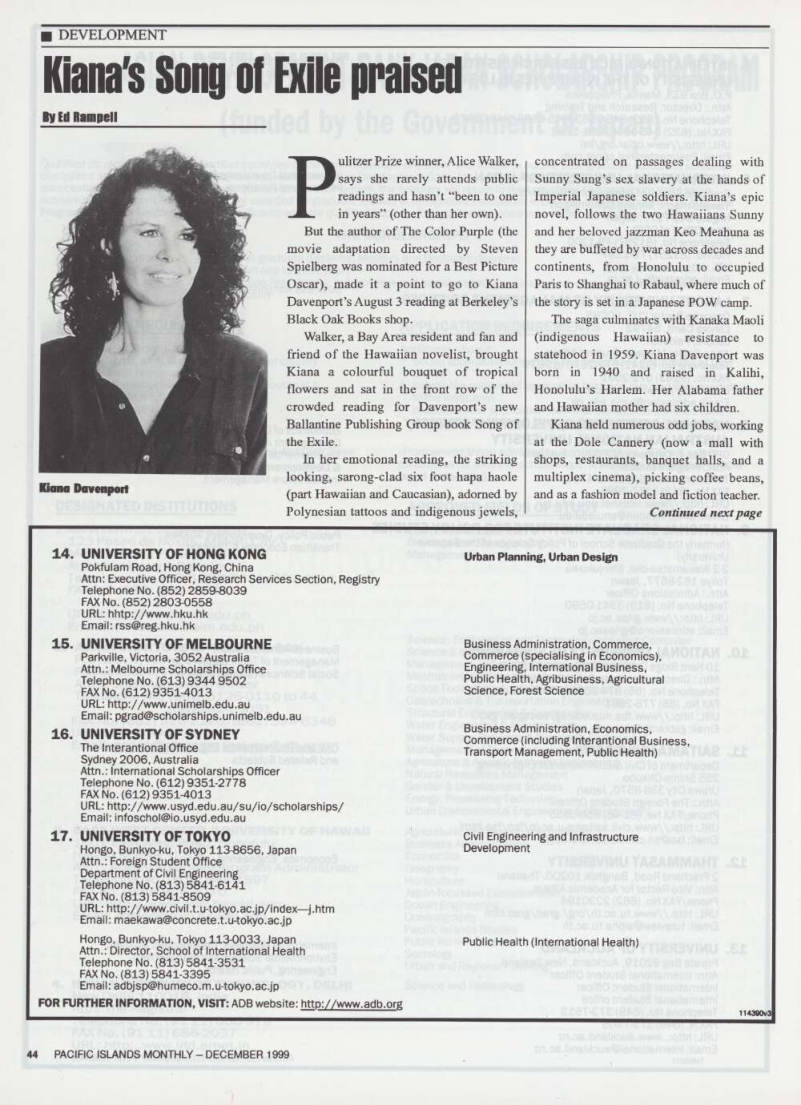
Kiana Davenport
Continued from previous page
After graduating from the University of Hawaii, Kiana moved to New York, seeking a literary mecca. She published three novels under her Americanized name, Diana Davenport, saying that “like a lot of multi culturals, I was trying to fit in.”
But returning to her Polynesian roots is what turned Kiana into becoming a writer in her own right. After eight years and the support of prestigious grants, the gargantuan Shark Dialogues emerged. The nearly 500 page novel is a generational saga that takes readers through 150 years of
Hawaii history.
In her novel, Kiana solves the dilemma of searching for meaning in life. The aloof, alienated jazz musician finally uses his talent to serve his people, and fights against statehood with his horn, which draws crowds to political rallies. (Like the East Timorese, in the 1959 political status plebiscite, Hawaiians had an option to remain a part of the dominant nation-state.
But unlike their fellow Pacific Islanders, 40 years ago Hawaiians did not have the ballot choice of independence, nor did they have UN observers, like their Melanesian
brethren.)
By showing the impact global politics has on individuals, the Islanders in Song of the Exile show that, just as the English poet John Donne wrote: “no man is an island,” and all are part of an interconnected continent of humanity.
After Kiana’s reading in Berkeley before about 30 people, Alice Walker told PIM; “I read Shark Dialogues (Kiana’s first novel, published by Atheneum in hardcover and Penguin/Plume in paperback) last winter and lived in it for one week. Kiana has an extraordinary love of the Hawaiian people that is incredibly profound.
I’m very moved that there’s a Hawaiian writer that cares enough to do the necessary suffering required to tell the real history of Hawaii.” As for Song of Exile, Walker says: “It was a very deeply moving experience. It again exhibits the character great writers must have - passionate love of people, dedication to the memory of people who suffered. In this case, the comfort women used by the Japanese army.”
Walker dealt with abuse against women in The Color Purple. Walker says
Davenport’s writing “reminds me very much of Charles Dickens. Her work is what
writing should be about: changing history.
Like Flaubert, Stendhal, Tolstoy, and other great authors, about what’s really happening to people, and move them to change. You can’t read Kiana without being transformed.”
Walker, who has visited Hawaii and Aotearoa/New Zealand, went on to say: “I love Hawaiians. There’s something in the Polynesian spirit that resonates with mine ...
You can’t read Kiana without perceiving
Polynesians differently. She is making her
people visible - until now, only fake Hawaiians were visible. Kiana Davenport makes them complete. Her Hawaiians are not doing hula, dressed in grass skirts, or in films with Elvis.”
Kiana left Berkeley after her August 3 reading, which sold numerous copies of her book, for a tour of bookstores in Hawaii, Down Under, and North American cities
(mainly at independent bookstores). Kiana
read at Dutton Books, an LA bookstore, where PIM caught up with her again, on the last leg of her trans-Pacific swing before returning to Boston, where she lives, for a Borders reading.
Kiana called the Hawaii portion of her tour “fantastic. People were hanging on the bookshelves. The turn out was overwhelming”. Song of the Exile was the number one bestseller in her homeland.
Kiana brings literary comfort to comfort women and others afflicted by oppression.
A resident of the Boston area who spends part of each year at Hawaii, she has become, like her characters, something of an exile herself.
But like Keo, Kiana has found the meaning of life by not merely using her gift to pursue fortune and fame, but to serve the people by writing books that raise, in an artistic, entertaining way, profound issues of colonialism, sovereignty, and resistance.
In the process, she has some of the best novels ever written by a Pacific Islander. ■