Former Ombudsman stands out in Vanuatu history
pp. 40-41 · Read in the full issue
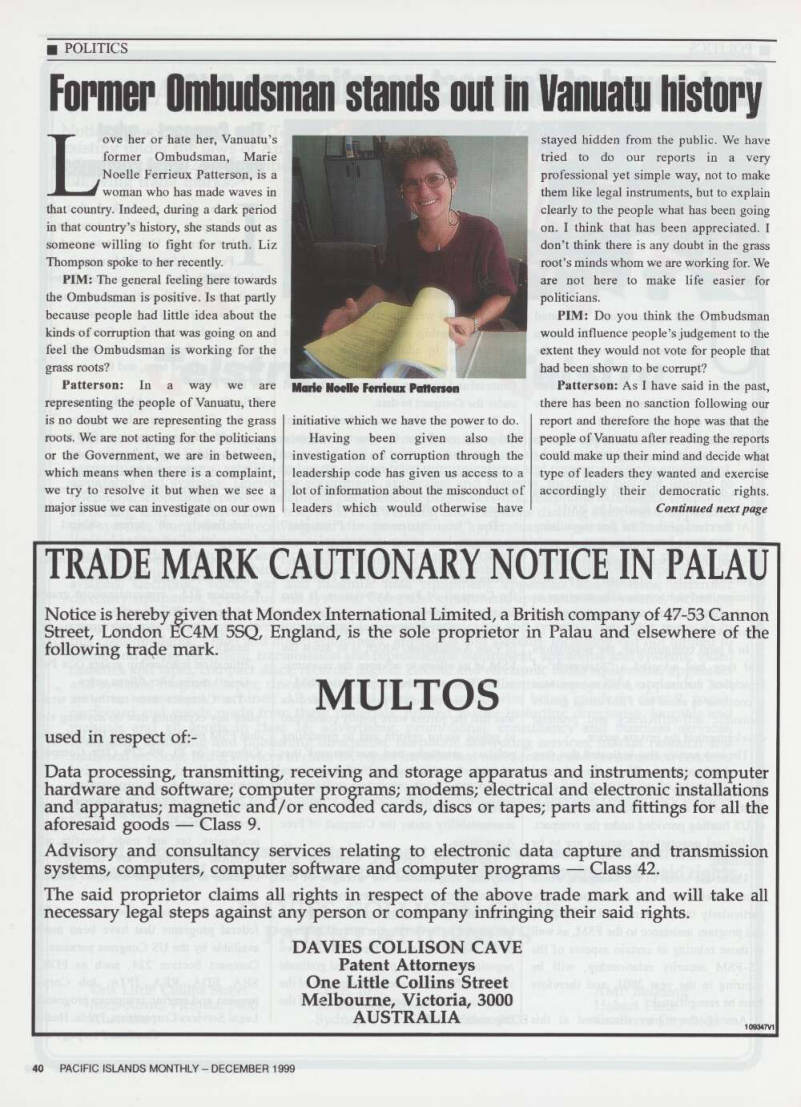
Love her or hate her, Vanuatu’s former Ombudsman, Marie Noelle Ferrieux Patterson, is a woman who has made waves in that country. Indeed, during a dark period in that country’s history, she stands out as someone willing to fight for truth. Liz Thompson spoke to her recently.
PIM: The general feeling here towards the Ombudsman is positive. Is that partly because people had little idea about the kinds of corruption that was going on and feel the Ombudsman is working for the grass roots?
Patterson: In a way we are representing the people of Vanuatu, there is no doubt we are representing the grass roots. We are not acting for the politicians or the Government, we are in between, which means when there is a complaint, we try to resolve it but when we see a major issue we can investigate on our own
initiative which we have the power to do.
Having been given also the investigation of corruption through the leadership code has given us access to a lot of information about the misconduct of leaders which would otherwise have
stayed hidden from the public. We have tried to do our reports in a very professional yet simple way, not to make them like legal instruments, but to explain clearly to the people what has been going on. I think that has been appreciated. I don’t think there is any doubt in the grass root’s minds whom we are working for. We are not here to make life easier for
politicians.
PIM: Do you think the Ombudsman would influence people’s judgement to the extent they would not vote for people that had been shown to be corrupt?
Patterson: As I have said in the past, there has been no sanction following our report and therefore the hope was that the people of Vanuatu after reading the reports could make up their mind and decide what type of leaders they wanted and exercise accordingly their democratic rights.
Continued next page
Mane Noelle Ferrieux Patterson
Continued from previous page
However this has not been so as leaders found guilty of wrong conduct were still elected. Our job is to make sure that people know the truth. And after that the people decide.
PIM: I ’ve heard that you have received death threats; does a job like this bring with it a lot of enemies?
Patterson: There were some death threats at some point. The main one was in 1998 warning me of a potential assassination plot. I had Police surveillance for many weeks. However more recently, some statements were forwarded to the Public Prosecutor, informing him of another such conspiracy in 1996, involving at the time a leader. The Police were supposedly investigating it, but nothing has come out of it.
PIM: Do you found the cultural ties of the wantok system, whereby people from the same clans have obligations to protect and assist each other on occasions hinder your investigators?
Patterson: Yes, we have found that.
The policy in this office is that we recommend very strongly or, even oblige investigators, whenever there is a link between them and the people being investigated to declare their conflict of interest. In this way we try to avoid having our staff faced with such a dilemma because it’s not fair for them to be put in that situation In Vanuatu such wantok links are stronger than in other countries because of the small size of the country and the Melanesian culture. I have also experienced this situation, that is, having to investigate people I was friendly with.
But there was no wantok link.
This job should be done without fear or favour. My staff are very aware of this aspect of their work and there are enough investigators in the Office to ensure that
impartiality can be applied.
PIM: Do you think that Vanuatu is likely to experience similar kinds of Law and Order problems to those experienced by Papua New Guinea and the Solomons?
Patterson: I recently read an interview in the paper of the Police Commissioner Peter Bong and his views were very
negative about the evolution of criminality in this country. He was basically blaming it on the reduction of the Police staff following the Comprehensive Reform Program.
We appear to be on a similar type of evolution to the Solomon Islands and Papua New Guinea. It’s a matter of time for the situation to evolve but the increase of criminality is higher than before.
We have big problems. We still have police who allegedly have not paid allowances that created the crisis of 1997 in the Force.
He was saying that there was a problematic situation with six hundred
fishermen and allegedly outstanding
payments of more than 100 millions vatu as mentioned by the Press. This involves the South Pacific Fishing Co, a company owned by the Vanuatu Government.. Now the company is on edge of being liquidated after accusations of misuse of funds. The Fishermen are still waiting for a resolution as mentioned in the paper recently.
Even though I am a citizen of Vanuatu, I feel often the first weapon used against me is racism and that I come from another country and am not familiar with the local custom.
Even though discrimination on the grounds of race is prohibited by the Constitution, often the politicians under investigation have called me a colonialist and other names. But a similar discrimination occurs between the indigenous people themselves on the basis of their islands and the reaction reminds us of what has happened recently in the Solomon Islands.
The corruption and abuse of power has been slightly controlled but unfortunately there have never been any consequences for wrongdoers and it is a bad example for the grass roots, especially unemployed grass roots who have lost respect for their politicians.
I think one big help would be for legal enforcement to come. All the Departments concerned are suffering from a shortage of funds or human resources. We have set up now with the Comprehensive Reform
Program many very good laws including
the Leadership Code Act but there is no enforcement of the law or effective
criminal prosecution.
The Police have been inefficient in its investigations, the prosecuter too and the Courts have clearly stated they could not give Justice to the people. ■
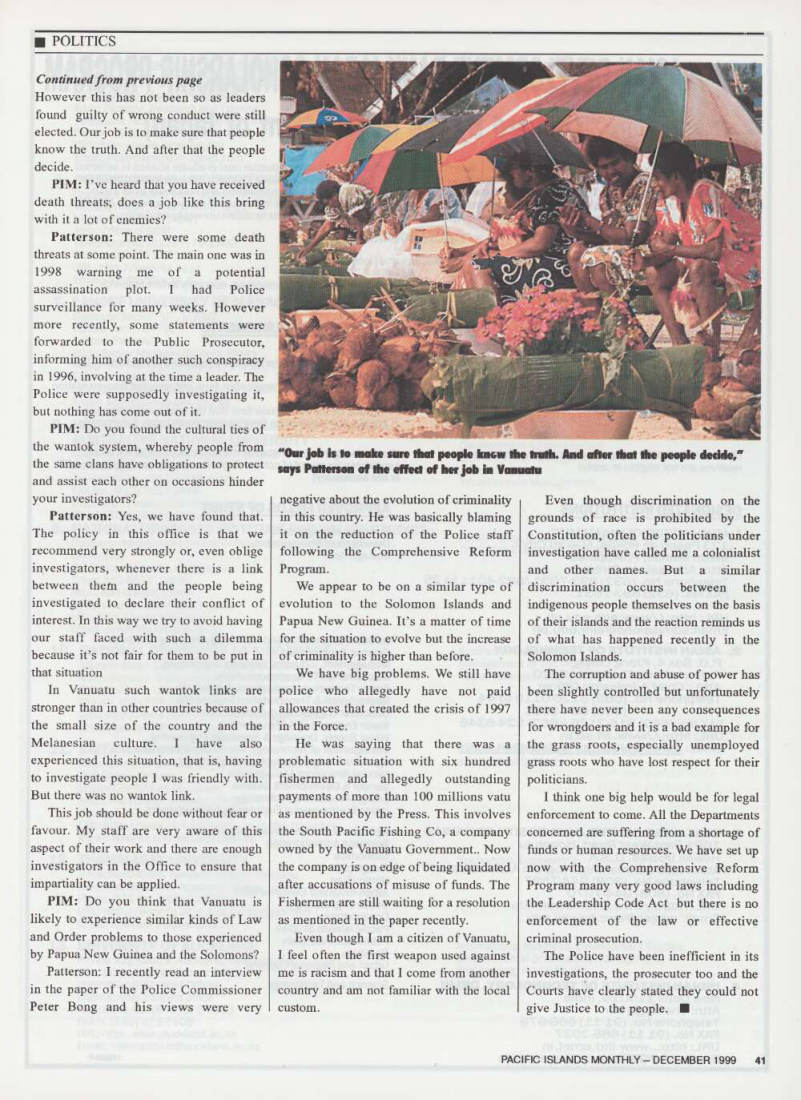
"Our job is to moke sure that people know the truth. And after that the people decide," says Patterson of the effect of her job in Vanuatu