Marshalls' nuclear test damage lingers
pp. 32-33 · Read in the full issue
By Giff Johnson
It’s more than 41 years since the last mushroom cloud rose into the sky above Bikini and Enewetak atolls in the Marshall Islands.
Despite the lapse of time, health problems arising from exposure to the 67 United States tests continue and the long term prognosis for future generations is unknown.
The troubling aspect of the Marshalls’ nuclear test picture is that: • In contrast to similarly exposed populations in the US (for example, the “Downwinders” in the Nevada and Utah area), Marshall Islanders have not received full compensation payments because of the limited amount of funding.
To date, about one-third of all islanders receiving compensation have already died without receiving their total compensation. • While the US has approved more than $2OO billion for its superfund cleanup sites in the United States, it argues over tens of millions of dollars for cleanups at
nuclear test sites and nearby atolls in the Marshalls; for Bikini, Enewetak and Rongelap - where cleanup funds have been provided - the funds are specifically intended to cleanup and rehabilitate only certain islands in these necklaces of coral islands, a concept that one islander described as like telling someone to eat an apple, half of which is rotten. • Many more islanders than previously admitted by US officials were, in fact, exposed to nuclear test fallout from many of the hydrogen bomb blasts of the 19505.
There are some positive developments that, while not balancing out the scale, at least offer a reason for optimism.
Beginning in January this year, the medical program for two of the atolls
affected by fallout changed hands, moving
from a US nuclear laboratory in New York to a private Hawaii-based consortium of medical doctors.
For 44 years, the medical program for Rongelap and Utrik had been run by Brookhaven National Laboratory - without
any kind of peer review or oversight. The program had been criticised repeatedly and, from its beginnings in 1954 through the early 1980 s, justifiably as research rather than treatment oriented.
After several years of lobbying by Marshall Islands officials, the US Department of Energy agreed to competitively bid the contract and the result is that a new contractor independent of the US government. Pacific Health Research Institute of Honolulu, is now running the program. • The Department of Energy (DOE) has, since 1994, turned over to the Marshall Islands more than one million pages of classified nuclear test reports and data, providing the Marshalls with a much clearer picture of the exposure problem.
It is a paradox of history that it is many of these formerly top secret US documents that have demonstrated how US officials deceived and withheld from Marshall Islands negotiators key documentation that would have changed the outcome of the nuclear test compensation package that was signed in the mid-1980s.
Instead, the US maintained the fiction of “four atolls” (Bikini, Enewetak, Rongelap and Utrik) exposed to nuclear testing, a myth that, sadly, continues to this day, despite the release of reports showing many more islands and populations were exposed to varying levels of fallout.
One telling document was drafted by US officials during the late 1970 s as the
negotiations on a compensation package
were progressing.
Its title - “Comparative Analysis of the Traditional (1954-1978) Brookhaven National Laboratory Medical Program and Required Revisions in Light of Actual and Projected Expansion” - and the report itself discuss a proposed expansion of the medical program to include an additional five atoll populations.
In anticipation of an increasing case load
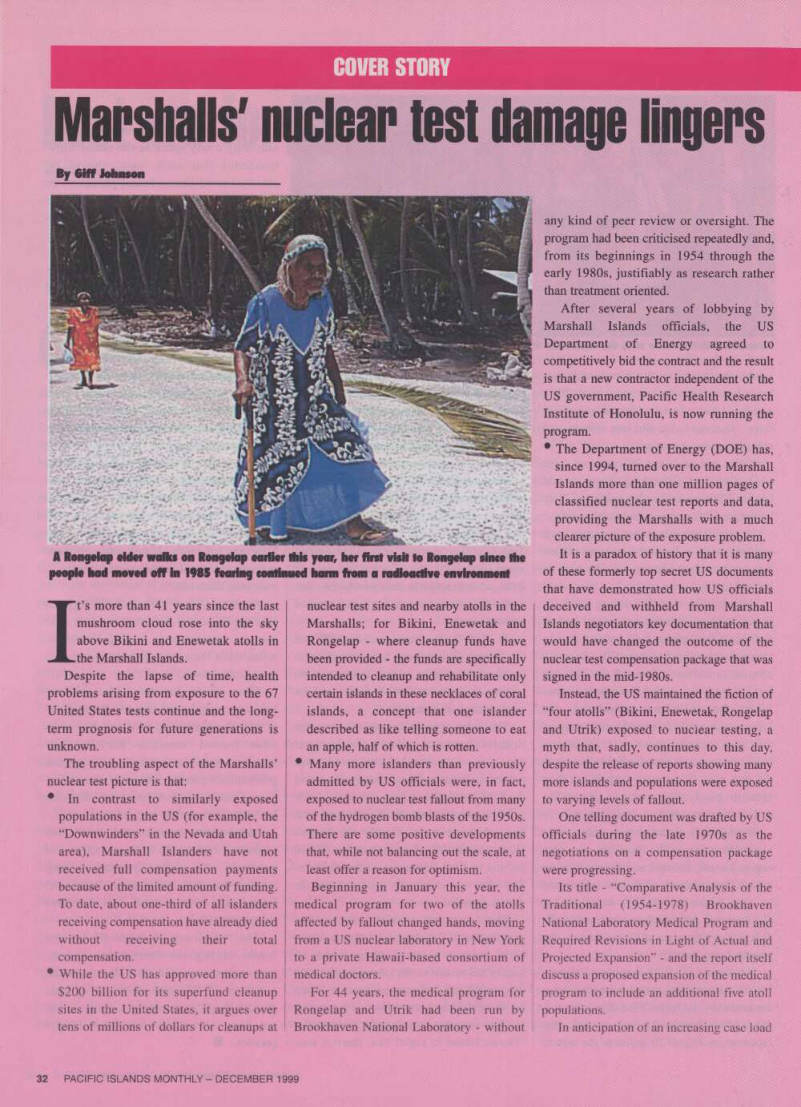
A Rongelap elder walks on Rongelap earlier Nils year, her first visit to Rongelap since the people bad moved off In 1985 fearing continued harm from a radioactive environment
of thyroid problems, US officials also reported in the late 1970 s that “a preliminary search” had been launched to identify US west coast hospitals that could provide surgery services to Marshall Islanders.
Perhaps not surprisingly, this report didn’t surface (for Marshallese, at least) until 20 years after it was written - certainly not in time for Marshall Islands negotiators to use it as leverage to get increase medical coverage or compensation for people from the named islands.
So the medical program was continued as a two-atoll program, only for Rongelap and Utrik.
“The sad part about the exclusion of ... people from DOE’s medical program is that DOE and its contractors expected that there would be a high level of radiogenic illnesses in the prematurely resettled communities (Bikini and Enewetak) and the communities adjacent to Utrik, such as Ailuk, Mejit, Wotje and Likiep,” Marshall Islands finance minister Tony deßrum told a US Congressional committee earlier this year.
There is, however, a more shocking aspect of this, because it confirms the deceptiveness of the US government scientists and doctors who for years have been downplaying the health threat of radiation to Marshall Islanders.
This late 1970 s medical report is just one of several declassified studies which confirm that the northern atoll of Wotje, Ailuk, Mejit and Likiep were dusted with doses of radiation above international radiation protection limits.
But US officials, who had access to this information, classified the populations of these islands as “unexposed” and used them as comparison populations for more heavily exposed Rongelap and Utrik islanders allowing US officials to understate the level of the health problem.
Brookhaven National Laboratory doctors did this, too, in the late 19505. Rongelap islanders were allowed to return to a highly radioactive island just three years after the 1954 Bravo test had dumped snow-like fallout on their home. Several years later the US doctors reported that the levels of radioactive cesium and other elements rose
dramatically among the people who returned to Rongelap - many of whom had not been on Rongelap in 1954 during, the fallout.
So the “unexposed” became “exposed” by living in a radioactive environment. But US doctors continued to treat the so-called “unexposed” islanders as a comparison control group, a fact that distorted their
medical findings.
Marshall Islands complaints about the use of “exposed” and “unexposed” to describe Marshall Islanders resulted, recently, in the US agreeing to drop those phrases from the lexicon. Instead, people who were exposed in 1954 are now being called “acutely exposed” and those who were not are labelled “chronically exposed.”
Marshall Islands leaders believe this is significant, as it amounts to recognition that all Marshall Islanders are exposed - as the government contends. The real question for the new millennium is how will the US respond to an appeal for expanded medical care and increased compensation payments?
Clearly both are needed, but to what extent? That question is awaiting the submission of a petition by the Marshall Islands to the US Congress that will trigger the so-called “changed circumstances” provision of the Compact of Free Association.
The provision allows the Marshalls to request additional compensation if it can prove that the original $l5O million trust fund (that pays out $270 million over 15
years) is “manifestly inadequate” and that new information has been discovered that wasn’t available to the negotiators in the late 19705. The Marshalls will likely submit the petition early next year. Related to that is the problem of nuclear cleanups at Bikini, Enewetak, Rongelap and possibly other atolls. The Marshall Islands has recently adopted a stringent US Environmental Protection Agency standard for cleanup sites of a maximum exposure level of 15 millirem per year for man-made radiation.
DOE and other US officials hotly contested the adoption of this standard by the Marshalls, saying that it will add a huge financial burden without significant health benefit.
But Marshalls officials, in adopting the standard, said that they believed that Marshallese deserved no less than Americans living in or near cleanup sites in the US.
Will the US, which is spending hundreds of billions of dollars to cleanup nuclear sites on the mainland, fork over the money needed to cleanup and rehabilitate the entire atolls of Bikini, Enewetak and Rongelap not just one or two or three islands in each?
It may take several billion dollars to resolve cleanup needs, adequately compensate for personal injuries and pay for a significantly expanded medical program.
The US is doing it for its citizens.
Will it do it for Marshall Islanders whose islands and people were the casualties of the Cold War? ■
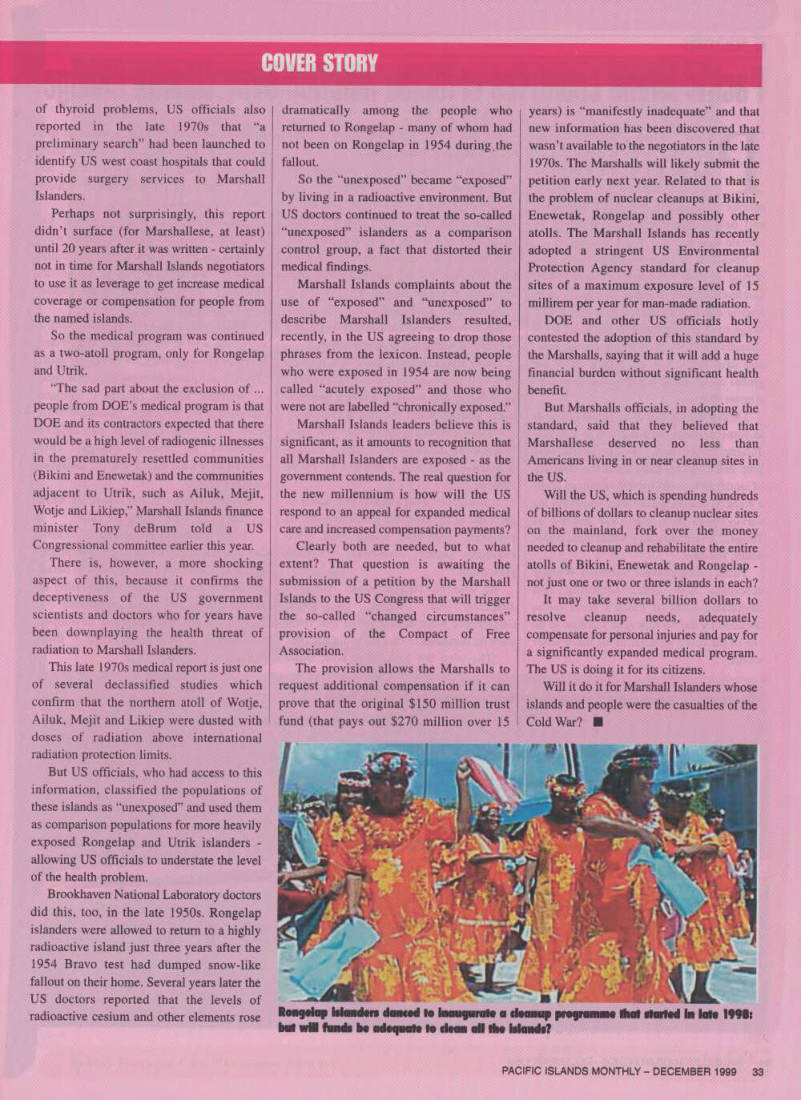
Rongelap islanders danced to inaugurate a cleanup programme that started In late 1998: but will fends be adequate to clean all the Islands?