Lest we forget
pp. 30-31 · Read in the full issue
Cover Story
By Michael Field
A brutal past century for
Nauruans, Banabans,
Marshallese and Moriori
One of the more prominent landmarks on Auckland’s skyline is that on top of One Tree Hill that commemorates the extinction of New Zealand’s Maori people. They survived and are resurgent but for the Moriori, the Nauruans, the Banabans and the Marshallese, life in the last century has proven to be brutal.
As the millennium’s first sunrise falls across New Zealand’s Chatham Islands, there are continuing arguments that the genocide that occurred there is still being covered up. At 4.49 AM (1604 December 31 GMT), the first sunrise of the new century will light up Mount Hakepa on Pitt Island, part of the Chatham Islands, 800 kilometres (500 miles) east of New Zealand’s mainland.
Its indigenous Moriori, a Polynesian people, were virtually wiped out by New Zealand’s indigenous Maori, also Polynesian, in the 19th Century.
So total was the disaster most New Zealanders believed Moriori were extinct until leading historian Michael King revealed the survivor’s story in his 1989 book “Moriori: A People Rediscovered”.
Moriori were related but different to Maori and had become pacifists when, in 1835 with some white help, the Maori Te Atiawa people invaded the islands.
According to King, they subjugated the Morioris brutally, killing around 300 of the estimated 1600 Moriori, eating many of them, and enslaving the rest. The colonial court system then awarded most of the land on the islands to the Maori.
Until King’s book, most New Zealanders believed the “last” Moriori was Tommy Solomon who died in 1933.
New Zealand’s National Museum Te Papa (“our place”) displays some Moriori cultural items but has no account of the massacre.
Te Papa’s research and development general manager Ken Gorbey warned Wellington’s Dominion against “a return to a view of history which has overtones of racism” and indicated that he thought it was racist to reveal statements that show Maori in a bad light. King said the exhibit was a big improvement on the way Moriori had
previously been displayed.
“As a historian, though, I find it odd that more substantial reference was not made to the 1835 invasion, because that episode conditioned what Moriori culture became in the 20th Century,” he said.
“To leave it out is rather like trying to explain East Timorese history and culture without reference to the Indonesian invasion.” The Moriori slaughter was in the 19th Century - the Banabans are perhaps the saddest people in the 20th Century anywhere.
At the opening of the 20th century, Banabans were living on a lush paradise; by the end of it, the landscape was a blasted ruin, its top-soils shipped off across the Pacific. Its people were so completely dispossessed, it is hard to imagine how any civilisation allowed it to happen.
New Zealander Albert Ellis was responsible for what happened by discovering in 1900 the phosphate riches of the island. He went to the island and met a man called Tomate who he described as the Chief of Banaba.
It was a familiar story; Tomate was not the chief of the whole island - Banaba was broken into five clans with no one having supremacy over the others. It did not bother Ellis and he had Tomate agree to his purchase and lease parts of the island for £5O a year for 999 years. The flag followed commerce and on September 1901 Banaba was annexed by Britain and attached to the
Gilbert Island colony.
The islanders discovered the British were not their protectors and inevitably saw what phosphate mining was truly about; stripping everything off the land, leaving only the white skeleton like coral pinnacles.
Arguments were intense and in 1931 Arthur Grimble, the poetic best selling author who acquired a reputation for sensitivity and passion for the people, compulsorily acquired their land. His loving writing should be sharply re-assessed for his robbery, albeit just following orders.
With Nauru in joint Australian, New Zealand and British mandate, the mining operations were consolidated under the British Phosphate Commission (BPC), an astonishingly immoral device with which to rob indigenous peoples whilst hiding profits from the League of Nations and the United Nations and the people of the owning governments.
In 1996, a report on the war’s impact on Gilbert Islands was tabled in the Maneaba ni Maungatabu (Parliament) in Bairiki, Tarawa. It contained a report by Bauro Ratieta from Abaiang who worked on Banaba, beginning there as a clerk in 1927.
At the end of 1941 he said there were 500 Banabans on the islands, 60 Europeans, 220 Chinese, 800 “other natives, mainly BPC indentured labour” (Chinese) and 70 Australian troops.
After the Japanese attack on Pearl Harbour most of the whites were taken off Banaba as the island started coming under attack. In March 1942 the British Government took control of the royalty money paid to the Banabans and used it to buy Rabi Island off Vanua Levu in Fiji.
The plan, unknown to most Banabans, was to move the indigenous people off their island completely. The Japanese occupation of Banaba on August 26, 1942 interrupted, but did not end the plan; in fact it made it easier. On August 25, 1942, a Japanese warship approached and began shelling the
island and next day the Japanese troops landed, encountering no opposition. They marched through the villages with their flags, destroyed the wireless station and other government property.
“The natives were very upset and frightened lest something nasty would happen,” Ratieta said in his evidence. They looted the BPC property and local people.
“I remember one case: a native was stabbed with a bayonet and got killed because he refused to produce the keys of his box to a Japanese soldier.”
Ratieta said the 500 strong garrison began to heavily fortify the island and as well as artillery pieces used coconut logs to create dummy fortifications; “The Japanese erected, in further defence of the island, a live wired (sic) round Solomons Point.
When this work was completed, the Japanese, in order to test the efficiency of the wire, ordered some natives who had been prisoners, to run blindfolded towards the live wire. They were told that if they failed to comply they were to be shot at. The natives of course died of electrocution.”
In mid 1943, Ratieta was forcibly made to join the exodus of the Banabans who were sent to Kosrae, Pohnpei and Nauru. “Before we left Ocean Island, a Japanese officer told us that whatever we do, we must not disclose any information concerning the defences or otherwise of Ocean Island - the penalty being death.”
On August 15, 1945, Japanese Emperor Hirohito accepted the total surrender terms demanded by the Allies. Five days later, five days after hostilities had ceased, the Japanese, on August 20, gathered the around
150 Gilbertese and told them they would soon be leaving. They had their hands tied behind their backs and their names were taken. They were then taken to the sea cliffs near Tapiang village in small groups and executed: only Kabuanase survived.
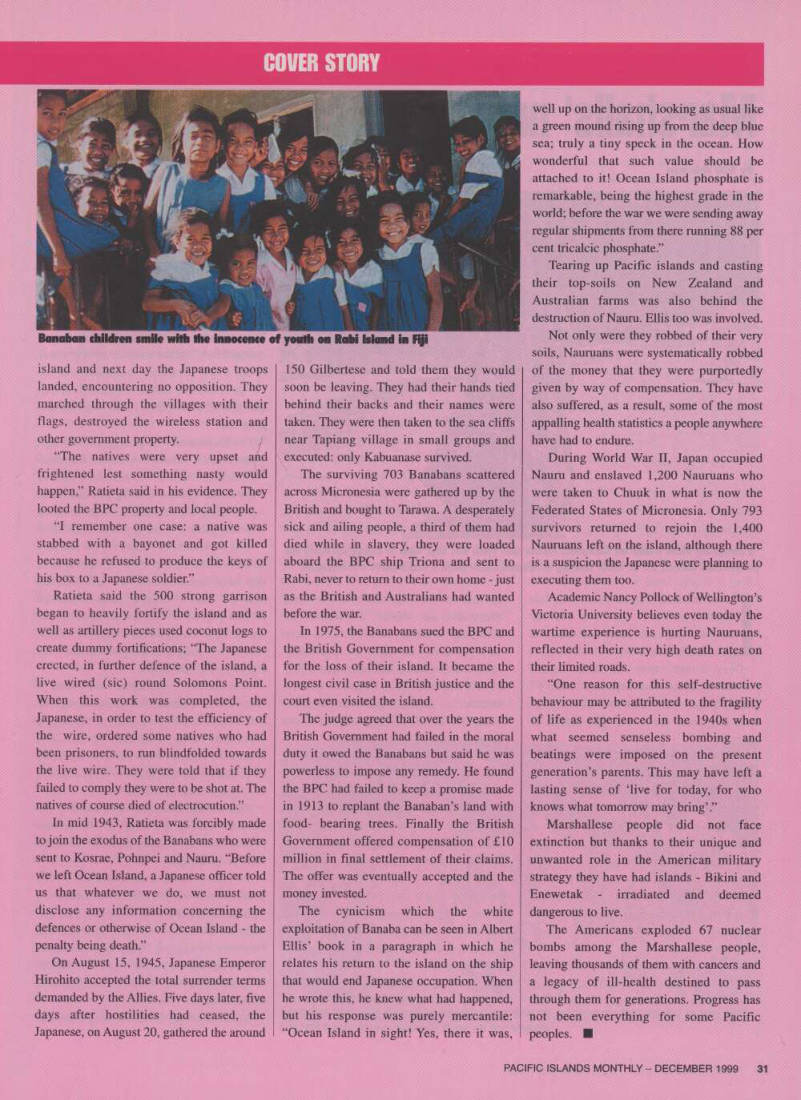
The surviving 703 Banabans scattered across Micronesia were gathered up by the British and bought to Tarawa. A desperately sick and ailing people, a third of them had died while in slavery, they were loaded aboard the BPC ship Triona and sent to Rabi, never to return to their own home - just as the British and Australians had wanted before the war.
In 1975, the Banabans sued the BPC and the British Government for compensation for the loss of their island. It became the longest civil case in British justice and the court even visited the island.
The judge agreed that over the years the British Government had failed in the moral duty it owed the Banabans but said he was powerless to impose any remedy. He found the BPC had failed to keep a promise made in 1913 to replant the Banaban’s land with food- bearing trees. Finally the British Government offered compensation of £lO million in final settlement of their claims.
The offer was eventually accepted and the money invested.
The cynicism which the white exploitation of Banaba can be seen in Albert Ellis’ book in a paragraph in which he relates his return to the island on the ship that would end Japanese occupation. When he wrote this, he knew what had happened, but his response was purely mercantile: “Ocean Island in sight! Yes, there it was,
well up on the horizon, looking as usual like a green mound rising up from the deep blue sea; truly a tiny speck in the ocean. How wonderful that such value should be attached to it! Ocean Island phosphate is remarkable, being the highest grade in the world; before the war we were sending away regular shipments from there running 88 per cent tricalcic phosphate.”
Tearing up Pacific islands and casting their top-soils on New Zealand and Australian farms was also behind the destruction of Nauru. Ellis too was involved.
Not only were they robbed of their very soils, Nauruans were systematically robbed of the money that they were purportedly given by way of compensation. They have also suffered, as a result, some of the most appalling health statistics a people anywhere have had to endure.
During World War 11, Japan occupied Nauru and enslaved 1,200 Nauruans who were taken to Chuuk in what is now the Federated States of Micronesia. Only 793 survivors returned to rejoin the 1,400 Nauruans left on the island, although there is a suspicion the Japanese were planning to executing them too.
Academic Nancy Pollock of Wellington’s Victoria University believes even today the wartime experience is hurting Nauruans, reflected in their very high death rates on their limited roads.
“One reason for this self-destructive behaviour may be attributed to the fragility of life as experienced in the 1940 s when what seemed senseless bombing and beatings were imposed on the present generation’s parents. This may have left a lasting sense of ‘live for today, for who knows what tomorrow may bring’.”
Marshallese people did not face extinction but thanks to their unique and unwanted role in the American military strategy they have had islands - Bikini and Enewetak - irradiated and deemed dangerous to live.
The Americans exploded 67 nuclear bombs among the Marshallese people, leaving thousands of them with cancers and a legacy of ill-health destined to pass through them for generations. Progress has not been everything for some Pacific
peoples. ■
Banaban children smile with the innocence of youth on Rabi Island in Fiji