Air Marshalls unloads Saab 2000
p. 16 · Read in the full issue
Business
By Gift Johnson
Air Marshall Islands’ Saab 2000 is history. That’s the good news. The bad news is that the sale in late October of the four year-old plane generated less than one-third of its original price tag of more than $l6 million.
The aircraft, which during its use by AMI suffered repeated and extended break downs, was sold for $5.3 million to a Europe-based air carrier. The sale generates much-needed cash for Air Marshall Islands - which has just recently initiated a $2B million deal to purchase two new 31 seat planes from the German manufacturer Dornier Fairchild.
Touted by government officials and the manufacturer as the perfect plane for the long, thinly travelled routes in the central Pacific, the Saab turned out to be the wrong plane in the wrong place.
AMl’s general manager Phil Marshall
described the Saab as a plane that AMI “should never have bought.” He said that the airline management was not involved in the decision to make the purchase in the
early 19905.\
Originally, the government had committed to buying two Saab 2000 s with an option to purchase two more.
The fast, nearly jet-speed twin-engine Saab, was so high tech that it, ironically, broke down repeatedly - partly due to the heavy humidity and salt air environment that is a fact of life on an atoll, but also, at least in part, as a result of the limitations of a maintenance crew that didn’t even have a hangar to do repairs inside.
The Marshalls isolation only complicated the breakdowns. It was often agonisingly slow to get parts from Europe into Majuro or, on occasion, even more distant Kiribati and Tuvalu, when the plane was grounded.
After operating the plane from 1995- 1998, AMI inked a deal with Air Vanuatu on a long-term lease for use of the plane between Fiji and Vanuatu. That expired in April, and the plane had been sitting in Nadi until its recent sale. The Saab was sold despite a last-minute hiccup that had threatened to drag out the sale.
The plane was to make an “acceptance flight”, which would have sealed the deal.
But the auxiliary power went down, preventing the flight from Nadi. “It was ironic,” said Marshall, “because this was the same part that failed when the plane was first flown out from the factory to Majuro in 1995 and had to be grounded on Guam.”
However, instead of waiting for days for parts to be flown in from Australia, AMI engineers in Fiji were able to solve the problem, allowing the plane to make its test
flight the following day, concluding the
deal.
Continued from previous page
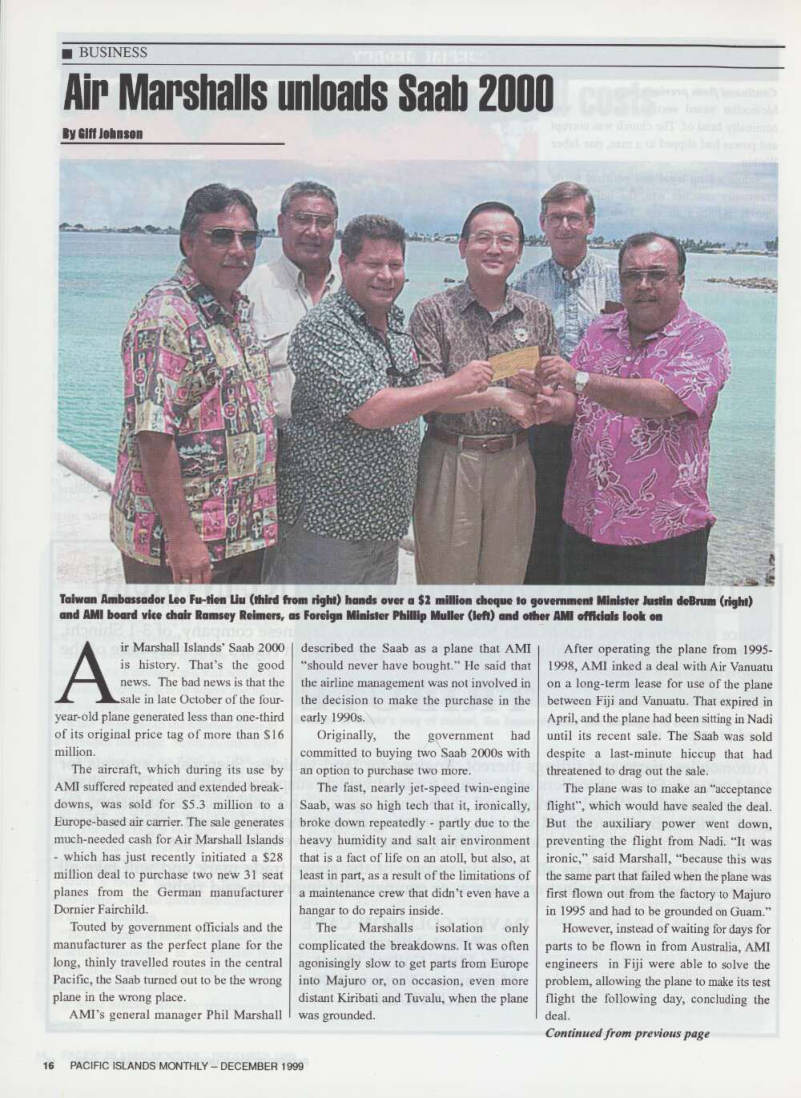
Taiwan Ambassador Leo Fu-tien Liu (third from right) hands over a $2 million cheque to government Minister Justin deBrum (right) and AMI board vice chair Ramsey Reimers, as Foreign Minister Phillip Muller (left) and other AMI officials look on