Queen Salute pushed security at all costs
pp. 14-17 · Read in the full issue
By Michael Held
If stability was a complete virtue, the Kingdom of Tonga would be among the world’s superpowers.
That most of its people are still as poor going into the new millennium as they were at the beginning of the 20th Century illustrates the perils of such stability.
In the entire 20th Century, Tonga has had just three heads of state and since 1923 has had just five unelected prime ministers.
More Tongans now live outside the Kingdom than in it while the royal family through schemes like passport sales, satellite slot leasing, breweries and Internet operations are richer than they have ever been.
The bulwark against change and development and the most influential figure in Tongan 20th Century was Salote Mafile’o Pilolevu, born on March 13, 1900, in the white wooden palace on Nuku’alofa’s coast.
She was the daughter of King Taufa’ahau Tupou II and Queen Levinia. At the time the royal family was both unpopular and uncertain, caught up in a swirl of domestic Tongan power struggle and imperial colonialism.
Salote’s mother died when she was two years-old. As a teenager she was sent to an Auckland boarding school where she lived for seven years.
When 18-years-old she returned home to an arranged marriage. Seven months later her father died and, on April 5, 1918, she was crowned Queen Salote Tupou 111.
Her first test of leadership was a disaster - the arrival of influenza on November 12, 1918. The ship Talune had also introduced
it into Samoa by evading quarantine.
Thousands of Tongans died within weeks.
Salote’s recent biographer, Elizabeth Wood-Ellem, says the queen failed her first test of her leadership.
“Her government broke down and took no action whatsoever to ameliorate the effects of the epidemic, either locally or nationally,” she wrote.
A white official strongly reprimanded
her at one point when she wanted to make a royal visit through Tongatapu villages. It was pointed out to her that more deaths would follow as a result.
“Salote took the reproach to heart, and was never again so neglectful of the welfare of her subjects,” Wood-Ellem said.
The queen was among the first advocates of the idea, still around, that Tonga is some kind of nirvana.
“There is not in the world a little
Kingdom like Tonga, peaceful, contented and happy,” said Salote in 1937.
She had three children, one of whom died when he was 16, another who as Prince Fatafehi Tu’ipelehake became the
kingdom's longest serving premier and her
eldest, Taufa’ahau Tupou IV who was born a crown prince and is the current king.
Salote’s major political battle was over religion and the Free Church of Tonga, the
Continued next page
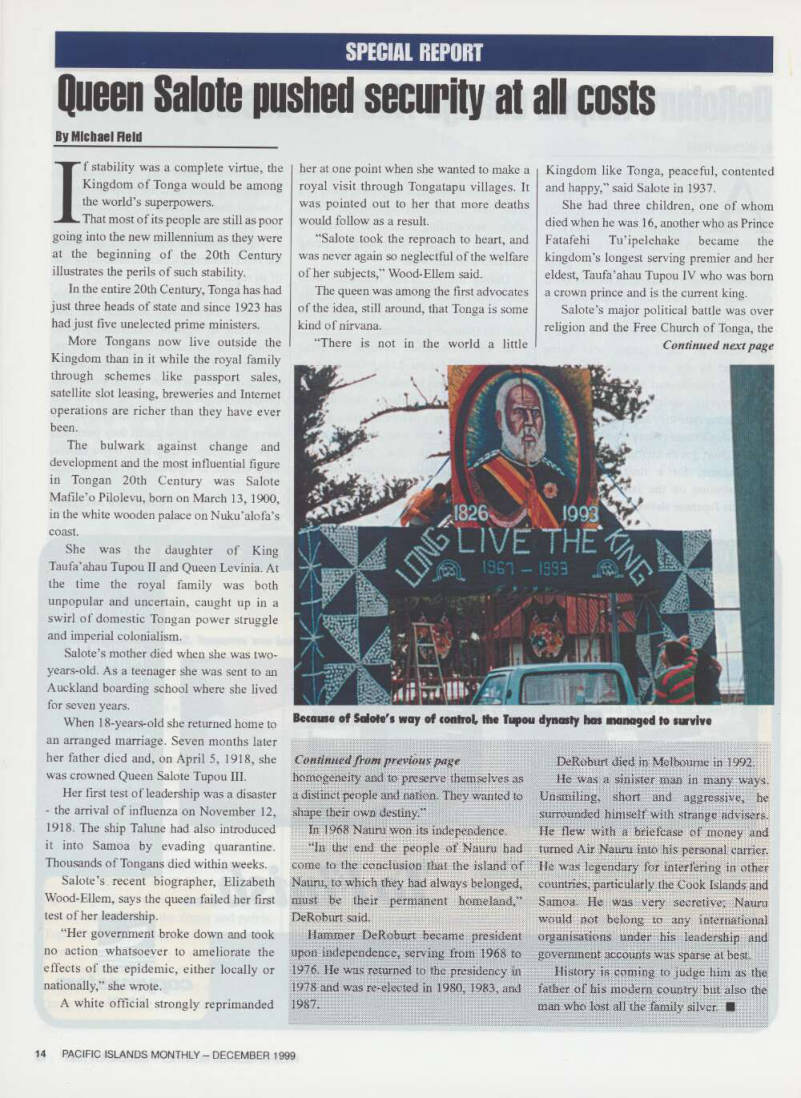
Because of S[?]ote's way of control, the Tupou dynasty has managed to survive
Continued from previous page
With the aid of Taiwan, the Marshall Islands has set in motion a $2B million deal to purchase two German-made airplanes.
In early October, Taiwan turned over a $2 million cheque to Air Marshall Islands, a contribution that will be used to fund downpayment on two new German Dornier Fairchild 328 airplanes.
The purchase of two Dornier 328 s - twin engine propeller planes that seat up to 31 passengers and are made by the same company that manufactures smaller Dorniers commuter planes now in use for travel to remote outer atolls in the Marshalls - has been under negotiation since earlier this year. The first plane should be in Majuro by mid- to late-December, according to Marshall. The second plane is expected next March.
With spare parts, training and other elements in the package, each of the new Dorniers will cost about $l4 million. The deal is being financed by a loan through the Berliner Bank in Germany, he said.
“There’s a lot that has to be done between now and when the plane arrives,”
Marshall said. He said that both pilots and
mechanics have to be trained for working on the larger planes. The Domier 328 s will be used for travellers heading to the scuba
dive mecca at Bikini Atoll, as well as for other domestic service and international travel to Tarawa, Kiribati. ■
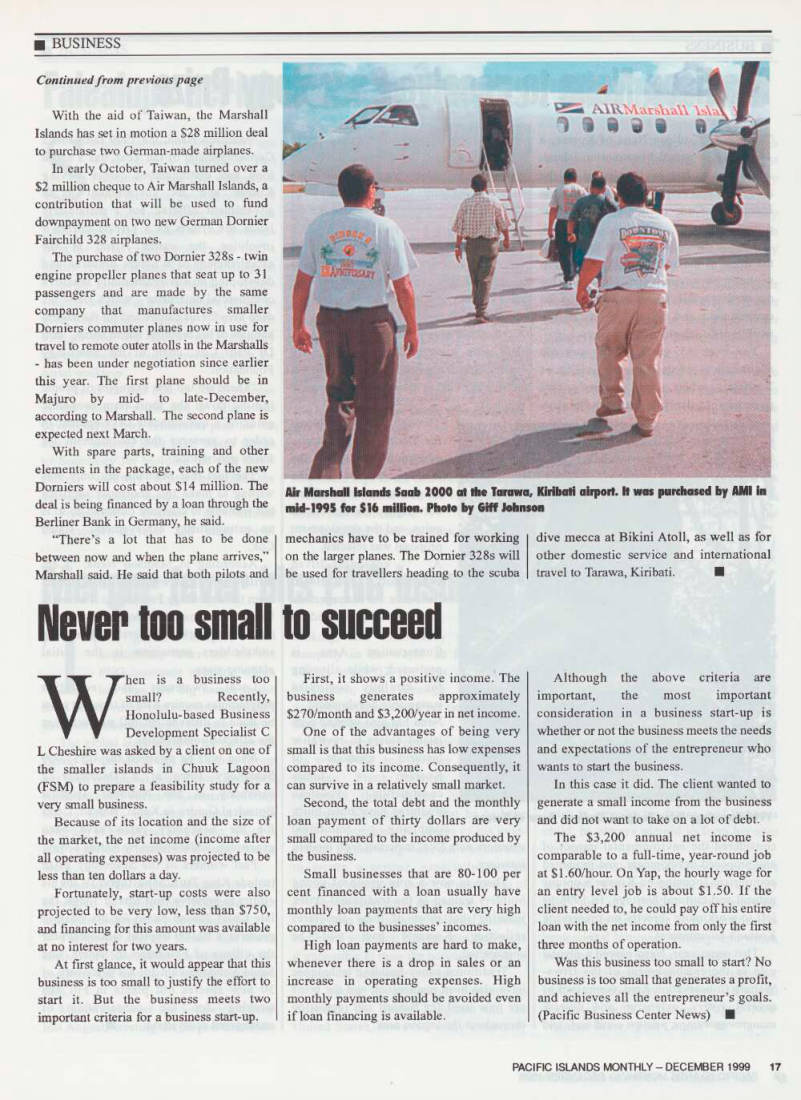
Air Marshall Islands Saab 2000 at the Tarawa, Kiribati airport. It was purchased by AMI in mid-1995 for $16 million. Photo by Giff Johnson