Internet development just the tip
pp. 38-39 · Read in the full issue
tip of the iceberg
By Erin Phelan
THINK of a journalist 40 years ago.
Tapping away - with luck on an electric typewriter - until the wee hours of morn’, a flask of whiskey aside, scattered notes strewn over the desk, a rotary phone like a heavy paperweight, ringing loudly with the scoop of the day.
Now, think of a journalist in 1999.
Information saved into folders in Word or Mac, websites saved in bookmarks, inter views interfaced through cable wires with unmet subjects thousands of miles away.
No technology has been more per vasive this century than the computer, and no information medium more revolution ary than the Internet. In fact, every 100 days the volume of traffic on the Internet doubles.
Media and information have become instant and, without sounding trite, if you want to compete you’ve got to get with the programme.
According to Mike Marasigan, chief operating officer for Business World Online, news media today aren’t prevalent unless they have a website, and the Internet has fast become a predominant source for news information. ‘The craze started exactly five years ago when the World Wide Web was born and became a very popular segment of the Internet. It is the fastest-growing medium in the history of mankind and has, in fact, the ability to consolidate or merge all media into one web site,” said Marasigan, in a fitting electronic interview from Mani la.
Marasigan is a regional expert on the Internet and the evolution of the media.
He has been a central force in the develop ment and success of the Philippines-based Business World Online. It’s a spin-off com pany from the successful Manila newspa per Business World. Marasigan was news editor of the print edition before launching the online edition, for which he is also still editor.
Marasigan has spoken throughout
Asia-Pacific on related subjects, and this year marks his third appearance as an
invited speaker for the annual Pacific Islands News Association (PINA) conven tion - held in Suva last month.
He says: “The Internet has also enabled media companies to distribute
their products cheaply and more speedily.
Five years ago, some media companies could not fully grasp what the Internet could do for them, but for the last two years, almost every media outfit - print, TV, radio - wants to have a web site. Give it another five years - all media companies will be on the WWW.”
During the Kosovo crisis, traffic on the Internet increased by 40 percent. Web sites such as CNN and MSNBC have incorporated video and audio into their sites, blurring lines between mediums.
Marasigan says that Business World Online makes money by selling subscriptions and by selling advertising. They have also begun to venture into e-commerce selling products and services.
But with technology changing fast, it is often a race to the finish. Says Marasi gan: “Right now, we are all overwhelmed by the technology, but like any other tech nology, the Internet is just another tool and
that’s how we should look at it.”
Some critics are less optimistic.
They envision a time when sound bytes and headlines stream across the computer screen, focused on immediacy rather than accuracy or content.
Marasigan disagrees.
“Eventually, media will no longer be limited to providing news articles, feature stories or opinion columns. They will go into a full e-commerce mode, selling everything they could through the net. The media will be a force to reckon with.”
The Pacific Islands media are well established on the Internet, and the traffic
is growing.
Marasigan says he keeps up to date with Pacific news via several websites everyday. Marasigan cites the French Poly nesia-based Tahiti Pacifique (http://www.tahiti-pacifique.com/) as an excellent example of a website run by a one-man show.
He says Fiji Village (http://www.fijivillage.com/index.html) is a good example of news organisations working together to give the Pacific a world wide web presence.
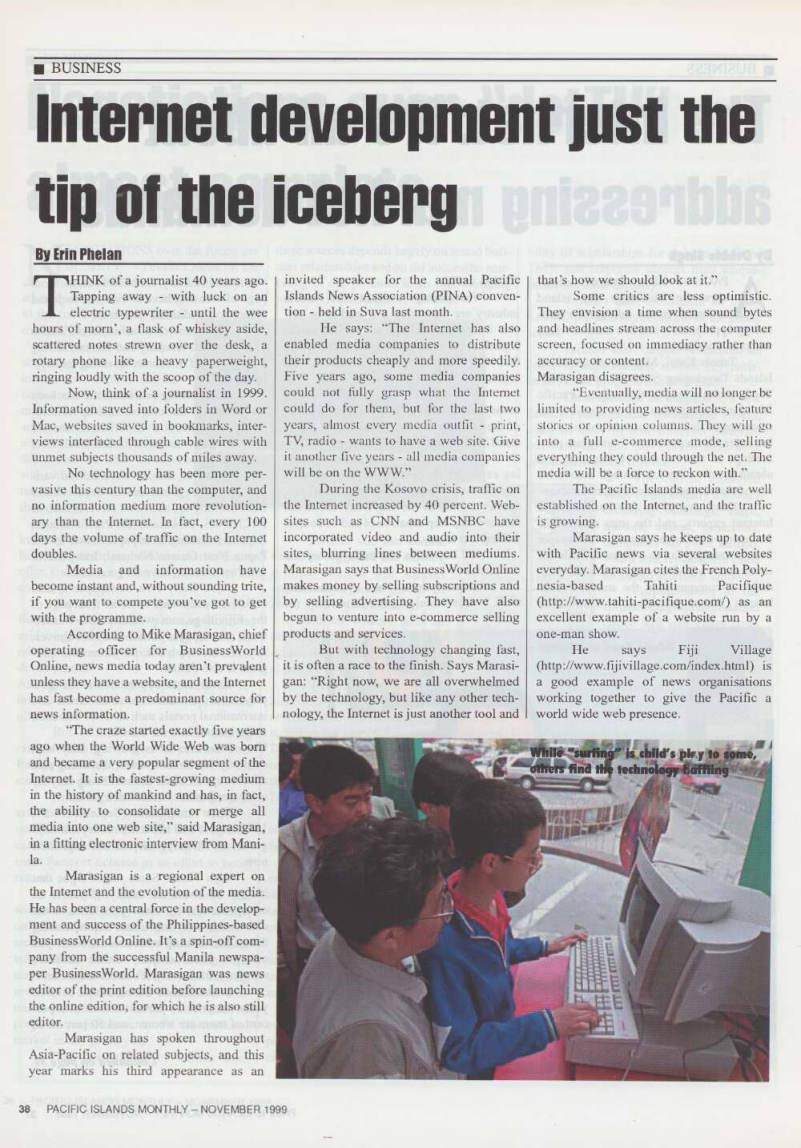
While "surfing" is child's play to some, others find the technology baffling
“During the early days of the world wide web, people were saying: everybody can be a publisher. That’s true and that’s how I understand the way the Internet has democratised the media,” said Marasigan.
“Everybody can publish what he wants to publish even if it is garbage. The Internet can give anybody the power to express or distribute information whether it is useful, relevant or otherwise.”
Is there the threat of the traditional newspaper becoming obsolete?
“I don’t think so, but maybe their reach and influence will be reduced,” said Marasigan. “We must remember that some developing regions do not have access to electricity or computers.”
Not entirely true. Recently Somalia became one of the last countries in the world to get connected, however access to phone lines - required for the Internet - is limiting the reach. Die Pacific suffers from the same problem and hi many countries such as Fiji - one company has a monopoly on the cable wires.
Opening up the market for competition will allow the Internet to grow - and it is
growing fast.
Says Marasigan: “We ain’t seen nothing yet.” (PINA Nius) ■
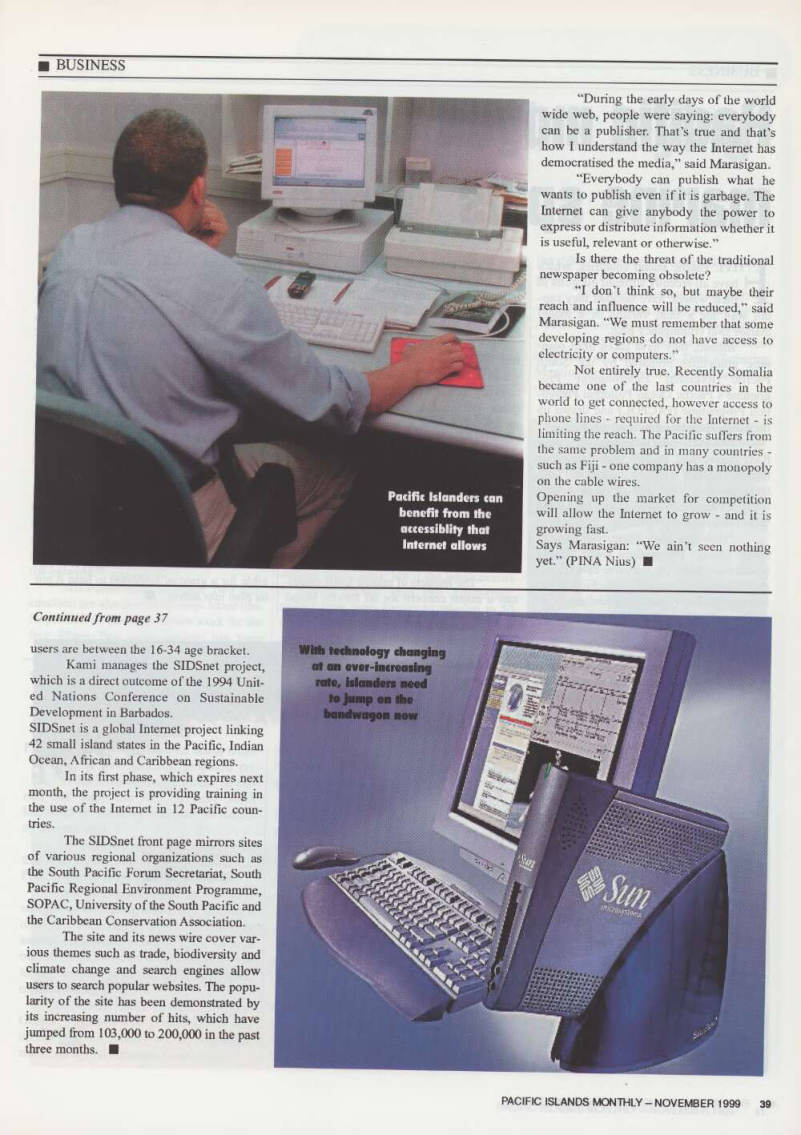
Pacific Islanders can benefit from the accessiblity that Internet allows