addressing market demands
pp. 37-39 · Read in the full issue
The Internet: it's all about addressing market demands
By Debbie Singh
A PACIFIC Island Internet expert says the challenge for island nations is to use information tech nology appropriately and in a manner which works in our time.
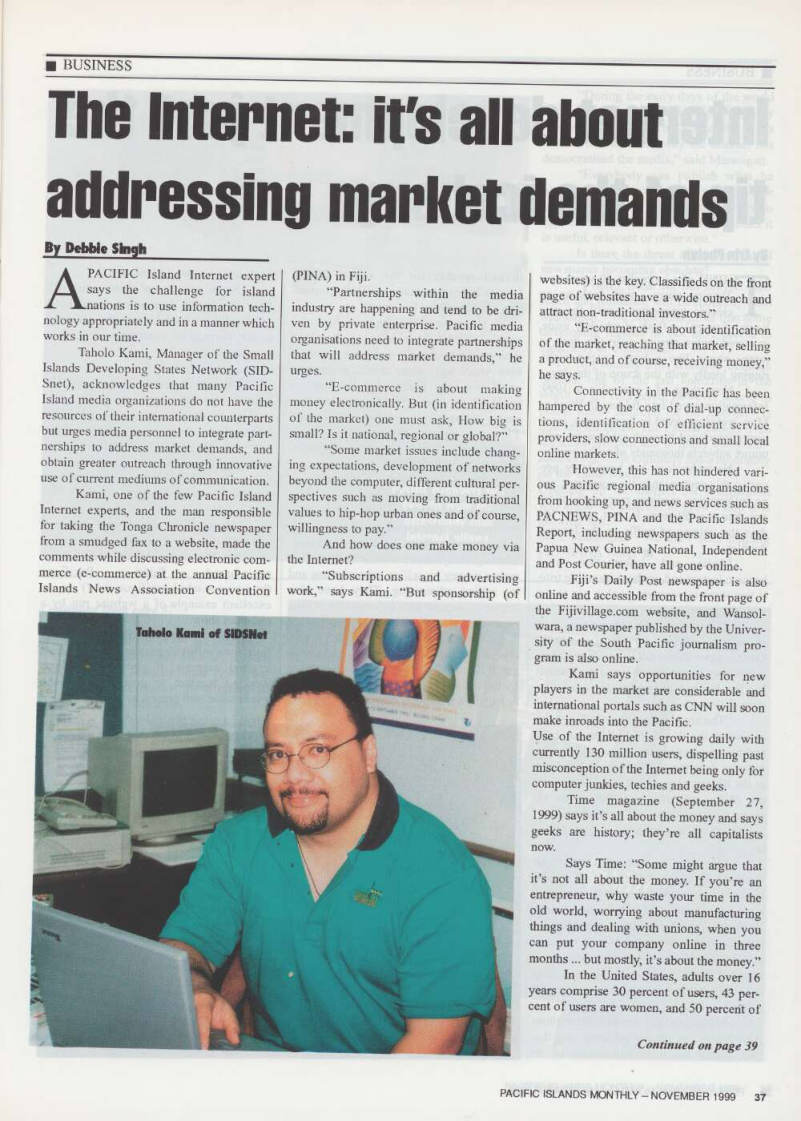
Taholo Kami, Manager of the Small Islands Developing States Network (SID- Snet), acknowledges that many Pacific Island media organizations do not have the resources of their international counterparts but urges media personnel to integrate part nerships to address market demands, and obtain greater outreach through innovative use of current mediums of communication.
Kami, one of the few Pacific Island Internet experts, and the man responsible for taking the Tonga Chronicle newspaper from a smudged fax to a website, made the comments while discussing electronic com merce (e-commerce) at the annual Pacific Islands News Association Convention
(PINA) in Fiji.
“Partnerships within the media industry are happening and tend to be dri ven by private enterprise. Pacific media organisations need to integrate partnerships that will address market demands,” he mges.
“E-commerce is about making money electronically. But (in identification ol the market) one must ask, How big is small? Is it national, regional or global?”
“Some market issues include chang ing expectations, development of networks beyond the computer, different cultural per spectives such as moving from traditional values to hip-hop urban ones and of course, willingness to pay.”
And how does one make money via the Internet?
“Subscriptions and advertising
work,” says Kami. “But sponsorship (of
websites) is the key. Classifieds on the front page of websites have a wide outreach and attract non-traditional investors.”
“E-commerce is about identification of the market, reaching that market, selling a product, and of course, receiving money,” he says.
Connectivity in the Pacific has been hampered by the cost of dial-up connec tions, identification of efficient service providers, slow connections and small local online markets.
However, this has not hindered vari ous Pacific regional media organisations from hooking up, and news services such as PACNEWS, PINA and the Pacific Islands Report, including newspapers such as the Papua New Guinea National, Independent and Post Courier, have all gone online.
Fiji’s Daily Post newspaper is also online and accessible from the front page of the Fijivillage.com website, and Wansol wara, a newspaper published by the Univer sity of the South Pacific journalism pro gram is also online.
Kami says opportunities for new players in the market are considerable and international portals such as CNN will soon make inroads into the Pacific.
Use of the Internet is growing daily with currently 130 million users, dispelling past misconception of the Internet being only for computer junkies, techies and geeks.
Time magazine (September 27, 1999) says it’s all about the money and says geeks are history; they’re all capitalists now.
Says Time: “Some might argue that it’s not all about the money. If you’re an entrepreneur, why waste your time in the old world, worrying about manufacturing things and dealing with unions, when you can put your company online in three months ... but mostly, it’s about the money.”
In the United States, adults over 16 years comprise 30 percent of users, 43 per cent of users are women, and 50 percent of
Continued on page 39
Taholo Kami of SIDSNET
Continued from page 37
users are between the 16-34 age bracket.
Kami manages the SlDSnet project, which is a direct outcome of the 1994 Unit ed Nations Conference on Sustainable Development in Barbados.
SlDSnet is a global Internet project linking 42 small island states in the Pacific, Indian Ocean, African and Caribbean regions.
In its first phase, which expires next month, the project is providing training in the use of the Internet in 12 Pacific coun tries.
The SlDSnet front page mirrors sites of various regional organizations such as the South Pacific Forum Secretariat, South Pacific Regional Environment Programme, SOPAC, University of the South Pacific and the Caribbean Conservation Association.
The site and its news wire cover var ious themes such as trade, biodiversity and climate change and search engines allow users to search popular websites. The popu larity of the site has been demonstrated by its increasing number of hits, which have jumped from 103,000 to 200,000 in the past three months. ■
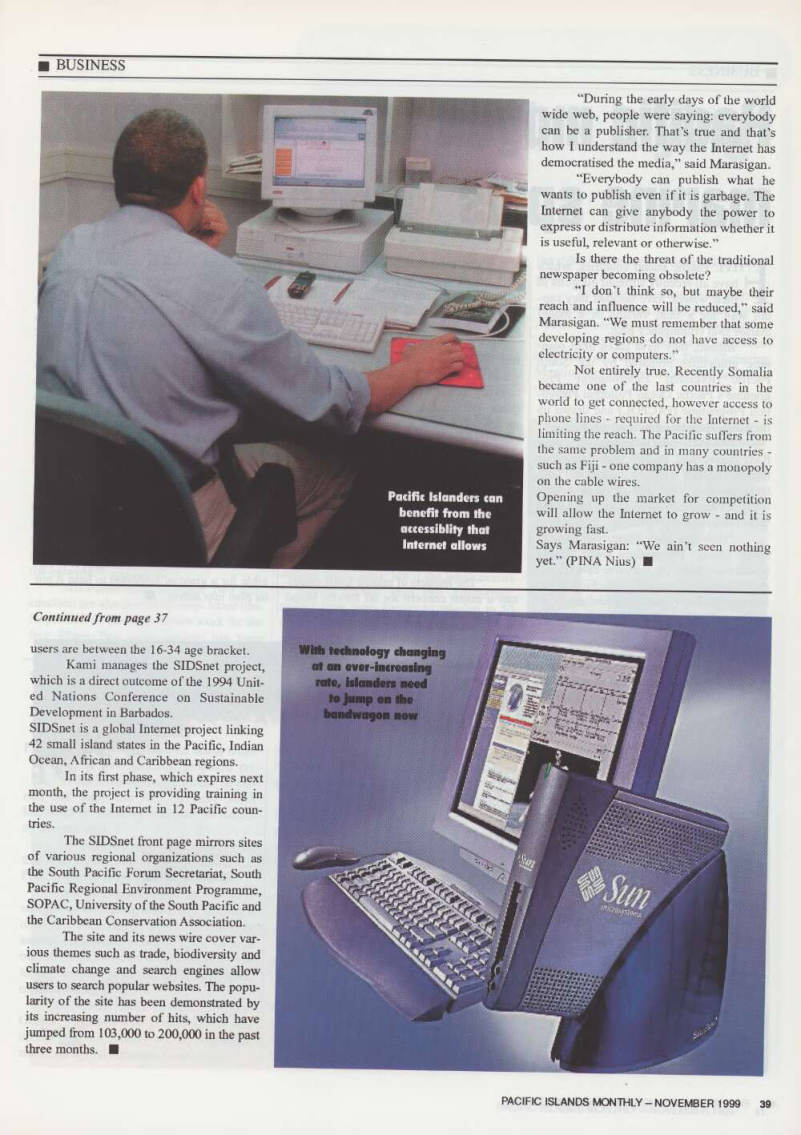
With technology changing at an ever-increasing rate, islanders need to Jump on the
bandwagon now