McKinnon maintains NZ-Pacific link
p. 56 · Read in the full issue
Opinion
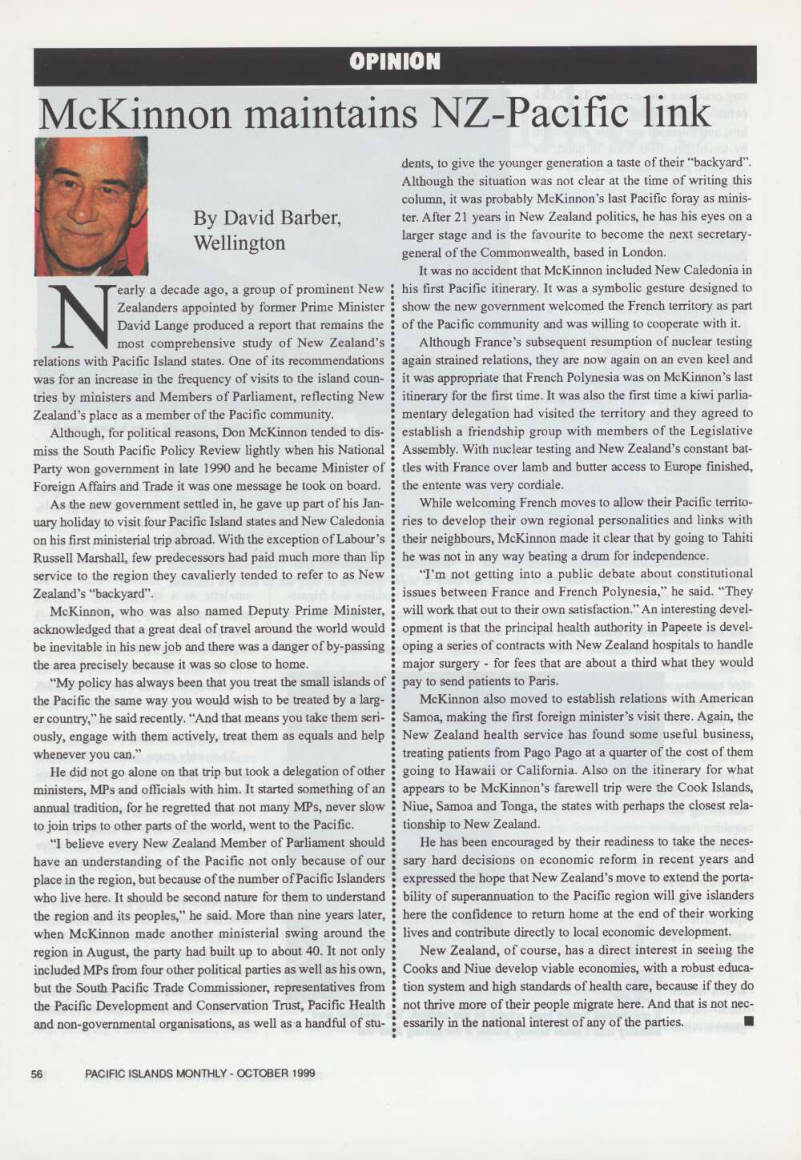
By David Barber, Wellington
Nearly a decade ago, a group of prominent New Zealanders appointed by former Prime Minister David Lange produced a report that remains the most comprehensive study of New Zealand’s relations with Pacific Island states. One of its recommendations was for an increase in the frequency of visits to the island coun tries by ministers and Members of Parliament, reflecting New Zealand’s place as a member of the Pacific community.
Although, for political reasons, Don McKinnon tended to dis miss the South Pacific Policy Review lightly when his National Party won government in late 1990 and he became Minister of Foreign Affairs and Trade it was one message he took on board.
As the new government settled in, he gave up part of his Jan uary holiday to visit four Pacific Island states and New Caledonia on his first ministerial trip abroad. With the exception of Labour’s Russell Marshall, few predecessors had paid much more than lip service to the region they cavalierly tended to refer to as New Zealand’s “backyard”.
McKinnon, who was also named Deputy Prime Minister, acknowledged that a great deal of travel around the world would be inevitable in his new job and there was a danger of by-passing the area precisely because it was so close to home.
“My policy has always been that you treat the small islands of the Pacific the same way you would wish to be treated by a larg er country,” he said recently. “And that means you take them seri ously, engage with them actively, treat them as equals and help whenever you can.”
He did not go alone on that trip but took a delegation of other ministers, MPs and officials with him. It started something of an annual tradition, for he regretted that not many MPs, never slow to join trips to other parts of the world, went to the Pacific.
“I believe every New Zealand Member of Parliament should have an understanding of the Pacific not only because of our place in the region, but because of the number of Pacific Islanders who live here. It should be second nature for them to understand the region and its peoples,” he said. More than nine years later, when McKinnon made another ministerial swing around the region in August, the party had built up to about 40. It not only included MPs from four other political parties as well as his own, but the South Pacific Trade Commissioner, representatives from the Pacific Development and Conservation Trust, Pacific Health and non-governmental organisations, as well as a handful of stu
jdents, to give the younger generation a taste of their “backyard”.
Although the situation was not clear at the time of writing this column, it was probably McKinnon’s last Pacific foray as minis ter. After 21 years in New Zealand politics, he has his eyes on a larger stage and is the favourite to become the next secretary general of the Commonwealth, based in London.
It was no accident that McKinnon included New Caledonia in his first Pacific itinerary. It was a symbolic gesture designed to show the new government welcomed the French territory as part of the Pacific community and was willing to cooperate with it.
Although France’s subsequent resumption of nuclear testing again strained relations, they are now again on an even keel and it was appropriate that French Polynesia was on McKinnon’s last itinerary for the first time. It was also the first time a kiwi parlia mentary delegation had visited the territory and they agreed to establish a friendship group with members of the Legislative Assembly. With nuclear testing and New Zealand’s constant bat tles with France over lamb and butter access to Europe finished, the entente was very cordiale.
While welcoming French moves to allow their Pacific territo ries to develop their own regional personalities and links with their neighbours, McKinnon made it clear that by going to Tahiti he was not in any way beating a drum for independence.
“I’m not getting into a public debate about constitutional issues between France and French Polynesia,” he said. “They will work that out to their own satisfaction.” An interesting devel opment is that the principal health authority in Papeete is devel oping a series of contracts with New Zealand hospitals to handle major surgery - for fees that are about a third what they would pay to send patients to Paris.
McKinnon also moved to establish relations with American Samoa, making the first foreign minister’s visit there. Again, the New Zealand health service has found some useful business, treating patients from Pago Pago at a quarter of the cost of them going to Hawaii or California. Also on the itinerary for what appears to be McKinnon’s farewell trip were the Cook Islands, Niue, Samoa and Tonga, the states with perhaps the closest rela tionship to New Zealand.
He has been encouraged by their readiness to take the neces sary hard decisions on economic reform in recent years and expressed the hope that New Zealand’s move to extend the porta bility of superannuation to the Pacific region will give islanders here the confidence to return home at the end of their working lives and contribute directly to local economic development.
New Zealand, of course, has a direct interest in seeing the Cooks and Niue develop viable economies, with a robust educa tion system and high standards of health care, because if they do not thrive more of their people migrate here. And that is not nec essarily in the national interest of any of the parties. ■