Sailing
pp. 54-55 · Read in the full issue
Yachting
Pacific hitchhikers
Story and pictures by Sally Andrew
Sailing
across the Pacific this win ter, I rediscovered one of the great joys of cruising - seabirds.
Seabirds often travel hundreds of miles to accompany us into port - circling high over head for days, swoop ing and soaring, skim ming the waves, lifting with the breeze. Some birds, however, prefer to land on deck for a catnap. Over the years we’ve had several avian hitchhikers.
Coming on watch, I’ve found noddies and boobies quietly reposing in the cock pit, lounging on the dodger, siesta’ing on the solar panels, skating along the side deck. Often, they are simply tired out after a storm at sea and need a safe sanc tuary.
Traditional Pacific navigators used seabirds as ready and reliable references in their advanced system of land-finding.
“We, The Navigators”, a classic work by Dr David Lewis, has this description of the navigator’s four best friends: “Towards evening the frigate birds ... will be seen to abandon their leisurely patrolling, climb even higher and set off in one direction, probably homing by sight. About the same time the boobies will tire of their inquisitive inspections and fly low and arrow-straight for the horizon. As the noddies depart they will weave slightly in and out between the crests of the larger waves, while the terns will be flying a little above them, but all
will be following a very exact path towards their home island.”
Noddies are frequent hitchhikers. In June, while storm petrels and a dozen shearwaters circled our boat near mid- Tasman sea mounts, a noddy landed mid afternoon on our solar panels. Two days later, another noddy spent the night grip ping the top of our vinyl dodger with her webbed-feet and top-quality sealegs. I have no idea how she held on for so long since the boat was rolling from side to side in big ocean swells.
Booby birds, too, are very interested in sailboats, often circling around the mast and landing on inappropriate parts of the rigging. Midway between Hawaii and Fanning Island (Kiribati), a masked (blue-footed) booby landed aboard Fel lowship, then squawked and slid forward before slithering aft, hopping in the cock pit and wedging herself into a leeward corner. Winds and seas were scrambled and the swells shaped like pyramids. I’d
had enough and so had the booby bird.
She stayed a day and a half before taking to the air once again.
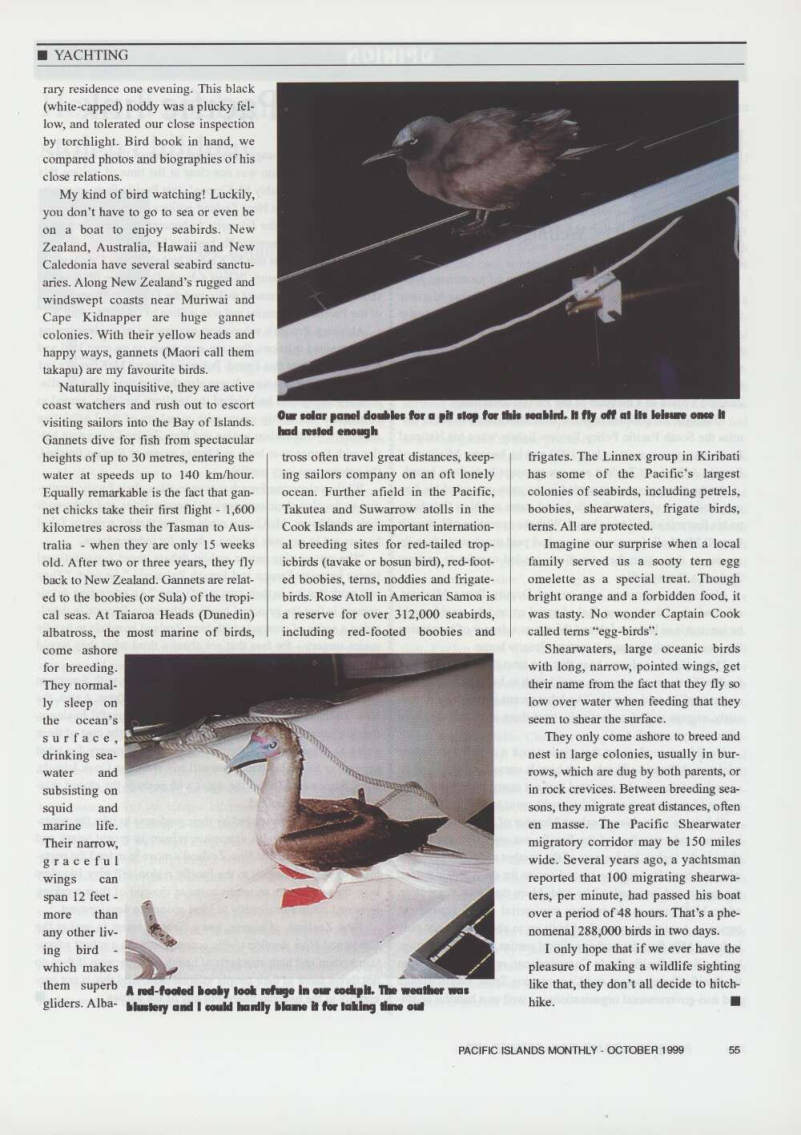
The laziest birds seem to those encountered along the route from Noumea to Gladstone. We billeted two red-footed boobies who landed simulta neously on one of our stern-mounted solar panels as we sailed south of Chesterfield reef in the Coral Sea.
The next night, a black noddy joined them on the starboard panel while anoth er red-footed booby took refuge in our cockpit. The weather was blustery and I could hardly blame these pelagic wan derers for taking time out in the midst of such inhospitable wind and sea condi tions.
Identifying birds is easy for some people who need only binoculars and a bird book, but cooperation helps. In New Caledonia, a black seabird landed on our lifeline (that’s the safety fence that encloses our decks) and took up tempo
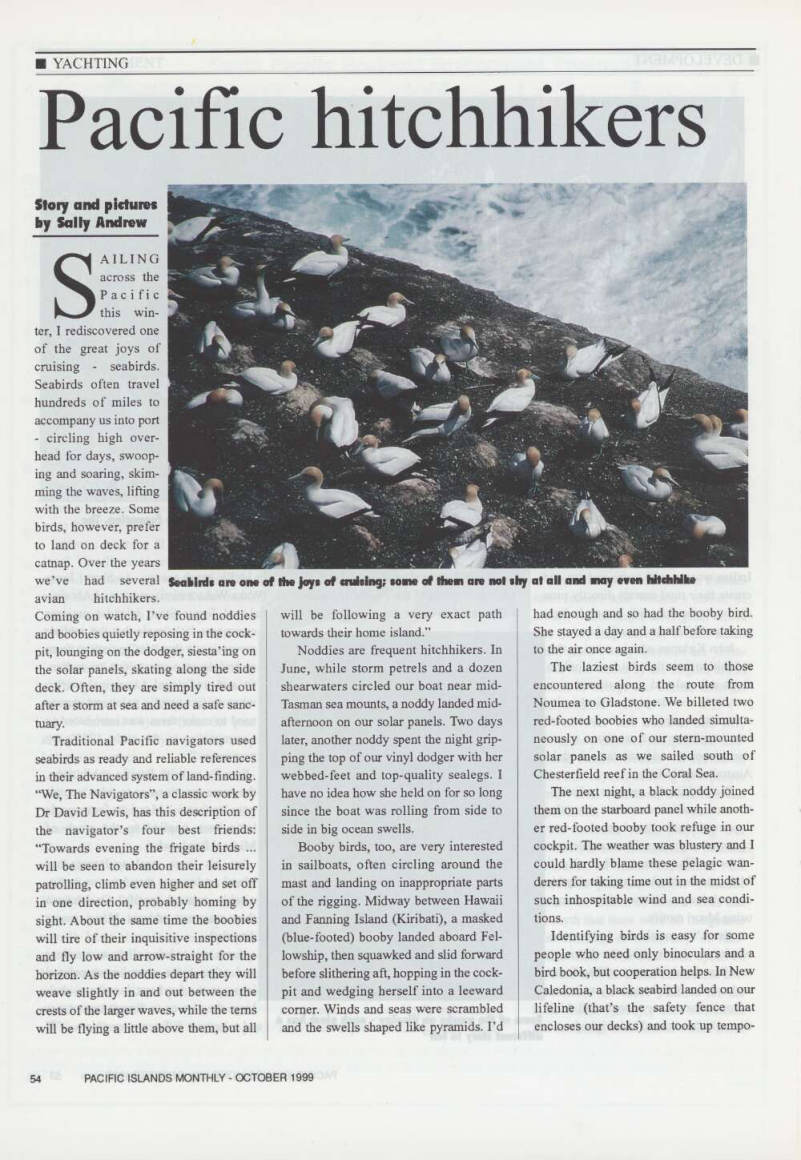
Seabirds are one of the Joys of crafting; tone of them are not shy at all and may even hitchhike
rary residence one evening. This black
(white-capped) noddy was a plucky fel
low, and tolerated our close inspection by torchlight. Bird book in hand, we
compared photos and biographies of his
close relations.
My kind of bird watching! Luckily, you don’t have to go to sea or even be on a boat to enjoy seabirds. New Zealand, Australia, Hawaii and New Caledonia have several seabird sanctu aries. Along New Zealand’s rugged and windswept coasts near Muriwai and Cape Kidnapper are huge gannet colonies. With their yellow heads and happy ways, gannets (Maori call them takapu) are my favourite birds.
Naturally inquisitive, they are active coast watchers and rush out to escort visiting sailors into the Bay of Islands.
Gannets dive for fish from spectacular heights of up to 30 metres, entering the water at speeds up to 140 km/hour.
Equally remarkable is the fact that gan net chicks take their first flight - 1,600 kilometres across the Tasman to Aus tralia - when they are only 15 weeks old. After two or three years, they fly back to New Zealand. Gannets are relat ed to the boobies (or Sula) of the tropi cal seas. At Taiaroa Heads (Dunedin) albatross, the most marine of birds,
come ashore for breeding.
They normal ly sleep on the ocean’s surface, drinking sea water and subsisting on squid and marine life.
Their narrow, graceful wings can span 12 feet more than any other liv ing bird which makes them superb gliders. Alba-
tross often travel great distances, keep ing sailors company on an oft lonely ocean. Further afield in the Pacific, Takutea and Suwarrow atolls in the Cook Islands are important internation al breeding sites for red-tailed trop icbirds (tavake or bosun bird), red-foot ed boobies, terns, noddies and frigate birds. Rose Atoll in American Samoa is a reserve for over 312,000 seabirds, including red-footed boobies and
frigates. The Linnex group in Kiribati has some of the Pacific’s largest colonies of seabirds, including petrels, boobies, shearwaters, frigate birds, terns. All are protected.
Imagine our surprise when a local family served us a sooty tern egg omelette as a special treat. Though bright orange and a forbidden food, it was tasty. No wonder Captain Cook called terns “egg-birds”.
Shearwaters, large oceanic birds with long, narrow, pointed wings, get their name from the fact that they fly so low over water when feeding that they seem to shear the surface.
They only come ashore to breed and nest in large colonies, usually in bur rows, which are dug by both parents, or in rock crevices. Between breeding sea sons, they migrate great distances, often en masse. The Pacific Shearwater migratory corridor may be 150 miles wide. Several years ago, a yachtsman reported that 100 migrating shearwa ters, per minute, had passed his boat over a period of 48 hours. That’s a phe nomenal 288,000 birds in two days.
I only hope that if we ever have the pleasure of making a wildlife sighting like that, they don’t all decide to hitch hike. ■
A red-fooled booby look refuge in our cockpit. The weather was blustery and I could hardly blame it for taking lime out
Our solar panel doubles for a pit slop for this seabird. It fly off at its leisure once it had rested enough