Australian Museum devotes
pp. 52-53 · Read in the full issue
gallery to Pacific art
By Maud Page
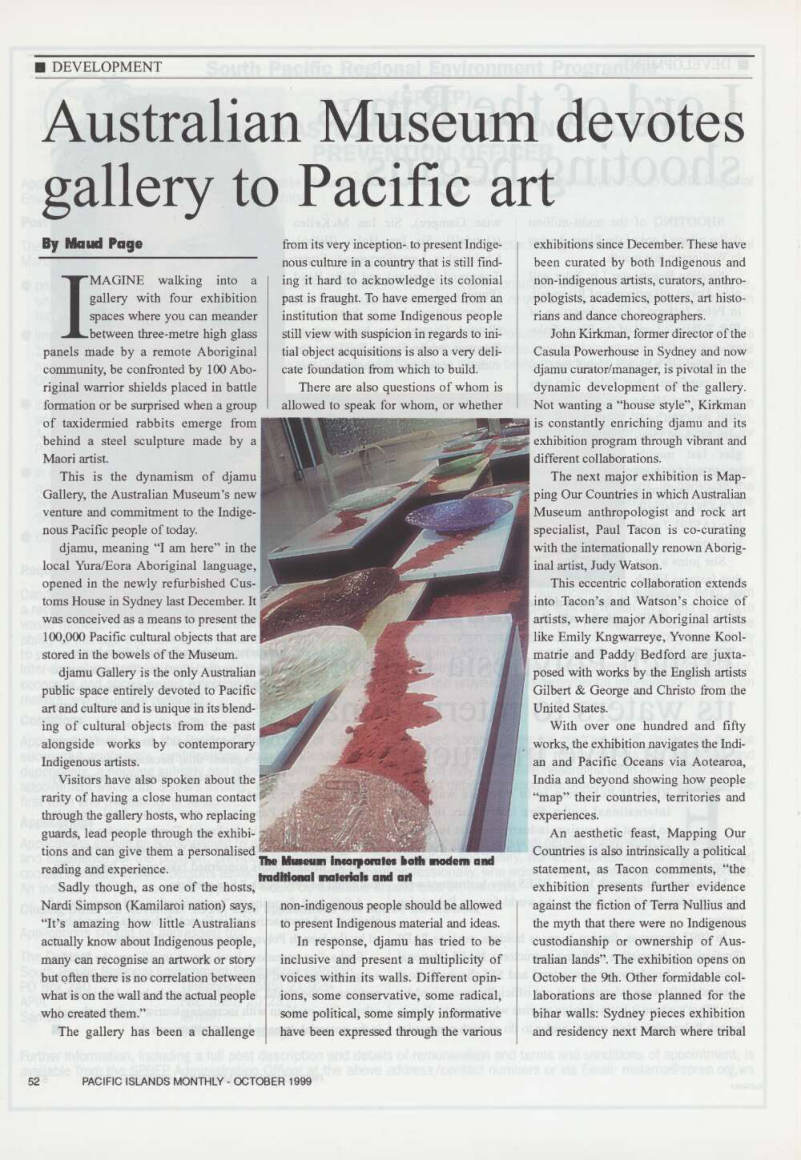
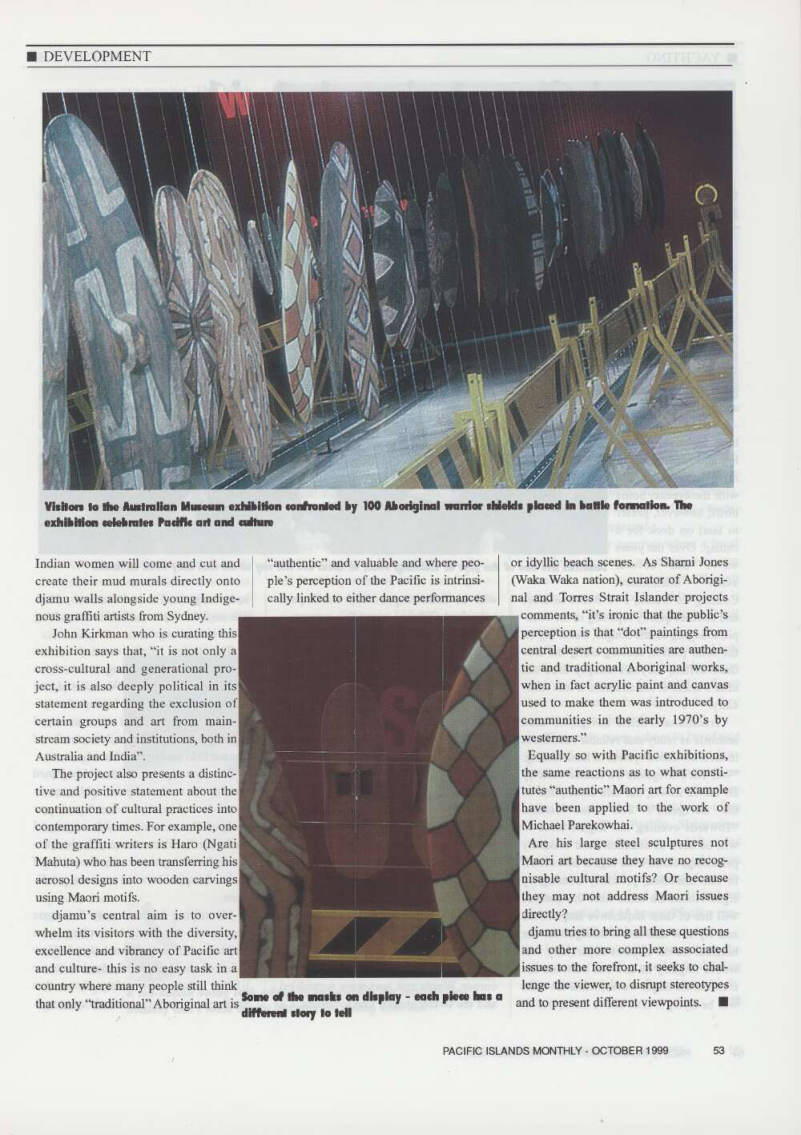
IMAGINE walking into a gallery with four exhibition spaces where you can meander between three-metre high glass panels made by a remote Aboriginal community, be confronted by 100 Abo riginal warrior shields placed in battle formation or be surprised when a group of taxidermied rabbits emerge from behind a steel sculpture made by a Maori artist.
This is the dynamism of djamu Gallery, the Australian Museum’s new venture and commitment to the Indige nous Pacific people of today. djamu, meaning “I am here” in the local Yura/Eora Aboriginal language, opened in the newly refurbished Cus toms House in Sydney last December. It was conceived as a means to present the 100,000 Pacific cultural objects that are stored in the bowels of the Museum. djamu Gallery is the only Australian public space entirely devoted to Pacific art and culture and is unique in its blend ing of cultural objects from the past alongside works by contemporary Indigenous artists.
Visitors have also spoken about the rarity of having a close human contact through the gallery hosts, who replacing guards, lead people through the exhibi tions and can give them a personalised reading and experience.
Sadly though, as one of the hosts, Nardi Simpson (Kamilaroi nation) says, “It’s amazing how little Australians actually know about Indigenous people, many can recognise an artwork or story but often there is no correlation between what is on the wall and the actual people who created them.”
The gallery has been a challenge
from its very inception- to present Indige nous culture in a country that is still find ing it hard to acknowledge its colonial past is fraught. To have emerged from an institution that some Indigenous people still view with suspicion in regards to ini tial object acquisitions is also a very deli cate foundation from which to build.
There are also questions of whom is allowed to speak for whom, or whether
non-indigenous people should be allowed to present Indigenous material and ideas.
In response, djamu has tried to be inclusive and present a multiplicity of voices within its walls. Different opin ions, some conservative, some radical, some political, some simply informative have been expressed through the various
exhibitions since December. These have been curated by both Indigenous and non-indigenous artists, curators, anthro pologists, academics, potters, art histo rians and dance choreographers.
John Kirkman, former director of the Casula Powerhouse in Sydney and now
djamu curator/manager, is pivotal in the
dynamic development of the gallery.
Not wanting a “house style”, Kirkman ! is constantly enriching djamu and its i exhibition program through vibrant and [ different collaborations.
The next major exhibition is Map ping Our Countries in which Australian Museum anthropologist and rock art specialist, Paul Tacon is co-curating with the internationally renown Aborig inal artist, Judy Watson.
This eccentric collaboration extends into Tacon’s and Watson’s choice of artists, where major Aboriginal artists like Emily Kngwarreye, Yvonne Kool matrie and Paddy Bedford are juxta posed with works by the English artists Gilbert & George and Christo from the United States.
With over one hundred and fifty works, the exhibition navigates the Indi an and Pacific Oceans via Aotearoa, India and beyond showing how people “map” their countries, territories and
experiences.
An aesthetic feast. Mapping Our Countries is also intrinsically a political statement, as Tacon comments, “the exhibition presents further evidence against the fiction of Terra Nullius and the myth that there were no Indigenous custodianship or ownership of Aus tralian lands”. The exhibition opens on October the 9th. Other formidable col laborations are those planned for the bihar walls: Sydney pieces exhibition and residency next March where tribal
The Museum incorporates both modem and traditional materials and art
Indian women will come and cut and create their mud murals directly onto djamu walls alongside young Indige nous graffiti artists from Sydney.
John Kirkman who is curating this exhibition says that, “it is not only a cross-cultural and generational pro ject, it is also deeply political in its statement regarding the exclusion of certain groups and art from main stream society and institutions, both in Australia and India”.
The project also presents a distinc-1 tive and positive statement about the continuation of cultural practices into contemporary times. For example, one of the graffiti writers is Haro (Ngati Mahuta) who has been transferring his aerosol designs into wooden carvings using Maori motifs. djamu’s central aim is to over whelm its visitors with the diversity, excellence and vibrancy of Pacific art and culture- this is no easy task in a country where many people still think that only “traditional” Aboriginal art is '
“authentic” and valuable and where peo ple’s perception of the Pacific is intrinsi cally linked to either dance performances
or idyllic beach scenes. As Shami Jones (Waka Waka nation), curator of Aborigi nal and Torres Strait Islander projects
comments, “it’s ironic that the public’s perception is that “dot” paintings from central desert communities are authen tic and traditional Aboriginal works, when in fact acrylic paint and canvas used to make them was introduced to communities in the early 1970’s by westerners.”
Equally so with Pacific exhibitions, the same reactions as to what consti tutes “authentic” Maori art for example have been applied to the work of Michael Parekowhai.
Are his large steel sculptures not Maori art because they have no recog nisable cultural motifs? Or because they may not address Maori issues
directly?
djamu tries to bring all these questions and other more complex associated ! issues to the forefront, it seeks to chal
lenge the viewer, to disrupt stereotypes an( j to present different viewpoints. ■
Visitors to the Australian Museum exhibition confronted by 100 Aboriginal warrior shields placed in battle formation. The exhibition celebrates Pacific art and culture
Some of the masks an display - each piece has a different story to tell