Howard apologises to the stolen children
p. 57 · Read in the full issue
stolen children ... or does he?
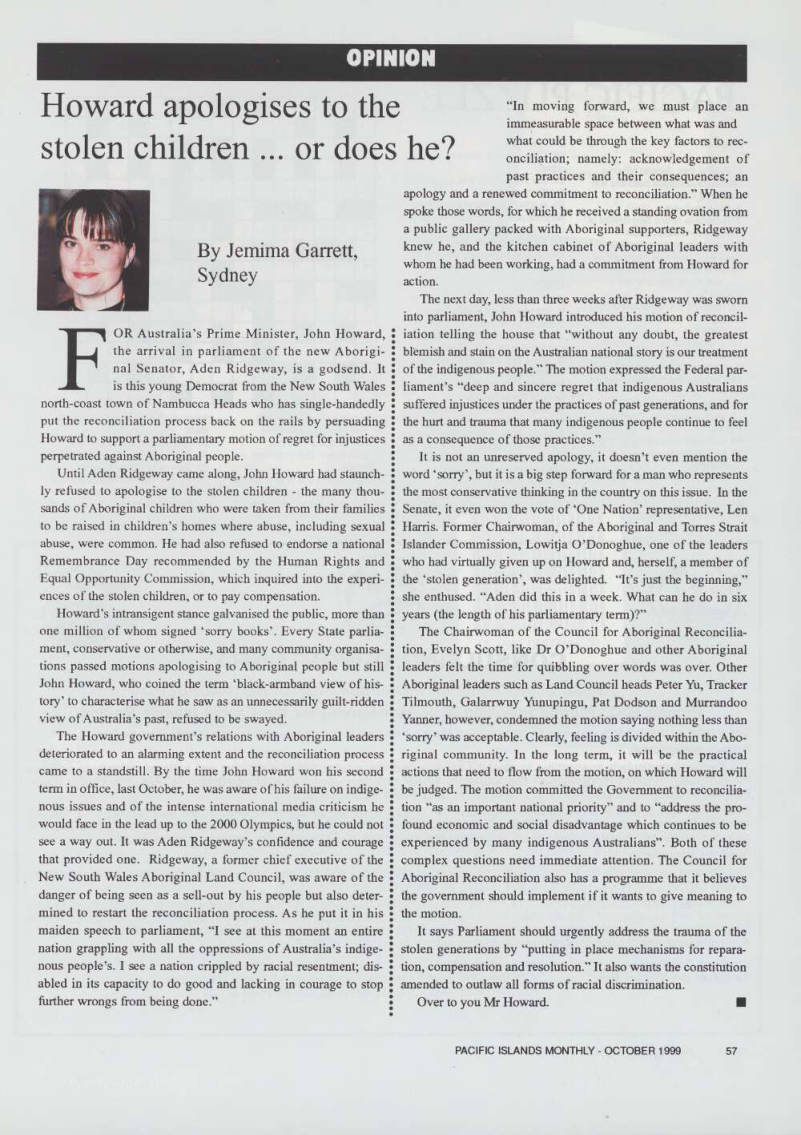
By Jemima Garrett, Sydney
FOR Australia’s Prime Minister, John Howard, the arrival in parliament of the new Aborigi nal Senator, Aden Ridgeway, is a godsend. It is this young Democrat from the New South Wales north-coast town of Nambucca Heads who has single-handedly put the reconciliation process back on the rails by persuading Howard to support a parliamentary motion of regret for injustices perpetrated against Aboriginal people.
Until Aden Ridgeway came along, John Howard had staunch ly refused to apologise to the stolen children - the many thou sands of Aboriginal children who were taken from their families to be raised in children’s homes where abuse, including sexual abuse, were common. He had also refused to endorse a national Remembrance Day recommended by the Human Rights and Equal Opportunity Commission, which inquired into the experi ences of the stolen children, or to pay compensation.
Howard’s intransigent stance galvanised the public, more than one million of whom signed ‘sorry books’. Every State parlia ment, conservative or otherwise, and many community organisa tions passed motions apologising to Aboriginal people but still John Howard, who coined the term ‘black-armband view of his tory’ to characterise what he saw as an unnecessarily guilt-ridden view of Australia’s past, refused to be swayed.
The Howard government’s relations with Aboriginal leaders deteriorated to an alarming extent and the reconciliation process came to a standstill. By the time John Howard won his second term in office, last October, he was aware of his failure on indige nous issues and of the intense international media criticism he would face in the lead up to the 2000 Olympics, but he could not see a way out. It was Aden Ridgeway’s confidence and courage that provided one. Ridgeway, a former chief executive of the New South Wales Aboriginal Land Council, was aware of the danger of being seen as a sell-out by his people but also deter mined to restart the reconciliation process. As he put it in his maiden speech to parliament, “I see at this moment an entire nation grappling with all the oppressions of Australia’s indige nous people’s. I see a nation crippled by racial resentment; dis abled in its capacity to do good and lacking in courage to stop further wrongs from being done.”
“In moving forward, we must place an immeasurable space between what was and what could be through the key factors to rec
onciliation; namely: acknowledgement of
past practices and their consequences; an
apology and a renewed commitment to reconciliation.” When he spoke those words, for which he received a standing ovation from a public gallery packed with Aboriginal supporters, Ridgeway knew he, and the kitchen cabinet of Aboriginal leaders with whom he had been working, had a commitment from Howard for action.
The next day, less than three weeks after Ridgeway was sworn into parliament, John Howard introduced his motion of reconcil iation telling the house that “without any doubt, the greatest blemish and stain on the Australian national story is our treatment of the indigenous people.” The motion expressed the Federal par liament’s “deep and sincere regret that indigenous Australians suffered injustices under the practices of past generations, and for the hurt and trauma that many indigenous people continue to feel as a consequence of those practices.”
It is not an unreserved apology, it doesn’t even mention the word ‘sorry’, but it is a big step forward for a man who represents the most conservative thinking in the country on this issue. In the Senate, it even won the vote of ‘One Nation’ representative, Len Harris. Former Chairwoman, of the Aboriginal and Torres Strait Islander Commission, Lowitja O’Donoghue, one of the leaders who had virtually given up on Howard and, herself, a member of the ‘stolen generation’, was delighted. “It’s just the beginning,” she enthused. “Aden did this in a week. What can he do in six years (the length of his parliamentary term)?”
The Chairwoman of the Council for Aboriginal Reconcilia tion, Evelyn Scott, like Dr O’Donoghue and other Aboriginal leaders felt the time for quibbling over words was over. Other Aboriginal leaders such as Land Council heads Peter Yu, Tracker Tilmouth, Galarrwuy Yunupingu, Pat Dodson and Murrandoo Yanner, however, condemned the motion saying nothing less than ‘sorry’ was acceptable. Clearly, feeling is divided within the Abo riginal community. In the long term, it will be the practical actions that need to flow from the motion, on which Howard will be judged. The motion committed the Government to reconcilia tion “as an important national priority” and to “address the pro found economic and social disadvantage which continues to be experienced by many indigenous Australians”. Both of these complex questions need immediate attention. The Council for Aboriginal Reconciliation also has a programme that it believes the government should implement if it wants to give meaning to the motion.
It says Parliament should urgently address the trauma of the stolen generations by “putting in place mechanisms for repara tion, compensation and resolution.” It also wants the constitution amended to outlaw all forms of racial discrimination.
Over to you Mr Howard. ■