Trade and competition policy:
pp. 32-35 · Read in the full issue

The implications of convergence on the Pacific
By John Low
THIS short article throws some light into the concepts of trade and competition poli cies that Pacific Island Countries should take note of, especially con cerning the economic reform processes they are undertaking.
Recently we have had Trade and Economic Ministers endorsing the principle of a free trade area (FTA) within the region. This makes it even more important to consider the two concepts and at some juncture such policies if pursued in isolation could create conflicting results.
Trade and competition have recent ly re-emerged with renewed signifi cance and have been included in the WTO work program after the Singa pore Ministerial Conference. It is likely to be further discussed at the forthcom ing Millennium Round.
In broad terms, competition policy is aimed at the efficient functioning of internal markets through the removal or control of anti-competitive practices.
Trade policy seeks to remove barri ers to international trade by improving market access conditions and reducing impediments, especially tariffs and non-tariff measures, for efficient trade flows. Despite a long history as an issue in international trade relations, trade and competition policy is now being identified as one of the “new issues” for consideration on the post
Uruguay Round multilateral trade agen da. Fifty or so years of cooperation on trade policy under the auspices of GATT, and now the WTO, have led to a consid erable convergence of international inter pretation and understanding of trade pol icy measures and concepts.
Some commentators treat the two concepts as the same, that trade and com petition policies to mean the same thing.
The issue of trade and competition has attracted increasing attention as tar iffs have fallen through successive rounds of multilateral trade negotiations
or through regional trading blocs, mak
ing internal barriers to market access more prominent. This has occurred at the
same time as firms increasingly seek the optimal mix of trade and investment activities relevant to their needs.
The current discussion of trade and competition therefore represents a new approach to the concept of market access by including impediments inside the market. The idea of market presence may be more useful since it can reflect better the forms in which a company or firm
may wish to be active in the domestic and international markets.
An OECD study in 1995 noted that liberalisation of trade and investment ranks highly among the driving forces of globalisation of business activities.
However, the elimination of govern ment-imposed barriers to trade and investment does not necessarily ensure open access to markets.
Business needs should be the main driving force for the consideration of trade and competition. The real ques tion for trade policy makers, therefore, is whether business will be interested in pursuing concerted government action on trade and competition as a
means of expanding its export activi ties. What is trade policy? A major characteristic of trade policy is that it deals with the treatment of foreign sup
pliers and their products through oblig
ations such as most-favoured-nation treatment, national treatment and trans parency. These are the responsibilities of governments. Trade policy also uses in defined circumstances some mecha
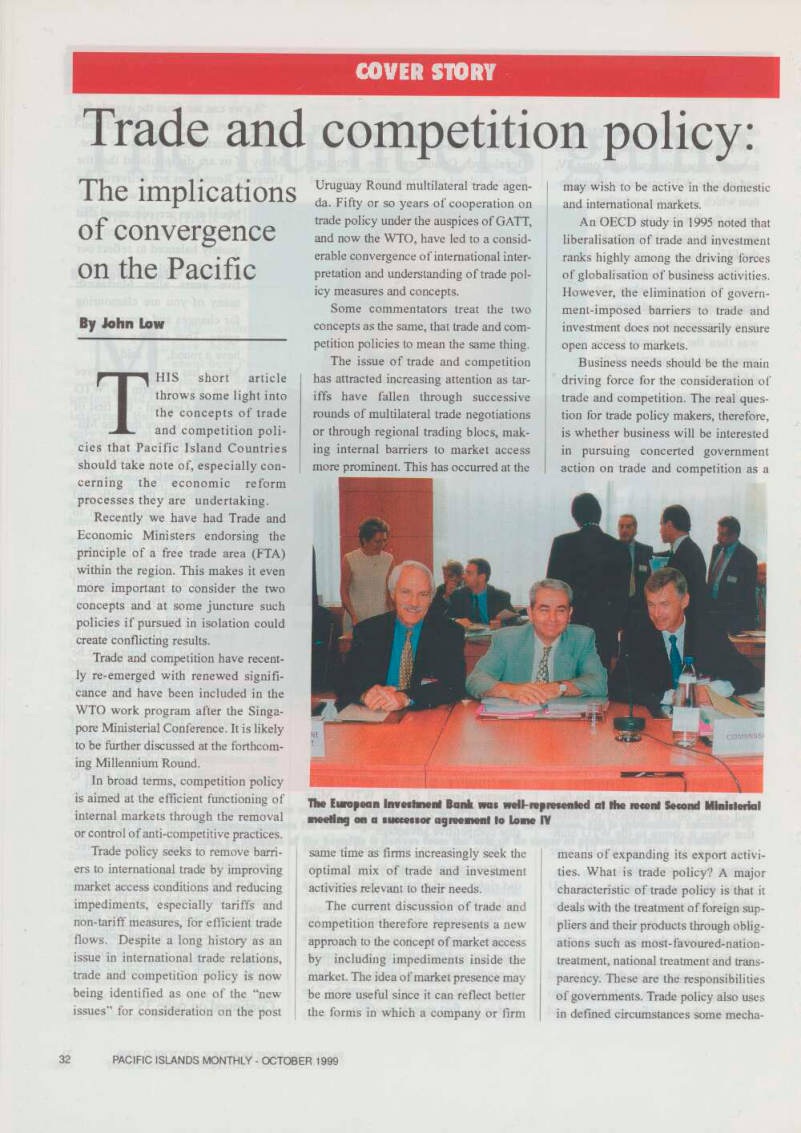
The European Investment Bank was well-represented at the recent Second Ministerial meeting on a successor agreement to Lome IV
nisms enabling it to influence the flow of imports. Prominent among these, but not necessarily the most important, are anti dumping measures, countervailing duties and safeguards measures.
Trade policy measures that may have an effect on competition policy include those relating to rules of
origin, import licensing,
the administration of import quotas, sanitary and
phyto-sanitary measures,
policies on state trading
operations and subsidies.
What is competition policy? Competition poli cy, on the other hand is concerned with the legal prohibitions on anti-com
petitive agreements,
monopolisation and anti
competitive mergers,
which is the “narrower
sense” of the term. Competition policy in the narrow sense is primarily aimed at regulating the behaviour of suppliers and acquirers of goods and services inside the market.
In summary the main activities or core elements of competition law, which is designed to rectify market failures leading to anti-competitive outcomes, are classified into four categories: - Horizontal arrangements whereby competing firms enter into collusive agreements to maintain prices, divide operating territories or refuse to deal with certain customers; - Vertical arrangements restraining competition over different stages of the
production process;
- Misuse of market power through attempts to prevent the entry of other
firms, predatory practices and price
squeezes aimed at damaging firms either already in the market or those seeking to enter it; and - Mergers and acquisitions control to ensure that competition remains a feature of the market. In the wider sense compe tition policy is concerned with the cre
ation of competition through new mech anisms, which involve the removal of
impediments, including government
imposed impediments to competition. It
may also include the introduction of ree-
ulation, such as price supervision for nat ural monopolies. However, member nations of the Organisation for Econom ic Cooperation and Development (OECD) define competition policy more narrowly as “the body of laws and regu
lations governing business practices”.
Therefore, trade and competition pol icy together in nutshell determine the nature and extent of competition in a domestic economy. Competition is an essential ingredient in the effective oper ation of a market economy.
However, trade and competition poli cy can come into conflict when either set of policies is not fully expressing competition principles. For example, trade policies create competition con cerns when they excessively restrict or distort market access. On the other hand, competition policies can constrain the benefits of trade liberalisation through restrictions on the coverage and strength of competition laws across an economy.
An example, is where domestic monopo lies impede market access by overseas firms, of which the Kodak and Fujifilm case is a good example.
The basic difference between trade and competition policy is that the for mer is concerned with international trade and its control at the border and tends to favour domestic producers
■'ho can in some cases .sk for relief from
import competition.
Competition policy
deals with regulation in economies and tends to favour domestic con sumers through ensur
ing suppliers do not
adopt anti-competitive
practices in the national market and that national markets remain con testable. Trade policy is the business of govern ments, but actual trade is carried out between
firms. Competition poli
cy, on the other hand, is
enforced and promoted through national laws enforced by the court system in a way that affects firms
directly.
The pressing issue for trade and competition can be summarised as “the existing range of trade policy instru ments and rules appears ill-equipped to address adequately the new dimen sions of market access and presence.”
Therefore, to avoid the distorting effects on trade and investment of undue recourse to inappropriate policy
instruments and approaches, policy
makers need to take a more integrated and comprehensive approach in trying to adapt existing rules and in devising appropriate new ones. The importance of trade and competition can be attrib uted to the process of globalisation, contestability of markets, intellectual property, and extra-territoriality.
The impact of globalisation is one of the main reasons for the importance of trade and competition policy. Trade and competition as an issue is impor-
Continued overleaf
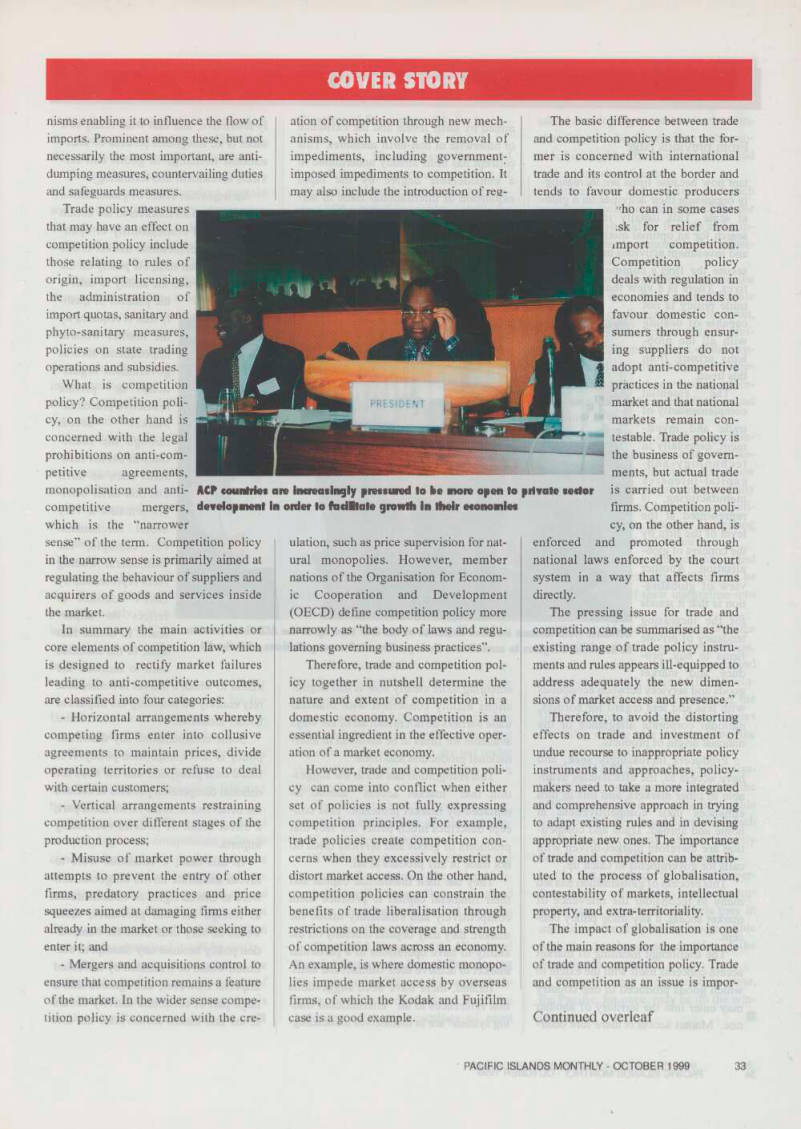
ACP countries are increasingly pressured lo be more open la private sector development in order lo faciliate growth in their economies
From previous page tant now because firms are increasing ly organising their activities on a glob al scale. This usually involves the search for an optimal mixture of trade and investment activities most likely to secure the firm’s commercial objec tives. There is a view that traditional trade policy is not
capable of dealing with all the prob lems arising from this trend.
The essential complementarity of trade and invest ment, especially in
technology-and
capital-intensive manufacturing, is represented at the level of the firm by the concept of glob alisation. Another view of globalisa tion is that it stands for the increasing tendency of private firms to buy, pro duce and market
goods and services between economies with less and less regard for borders, national corporate allegiance or the national origin of products.
Producers increasingly seek, and have access to, the efficiencies avail able in other markets, and this in turn enhances their competitiveness at home and abroad. Trade and competi tion are therefore market-driven with calls for governments to catch up.
This process of globalisation has led many to reconsider the relevance of market access, a key trade policy con cept.
The traditional meaning of market access concerns itself with the extent to which goods produced in one country may enter into the territory of another one. Market access is there fore deter
mined by tariff levels and the existence or otherwise of non-tariff measures. This concept has been already undermined to a considerable degree by the rapid expansion of international trade in ser vices because many services can only be delivered through a commercial presence in the foreign market. Trade in goods also often requires a form of commercial presence in the importing market. A view
emerging more clearly now is that negoti ations mainly concerned with bilateral trade barriers do not reflect all of the ways available for firms to be involved in inter national production and trade.
This recognition has led to the sugges tion that “market access” should be replaced by market presence. This con cept describes much better the fact that producers of goods and services often do not trade in any product at all.
They use their intellectual capital and their financial capital to produce them competitively and efficiently inside the market: they may depend crucially on the ability to have operations in a particular market to achieve their commercial aims.
Indeed, there have been suggestions that references to an “international trad ing system” are in themselves misleading
ly restrictive, and that what really is a stake is an integrated process of inter national exchange in goods and ser vices, investment and technology.
An important effect of globalisation is that its exposes markets to the notion or concept of contestability or open ness. A fully contestable market is one which firms can compete purely on the basis of price and the ability to deliver
the product of quali ty that is required by the market without impediments such as government regula tions or private restrictive practices.
Market access through the reduc tions in border mea sures such as tariff and non-tariff barri ers remains a very useful mechanism.
For example, the
multilateral trading
rules represented by GATT continue to reflect its impor tance. In actual fact some of the methods used to indicate the
extent to which a market is contestable rely entirely on assessing the impact of border measures.
Some commentators say that trade policy is now competition policy. It is based on a perception that the need for national competition policies to control the behaviour of firms is, for most part, a direct result of policies restricting
imports.
In this case, if countries were to favour moderate tariffs on goods and were to extend rights of establishment to foreign services providers, there would be very little need for competi tion policy because any attempt at col lusion would be frustrated by increased imports. However, this ignores that a large part of economic activity occurs in the non-traded sector. Also the fact
Officials from African member countries of the ACP turn up at the ACP Headquarters in Brussels. Belgium to consolidate their position before negotiations with the EU
is that fewer countries have undertaken the necessary complementary liberalisa tion within their domestic economies.
The reality is that many international ly traded goods and services contain some intellectual property component.
Therefore, agreements to license patents and intellectual property pose some spe cial challenges for competition policy.
This is the case when they give license holders access to specified terri tories only, or if they are confined to par ticular products.
Several commentators have observed that in the absence of laws to protect intellectual property, such agreements might well be found illegal by competi tion authorities.
Extra-territoriality is an issue of gen eral concern in international trade and investment, in particular in the applica tion of domestic competition laws, as well as some other laws by the United States.
Such measures can have a consider able effect on the ability of others to compete in third markets. For example, the United Helms-Burton legislation passed recently, which is aimed at restor ing democracy in Cuba, effectively pre vents third country firms from investing in Cuba.
This is so because they can be liable to punitive damages awarded by the United States courts to the previous own ers of property located in Cuba.
However, there is a view that some degree of extra-territoriality in the administration of competition law may be inevitable.
Some claim that the state is justified in applying such competition rules to conduct abroad that is detrimental to its economy or to control transnational cor porations that might otherwise be able to escape the reach of the law. If you accept this argument than the real problem would be its abuse and it will be costly. * The views expressed are that of the author, John Low, and not necessarily of the Forum Secretariat where he is employed as Resources Advisor. ■