new Hollywood
pp. 36-38 · Read in the full issue
Industry
Hawaii - the new Hollywood
LA expects to lose $2O billion as more movies are shot offshore
By Ed Rampell
AN unlikely location, usually regarded as a tourist destination but not as a movie
Mecca, is chal lenging a Los Angeles entertain ment-industrial complex that
already feels
threatened by run away productions.
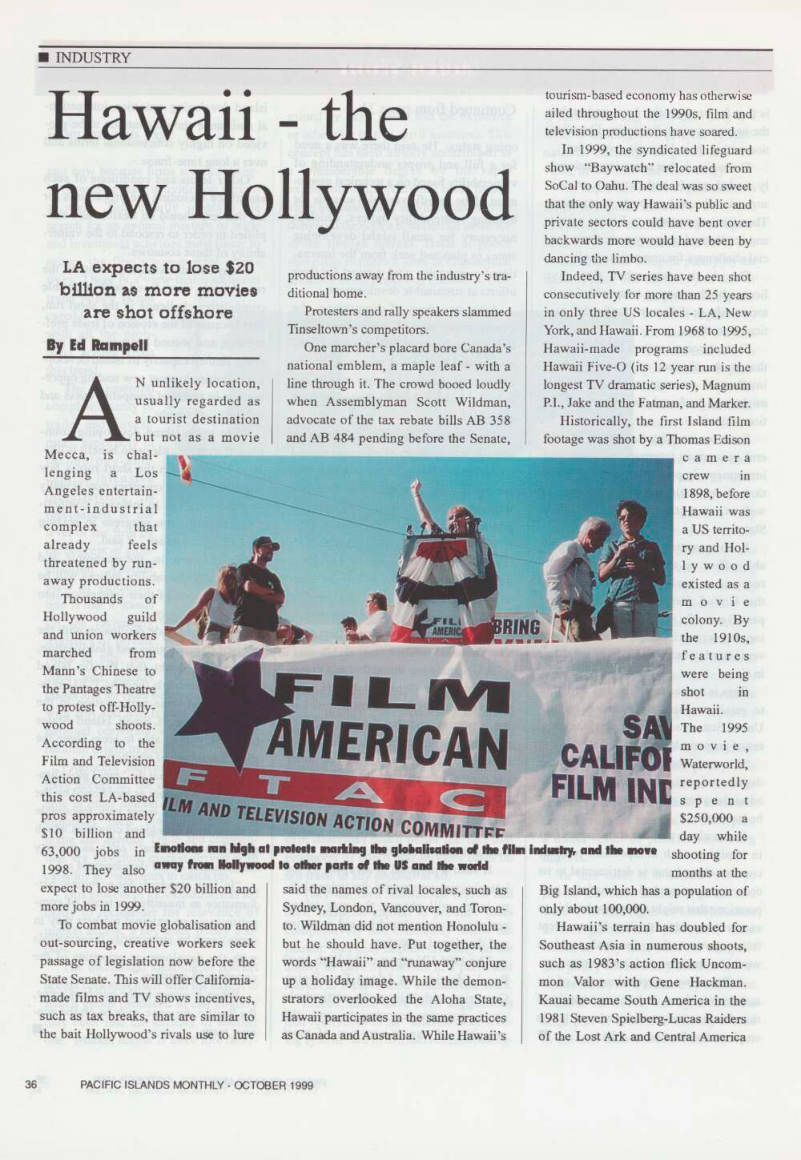
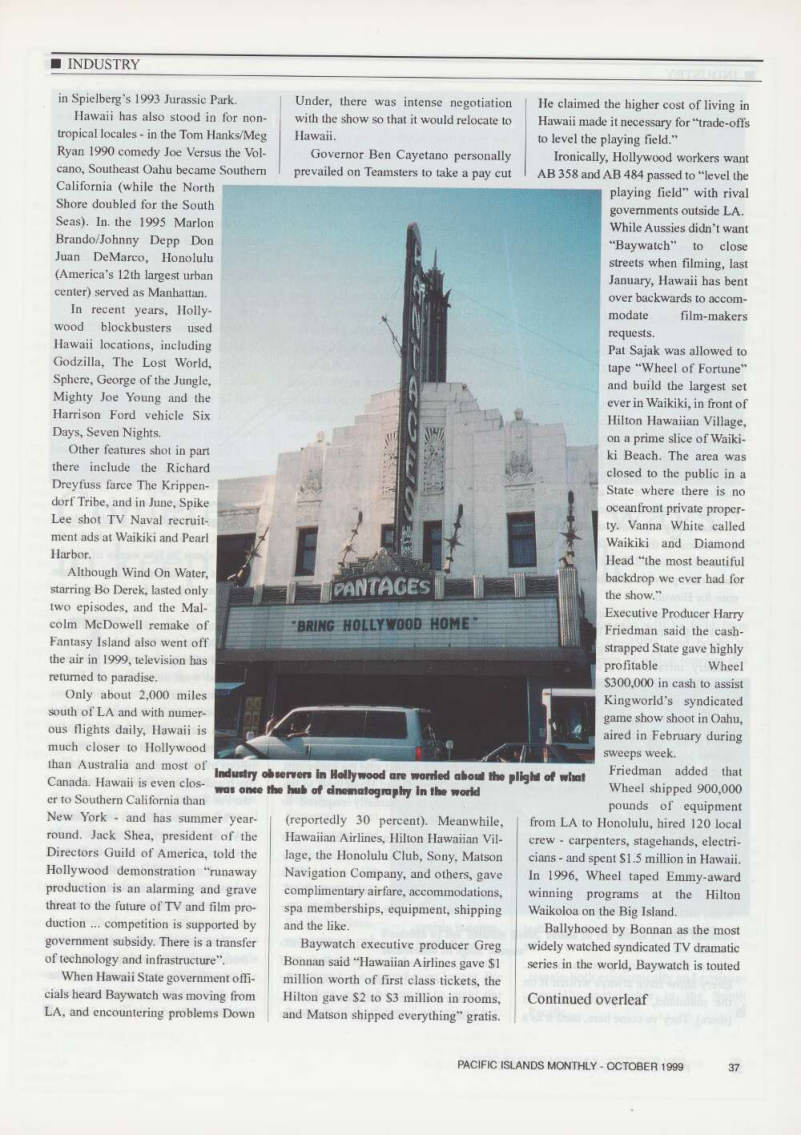
Thousands of Hollywood guild and union workers marched from Mann’s Chinese to the Pantages Theatre to protest off-Holly wood shoots.
According to the Film and Television Action Committee this cost LA-based pros approximately $lO billion and
63,000 jobs in 1998. They also
expect to lose another $2O billion and more jobs in 1999.
To combat movie globalisation and out-sourcing, creative workers seek passage of legislation now before the State Senate. This will offer California made films and TV shows incentives, such as tax breaks, that are similar to the bait Hollywood’s rivals use to lure
productions away from the industry’s tra ditional home.
Protesters and rally speakers slammed
Tinseltown’s competitors.
One marcher’s placard bore Canada’s national emblem, a maple leaf - with a line through it. The crowd booed loudly when Assemblyman Scott Wildman, advocate of the tax rebate bills AB 358 and AB 484 pending before the Senate,
said the names of rival locales, such as Sydney, London, Vancouver, and Toron to. Wildman did not mention Honolulu but he should have. Put together, the words “Hawaii” and “runaway” conjure up a holiday image. While the demon strators overlooked the Aloha State, Hawaii participates in the same practices as Canada and Australia. While Hawaii’s
tourism-based economy has otherwise ailed throughout the 19905, film and television productions have soared.
In 1999, the syndicated lifeguard show “Baywatch” relocated from SoCal to Oahu. The deal was so sweet that the only way Hawaii’s public and private sectors could have bent over backwards more would have been by dancing the limbo.
Indeed, TV series have been shot consecutively for more than 25 years in only three US locales - LA, New York, and Hawaii. From 1968 to 1995, Hawaii-made programs included Hawaii Five-O (its 12 year run is the longest TV dramatic series), Magnum PL, Jake and the Fatman, and Marker.
Historically, the first Island film footage was shot by a Thomas Edison
camera crew in 1898, before Hawaii was a US territo ry and Hol -Iyw o o d existed as a movie colony. By the 1910 s, features were being shot in Hawaii.
The 1995 movie, Waterworld, reportedly spent $250,000 a day while
shooting for months at the
Big Island, which has a population of only about 100,000.
Hawaii’s terrain has doubled for Southeast Asia in numerous shoots, such as 1983’s action flick Uncom mon Valor with Gene Hackman.
Kauai became South America in the 1981 Steven Spielberg-Lucas Raiders of the Lost Ark and Central America
Emotions ran high at protests marking the globalisation of the film industry, and the move away from Hollywood to other parts of the US and the world
in Spielberg’s 1993 Jurassic Park.
Hawaii has also stood in for non tropical locales - in the Tom Hanks/Meg Ryan 1990 comedy Joe Versus the Vol cano, Southeast Oahu became Southern
California (while the North Shore doubled for the South Seas). In. the 1995 Marlon
Brando/Johnny Depp Don
Juan DeMarco, Honolulu (America’s 12th latest urban center) served as Manhattan.
In recent years, Holly wood blockbusters used Hawaii locations, including Godzilla, The Lost World, Sphere, George of the Jungle, Mighty Joe Young and the Harrison Ford vehicle Six Days, Seven Nights.
Other features shot in part there include the Richard Drey fuss farce The Krippen dorf Tribe, and in June, Spike Lee shot TV Naval recruit ment ads at Waikiki and Pearl Harbor.
Although Wind On Water, starring Bo Derek, lasted only two episodes, and the Mal colm McDowell remake of Fantasy Island also went off the air in 1999, television has returned to paradise.
Only about 2,000 miles south of LA and with numer ous flights daily, Hawaii is much closer to Hollywood than Australia and most of Canada. Hawaii is even clos er to Southern California than
New York - and has summer year round. Jack Shea, president of the Directors Guild of America, told the Hollywood demonstration “runaway production is an alarming and grave threat to the future of TV and film pro duction ... competition is supported by government subsidy. There is a transfer of technology and infrastructure”.
When Hawaii State government offi cials heard Baywatch was moving from LA, and encountering problems Down
Under, there was intense negotiation with the show so that it would relocate to Hawaii.
Governor Ben Cayetano personally
prevailed on Teamsters to take a pay cut
(reportedly 30 percent). Meanwhile, Hawaiian Airlines, Hilton Hawaiian Vil lage, the Honolulu Club, Sony, Matson Navigation Company, and others, gave complimentary airfare, accommodations, spa memberships, equipment, shipping and the like.
Baywatch executive producer Greg Bonnan said “Hawaiian Airlines gave $1 million worth of first class tickets, the Hilton gave $2 to $3 million in rooms, and Matson shipped everything” gratis.
He claimed the higher cost of living in Hawaii made it necessary for “trade-offs to level the playing field.”
Ironically, Hollywood workers want AB 358 and AB 484 passed to “level the
playing field” with rival governments outside LA.
While Aussies didn’t want “Baywatch” to close streets when filming, last January, Hawaii has bent over backwards to accom modate film-makers requests.
Pat Sajak was allowed to tape “Wheel of Fortune” and build the largest set ever in Waikiki, in front of Hilton Hawaiian Village, on a prime slice of Waiki ki Beach. The area was closed to the public in a State where there is no oceanfront private proper ty. Vanna White called Waikiki and Diamond Head “the most beautiful backdrop we ever had for the show.”
Executive Producer Harry Friedman said the cash strapped State gave highly profitable Wheel $300,000 in cash to assist Kingworld’s syndicated game show shoot in Oahu, aired in February during sweeps week.
Friedman added that Wheel shipped 900,000 pounds of equipment
from LA to Honolulu, hired 120 local crew - carpenters, stagehands, electri cians - and spent $1.5 million in Hawaii.
In 1996, Wheel taped Emmy-award winning programs at the Hilton Waikoloa on the Big Island.
Ballyhooed by Bonnan as the most widely watched syndicated TV dramatic series in the world, Baywatch is touted
Continued overleaf
Industry observers in Hollywood are wonted about the plight of what was once the hub of cinematography in the world
From previous page as a major boost to Hawaii’s top indus try, tourism. The service providers that cooperate with Baywatch Hawaii expect to benefit through screen credit, mentions, and product placement which Bonnan said he pioneered on TV.
One hundred million viewers in 148 countries and 40 languages watch the providers’ products on the program twice a week, for a run expected to last years.
Honolulu producer and tourism offi cial April Masini claimed 9.25 million Americans watch Baywatch on the USA network. Masini, an avid booster of Island-based productions, said each Baywatch episode is equal to 10 min utes of advertising for Hawaii. It is worth the advertising equivalent of $29 million a week for a State where the number of visitors declined.
According to Bonnan, the latest incarnation of the show featuring biki nis and barechested hunks will do much more than provide international expo sure for Hawaii.
What is more important, he says, is Baywatch Hawaii will build a com plete, one stop, A through Z film/TV industry infrastructure in the Aloha State. Diamond Head Studios was built when Hawaii Five-O was shot in Hawaii. Bonnan said as part of its deal with Baywatch Hawaii, the State agreed to make “the best underwater tank ever used for motion picture or television production”- with local labour.
The tank will be left in the maritime State after the lifeguard drama eventu ally leaves Hawaii, and the producer added Baywatch Hawaii will expand Diamond Head Studios with other addi tions, such as new editing facilities.
Bonnan went on to declare that “we’re the first show ever to do the whole film-making process here ...
Every show have always written it on the mainland, and post-produced it [there]. They’ve come here, used it as a
backlot: ‘gee, it’s a pretty palm tree, but we don’t need your people, your talent, we don’t need anything, we don’t even need your money, and we don’t care what money we put into the industry.
We’ll come here, shoot it, see ya. We’ll go home and do the important stuff there on the mainland where people know what they’re doing.’ I found that insult ing.”
Bonnan said “everybody thought before that they had to come over here and bring everybody: makeup, hair, wardrobe, directors, writers, producers, editors, prop men, grips, electricians ...
Well, that’s a joke. The talent is here.
Nobody just took the time to go out and find it and train it.” Bonnan maintained using much local talent, from Hawaiian actors Kala’i Miller, Jason Mamoa, and Stacey Kamano to assistant editors, is a
Bay watch Hawaii’s biggest contribution to the 50th State’s economy - and its biggest threat to LA craft guilds and unions - could be a totally self-suffi cient Hawaii-based film/TV industry
raison d’etre of Baywatch Hawaii. He is only bringing eight crew members to Hawaii from LA, and said the entire cast and crew, from David Hasselhoff to the writers, are contractually required to relocate to Hawaii.
But Baywatch Hawaii, which began shooting July 8 in Kauai, is not the only television show to shoot in the 50th State. Two episodes of cable TV’s Pacif ic Blue were recently made in Oahu, for summer airings.
Pacific Blue pumped $1.5 million into Hawaii, and producers reportedly said if all goes well with these shows, Pacific Blue may relocate to the Islands. Masini, who helped land the Baywatch, Pacific
Blue, Wheel of Fortune, and Miss Uni verse productions for Hawaii, said a TV talent contest type show, Destina tion Stardom, is being based there, too.
Even independent film-makers are finding Hawaii a haven.
David Cunningham grew up on the Big Island, where he shot Beyond Par adise, the first feature shot on the Big Isle since Waterworld, and which, the director said, “had less than a week’s total budget” of the Kevin Costner
epic.
His LA-based company, Pray For Rain Pictures, is set to shoot its next feature - a $lO-$ 15 million W.W.11 drama set in Southeast Asia - on loca tion in Kauai. It is the site of many W.W.11 pictures, such as Frank Sina tra’s 1965 None But the Brave.
Cunningham said, “independent
filmmakers bring less money, but they spread it out evenly [while] big pic tures give money to a few.”
He added that with studio block busters, such as Jurassic Park, the majors shoot “a few weeks of second unit, get the background, and are gone.
I’m planning to be in Kauai for months.”
Cunningham said that in Hawaii, he held “seminars on how to launch a pro ject and editing, and trained local peo ple, who went on to work for Disney and commercials”.
Hawaii born and raised Edgy Lee made a career for herself in LA. But she returned home in the mid-1990s to
shoot award winning documentaries,
such as Paniolo O Hawaii, Cowboys of the Far West.
“Many of us [Hawaii transplants to LA’s film industry] thought we could n’t move back here - boy, is that not true ... I’m very glad to relocate where I grew up. Everyone assumes that you can’t do it here, but there’s 10 times the enthusiasm.”
The cooperation Baywatch receives
from the public and private sector
means “they’re showing other produc
ers they can do business in Hawaii,”
Bonnan stressed. ■