The numbers game
pp. 30-35 · Read in the full issue
Cover Story
Time for small islands to level the playing field
By Sophie Foster Hildebrand
MANY comments
have been made about how Pacific Islanders are the
perfect build for ath leticism. But it is only now that island countries are begin ning to realise just what competitive advantages they have when it comes an age-old political and economic sport - I the numbers game.
FOR too long, island nations have been left feeling sorry j for themselves, I because of factors such as their isolation, geog- raphy, lack of econom- ! ic diversity, and brain drain which make them vulnerable to
change.
But change is com ing, and at a rate which is leaving many officials breathless from the round of
negotiations, counter-negotiations and summits which they must attend to stay on the ball.
There are two levels of negotiations - one for the successor agreement to the Lome IV Convention, and the other is the next round of talks of the World Trade Organisation (WTO) - dubbed the Millennium Round.
In four months’ time, the Lome IV Convention between the European Union and countries of the African, Caribbean and Pacific (ACP) grouping will expire.
This will affect the eight Pacific Island countries that benefit under Lome IV - Fiji, Solomon Islands, Vanuatu,
Papua New Guinea, Tonga, Samoa, Tuvalu and Kiribati. But other Pacific Island countries which are not party to the agreement wish to join in future.
Last month, the Cook Islands made an application to Brussels to become party to the successor to the Lome Convention.
Although a previous application by
the Cooks to become party to the Con
vention was unsuccessful because it was not deemed to be an independent state, it seems likely that their recent application will be favourably consid ered this time around.
Earlier this year, the ACP allowed the Cooks observer status in their sum mit.
The ACP countries, naturally, would like to keep the preferences that
they receive under Lome IV, but the EU is being increasingly pressured, from both inside and out, to make changes that would see the erosion of the special treatment that the ACP receives from them.
Ironically, the second round of talks that the Pacific is interested in the Millennium Round - will affect the
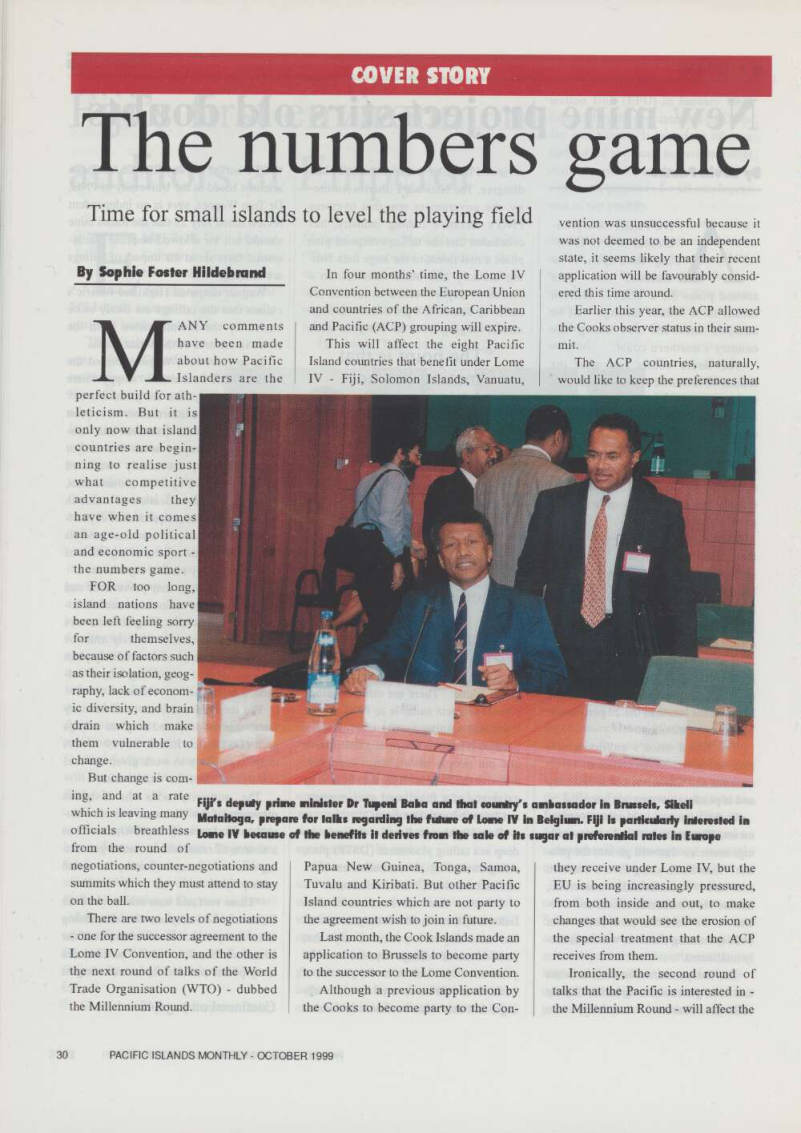
Fiji's deputy prime minister Dr Tupeni Baba and that country's ambassador in Brussels, Sikeli Matailoga, prepare for talks regarding the future of Lome IV in Belgium. Fiji is particularly interested in Lome IV because of the benefits it derives from the sale of its sugar at preferential rales in Europe
outcome of the first. It is the expiry of a WTO waiver in February which is forcing re-negotiations on Lome IV, and it is the WTO stance on liberalisa
tion which is affecting whether or not the Pacific gets to keep its competitive advantage in the EU.
The Lome Convention began 24 years ago, when the agreement was signed between nine member states of what was then the European Com munity and 46 countries of the ACP area.
Today, Lome IV is a coop eration agreement tying together 15 member states of the European Union and 70 ACP countries, representing about 500 million people.
Of the global volume of aid
received by developing coun
tries, half is provided by Euro pean citizens, of which 15 per cent is administered by the European Commission. Fifty per cent of this Community aid is distributed to the ACP coun tries. One competitive advan tage which island nations are being to plug now is their sheer
numbers. At the Second Ministerial Negotiations on a post Lome Agree ment recently, the ACP countries emphasised that the WTO is not a force unto itself - it is designed to serve the interests of its members.
The ACP officials stressed this fact, and called on EU support to ensure that when it comes to the WTO num bers game, the ACP and the EU were batting for the same team.
At the same meeting, the EU pledged its support for the ACP initia tive, and the time looks right for small islands to level the liberalisation play
ing field.
The EU agrees that the next round of WTO negotiations needs to take into account the specific economic and
social constraints of the developing countries, and in particular, the Least Developed Countries. The Uruguay Round, island countries argue, was not
representative of all economic situations, focussing instead on that of developed countries.
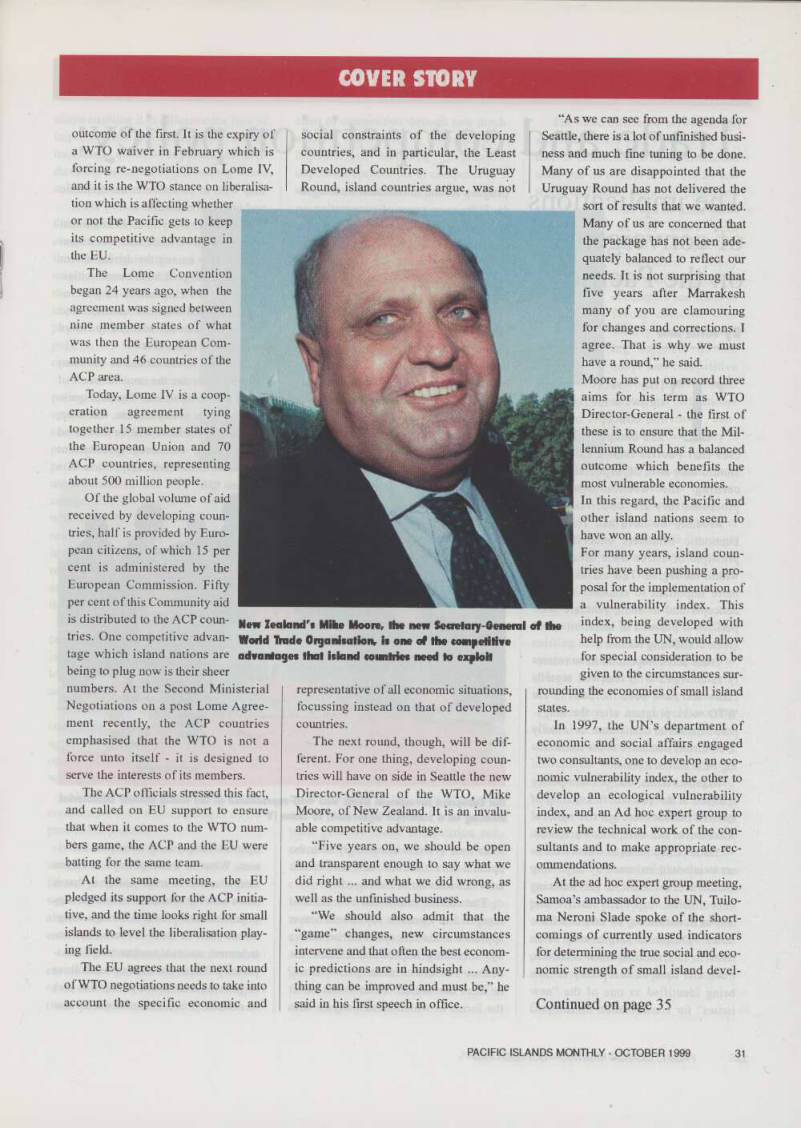
The next round, though, will be dif ferent. For one thing, developing coun tries will have on side in Seattle the new Director-General of the WTO, Mike Moore, of New Zealand. It is an invalu able competitive advantage.
“Five years on, we should be open and transparent enough to say what we did right ... and what we did wrong, as well as the unfinished business.
“We should also admit that the “game” changes, new circumstances intervene and that often the best econom ic predictions are in hindsight ... Any thing can be improved and must be,” he said in his first speech in office.
“As we can see from the agenda for Seattle, there is a lot of unfinished busi ness and much fine tuning to be done.
Many of us are disappointed that the Uruguay Round has not delivered the
sort of results that we wanted.
Many of us are concerned that the package has not been ade quately balanced to reflect our needs. It is not surprising that five years after Marrakesh many of you are clamouring for changes and corrections. I agree. That is why we must have a round,” he said.
Moore has put on record three aims for his term as WTO Director-General - the first of these is to ensure that the Mil lennium Round has a balanced outcome which benefits the most vulnerable economies.
In this regard, the Pacific and other island nations seem to have won an ally.
For many years, island coun tries have been pushing a pro posal for the implementation of a vulnerability index. This index, being developed with help from the UN, would allow for special consideration to be given to the circumstances sur
rounding the economies of small island states.
In 1997, the UN's department of economic and social affairs engaged two consultants, one to develop an eco nomic vulnerability index, the other to
develop an ecological vulnerability
index, and an Ad hoc expert group to review the technical work of the con sultants and to make appropriate rec ommendations.
At the ad hoc expert group meeting, Samoa’s ambassador to the UN, Tuilo ma Neroni Slade spoke of the short comings of currently used indicators for determining the true social and eco nomic strength of small island devel-
Continued on page 35
New Zealand's Mike Moore, the new Secretary-General of the World Trade Organisation is one of the competitive advantages that island countries need to exploit
Continued from page 31
oping states. He said there was a need for a full and proper understanding of vulnerability based on a technical assess ment of the specific variables suitable for building vulnerability indices, which is necessary for small island developing states to plan and seek from the interna tional community vital support for their efforts at sustainable development.
After two days of discussions, the expert group agreed that vulnerability indices are meant to reflect relative eco nomic and ecological susceptibility to exogenous shocks, in other words, the risk of a country being affected by such shocks.
The vulnerability index is designed to identify which group of countries exceed a threshold of vulnerability at which they are particularly susceptible to risks and warrant special attention from agencies
providing assistance.
At the same time the index and its components are intended to provide a multi-dimensional approach to the iden tification of programmes designed to reduce individual countries’ exposure to exogenous factors that may affect their
development.
A UN study has found that as a group, small island developing states are more vulnerable than other groups of develop ing countries, and that the vulnerability referred to is structural vulnerability that depends on factors which are not under the control of national authorities when the shocks occur.
The indicators should reflect expo sure to shocks, that is to say, their magni tude and their probability, If such a proposal is accepted by the international community, the vulnerabili ty index will change the way island nations are considered by aid agencies and developed countries.
The 1996 UN report of the High-level Panel Meeting on Island Developing Countries said: “Given the particularly acute resource constraints and the volatility of export earnings of most
island developing countries, internation al assistance should continue to be pro vided on highly concessional terms and over a long time-frame.
Other terms and conditions of such assistance including the procedures for aid delivery should be flexible and sim plified in order to respond to the vulner ability of these countries.”
Many island developing countries, the report said, were faced with a double competitive challenge in the short run, first because of the erosion of trade pref erences, and second because of the gen
erally limited capacity of island develop
ing countries to meet new trading oppor tunities in terms of competitiveness and
reliability of supply.
“For some island developing coun tries, therefore, little or no benefit is like ly to be gained in the short run; a few island developing countries may actually be net losers due to losses in competi tiveness and slow progress in seizing
trading opportunities,” it said.
For this reason, the economic and ecological vulnerability indices will be the cornerstone of their integration into the world economy.
With world-wide disillusion with the pace of liberalisation and globalisation, there is no doubt that Pacific Island countries, through their ACP-EU rela tionship and their participation in the UN’s Alliance of Small Island States (AOSIS), will be able to press home the sheer advantage of numbers.
The EU says that the “rapid globalisa tion of the economy as sanctioned by the GATT agreement is not very favourable to those least developed countries which the Maastricht Treaty cites as priority beneficiaries of EU development aid.
“In fact, standards for economic per formance as measured in terms of com petitiveness on external markets may in some cases be temporarily incompatible with the development priorities of the countries in question.”
When it comes to the numbers game, the Pacific, for once, may be on the win ning team. ■