'greater than
p. 18 · Read in the full issue
Ok Tedi damage 'greater than forecast'
OK Tedi Mining Limited (OTML) has admitted that discharge from waste
dumps at the Ok Tedi copper mine in Western province had caused excessive flooding in a major river system, killing fish and vegetation.
OTML, majority owned by BHP, released reports in Papua New Guinea (PNG) mid-August verify ing earlier studies that the environ mental effects of the mine on areas around the Ok Tedi and Fly Rivers would be greater and more damag ing than anticipated.
OTML managing director Dr Roger Higgins said greater environ mental damage could leave the company open to claims by local landowners for higher compensa tion than is currently paid by
Otml.
“The environmental effects gen erally arise from the fact that by dis charging tailings which is eroded from our waste dumps into the river, we add to the already significant sediment flow of that river, exceed ing its capacity to transport sedi ment,” Dr Higgins said.
“Sediment fills up the bottom part of the channel, causing the river to flood over its banks more fre quently than it otherwise would.”
Dr Higgins said the increased flooding affected the capacity of vegetation sur rounding the rivers to cope with “getting its feet wet,” which led to defoliation, the death
of some trees, and a change in the type of vegetation near the river system.
Flooding along the river was a regular occurrence but the dumping of mine waste had increased the frequency of flooding in parts of the river from one quarter of each year to half of each year.
The flooding currently affected 400 to 500 square kilometres in the lower Ok Tedi and middle Fly Rivers.
It was projected that as the mine con tinued to operate until its anticipated clo sure date in 2010, up to 1,350 square kilo metres could eventually be affected.
Local areas would continue to be dam aged beyond the mine’s closure because contaminated sediment would still be moved through the river system.
Dr Higgins said the environmental damage had so far affected about 4,000 people in the lower Ok Tedi and middle Fly but that could eventually climb to
8,000 or 9,000.
The increased sediment in the rivers had smothered marine habitats and led to a “significant reduction in fish numbers.”
“It may get somewhat worse,” Dr
Higgins said.
But he said there were still more fish than required by the local people for subsistence purposes, and testing had shown that fish were still fit for con
sumption.
Dr Higgins said none of the options considered by Ok Tedi to halt the
pollution - including a tailings dam,
and dredging the lower Ok Tedi would have the desired environmen tal affect or were too risky.
He said OTML was in regular con tact with landowners along the river system.
“There’s no doubt that while they feel that they are entitled to be com pensated for damage - and we accept that - they see that the mine is the principal thing that creates benefits for them in the area,” he said.
“There is virtually no other form of economic activity or government activity, so they (the landowners) are very keen to see for a way for it to continue.” PNS ■
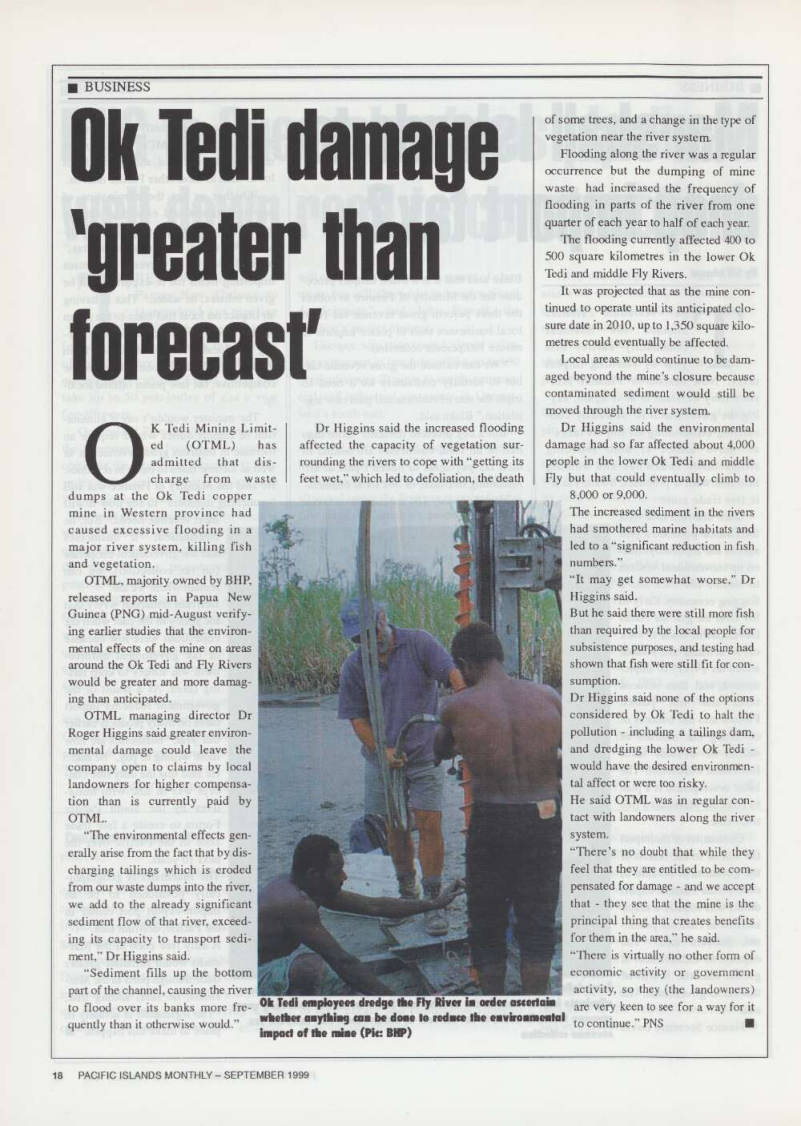
Ok Tedi employees dredge the Fly River in order ascertain whether anything can be done to reduce the environmental impact of the mine (Pic: BHP)