drop import tax?
p. 17 · Read in the full issue
Marshall Islands to drop import tax?
By Giff Johnson
The Marshall Islands stunned the business community earlier this year by slashing import taxes. Now Marshalls’ Finance Min ister Tony deßrum is at it again, say ing the government is seriously con sidering eliminating all import taxes a move aimed at both reducing enforcement headaches and coming into line with a proposed South Pacif ic free trade zone.
Since deßrum took over the Finance portfolio a year ago, he has repeatedly shak en up conventional wisdom to breathe life back into a flagging economy. Early in his term he got the Asian Development Bank to back off its demand that a value added tax (VAT) be imple mented, and then reduced taxes and has pushed Finance into the business of collecting the millions of dollars of overdue taxes from local businesses. The latest development is a plan to make the Marshalls a free trade zone.
Elimination of the import tax will be to the benefit of the government because to enforce the current import duties will require a major increase in customs person nel, deßrum said. “The expense of enforcement is greater than the benefit of this tax to government,” he said.
Finance Secretary David
Blake said that it is a much simpler proce dure for the Ministry of Finance to collect the three percent gross revenue tax from local businesses than to police imports to ensure 100 percent collection.
“We can enforce the gross revenue tax, but to identify containers we’d need to triple the size of customs and pass new leg islation,” Blake said.
But a key problem remains: more than half of all local businesses are behind in their tax payments or haven’t paid at all.
According to Blake, of 362 local business es identified, only 160 are current on taxes.
Import taxes currently provide about
18 percent of the RMFs “discretionary revenue,” deßrum said, adding that this is lower than in most other Pacific nations.
Whether or not the elimination of import duties would extend to alcohol and tobacco products is still under discus sion. “We’re still looking at the sin tax,” he said. But, in any event, businesses importing items for re-export would be given rebates, he added. This is having an impact on local fuel sales to the Asian
fishing fleet, which increasingly is buy
ing fuel locally instead of fueling from mother ships in the lagoon because of the competitive, tax free prices offered local ly- The minister wouldn’t say if elimina tion of import duties would require an increase in business gross revenue tax as well as income taxes to bring in revenues.
He said the Ministry of Finance was still “crunching numbers” to see how it will
meet revenue needs. But, he emphasised, “if businesses and the government cooperate (on tax collection), we can remain where we are.”
Deßrum remarked wryly that the policy in the past when tax collections were low because of lax government enforce ment was simply to keep rais ing taxes. As a result of the government reducing import taxes on many products earlier this year, “businesses are now more willing to pay,” he said.
He said that the duty free con cept was in line with initia tives by the South Pacific Forum to create a free trade zone in the Pacific over the next 10 years.
The Marshalls is geographi cally positioned to be an import-export port center in the Pacific, deßrum said.
A duty free zone in the Mar shalls would stimulate greater trade through ports in the Mar shalls, he said, adding that, “The legislation is actually in place to make this happen.” ■
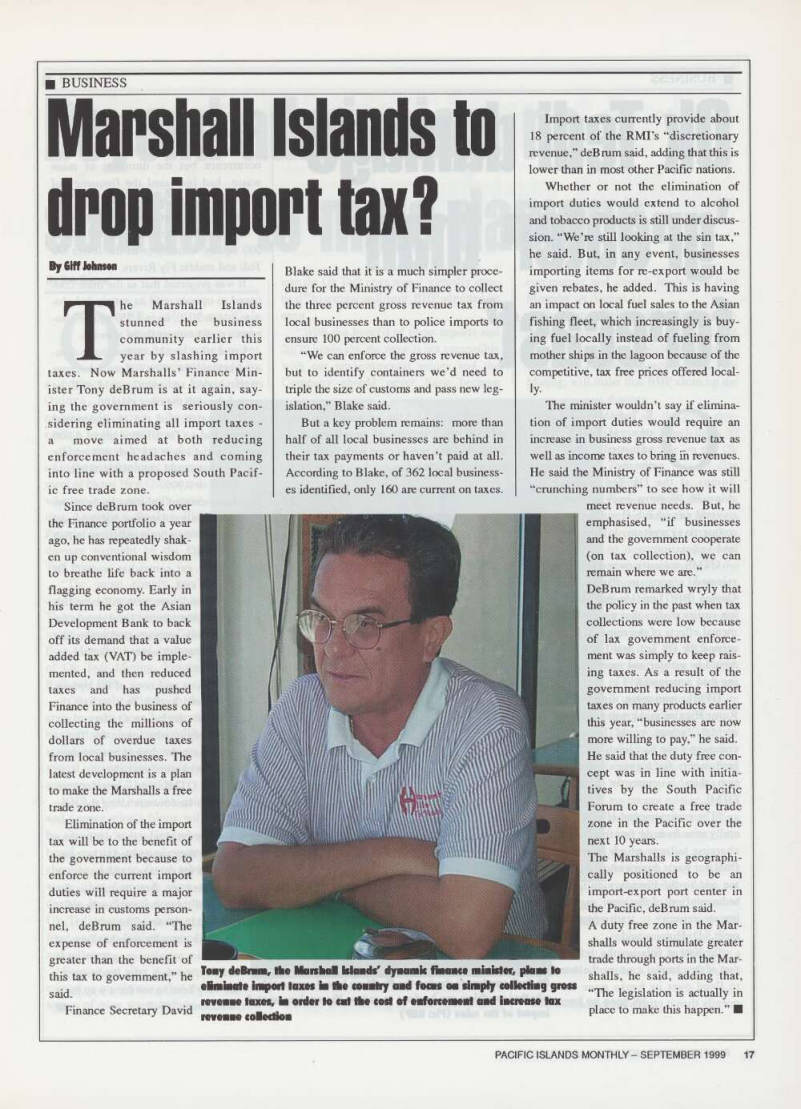
Tony deBrum, the Marshal Islands' dynamic finance minister, plans to eliminate import taxes in the country and focus on simply collecting gross revenue taxes, in order to cut the cost of enforcement and increase lax revenue collection