Beyind admission, no
pp. 19-20 · Read in the full issue
solution to mino donum
By Bob Burton
ONE of Australia’s biggest mining compa nies has admitted major environment damage by a project in runs in Papua New
Guinea, but this does not necessarily bring a happy ending to the controversy.
The pressure has now shift ed to the near-bankrupt govern ment of Papua New Guinea and whether it can, and will, insist that Australia’s Broken Hill Proprietary (BHP) clean up the damage wrought by the Ok Tedi mine.
“The mine simply can’t continue to operate as it is.
There have to be changes made in the regulatory regime,” the Port Moresby-based manager of Ok Tedi Mining, Vincent Bull, told IPS.
“Obviously it is up to the state to make those judgments having taken into account the social, economic and environ mental interests that have to be accommodated,” he added.
BHP, which hopes the gold and copper mine’s future will be resolved at its November board meeting, released reports showing damage from mine waste that for well over a decade has flowed down the Ok Tedi river and destroyed food gardens, fishing grounds and villagers.
Four years after it ran an advertising campaign proclaiming that the 90 million tonnes of mine waste it dumped each year
into the Ok Tedi river were ‘ ’virtually iden tical” to natural sediment, BHP admitted its error.
“With the benefit of these reports and 20/20 hindsight, the mine is not compatible with our environmental values and the Company should never have become
involved,” said BHP managing director and chief executive officer Paul Anderson.
The environmental reports were released at a meeting of local government.
community and church leaders in Port
Moresby on August 11.
But despite BHP’s admission, commu nity groups in PNG are not optimistic that new Prime Minister Mekere Morauta, who was a founding director of Ok Tedi Mining, will insist that BHP clean up the
damage.
After all, the PNG gov ernment - which has a 30 percent stake on the Ok Tedi mine - is in dire straits.
Having taken office only in mid-July, the Morauta government is struggling to negotiate a financial rescue package with the International Monetary Fund and find enough revenue to cover social services.
With the Ok Tedi mine accounting for one-fifth of PNG exports, Morauta is under intense pressure that the mine continues.
On August 10, he launched an emergency mini-budget including tax changes designed to encourage mining and oil development to bring more hard currency into the country.
Activists say BHP’s responsibility does not end with the release of the environmental reports, which the firm
was forced to commission in 1996 after a legal settlement to a class action suit
Continued on page 20
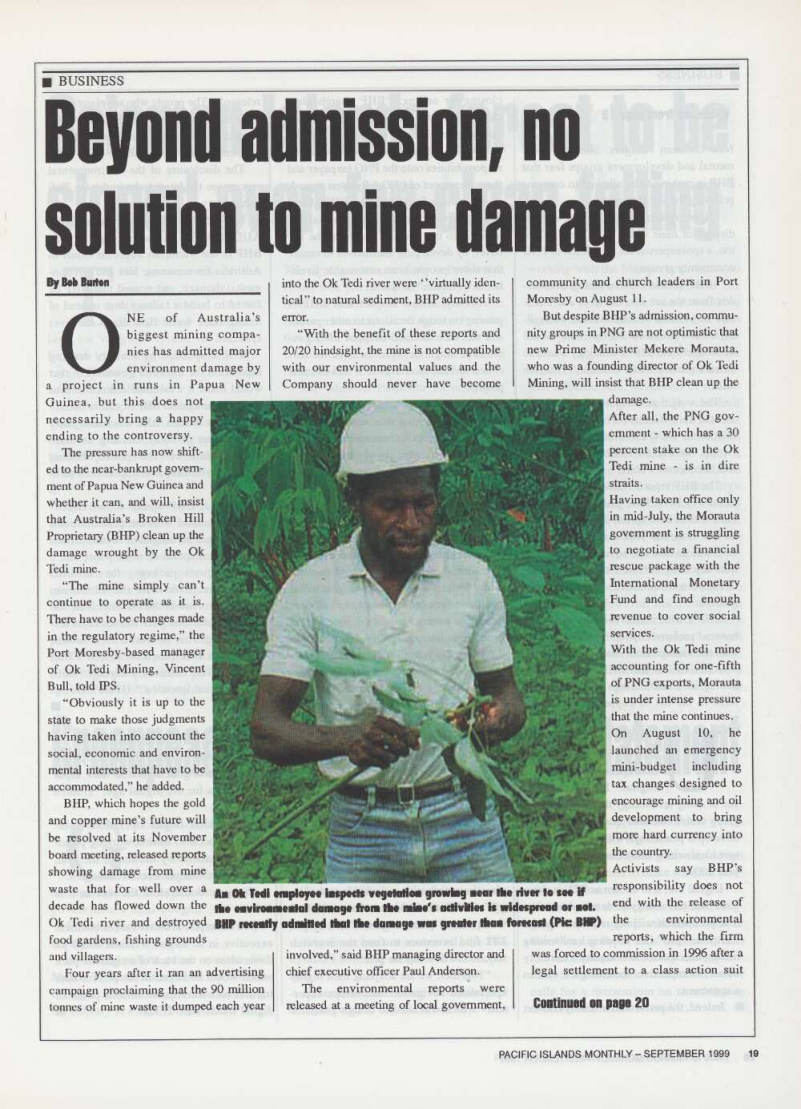
An Ok Tedi employee {aspects vegetalion growing near the river to see if the environmrntal damage from the mine's activities is widespread or not.
BHP receatly admitted that the damage was greater than forecast (Pic: BHP)
New Guinean villagers. Some environ mental and development groups fear that BHP is pushing to be allowed to continue polluting the Ok Tedi river.
“River systems should not be used to dispose of mine waste,” said Brian Brun ton, a spokesperson for a coalition of PNG community groups.
“BHP should cease pushing overbur den from the ore into the river and a new safe way should be found to deal with tail ings, even if this means the mine should be smaller, and new technology found to extract greater metal content,” Brunton said.
The coalition includes the Environ mental Law Centre, PNG Alliance of NGOs, the NGO Environmental Working Group, the Pacific Heritage Foundation and Greenpeace Pacific.
The BHP reports confirm that fisheries in the Fly River have been damaged and mine wastes have spread down 1,000 kilo metres of the Ok Tedi and Fly Rivers and across more than 100 square kilometres of land adjoining the river, killed large areas of forests and smothered village vegetable gardens.
BHP’s Bull insists the firm does not have a “preferred option” on how to deal with the damage from mine wastes.
Activists fear that BHP is considering adding its shareholdings in the Ok Tedi mine to the list of copper projects it is
closing or selling. “BHP shareholders should bear the environmental cost of (any) mine closure, and should not be allowed to offload their environmental responsibilities onto the PNG taxpayer and the government of PNG,” Brunton argued.
“If mining finishes early, BHP share holders should carry any cost of social dis location to the affected people of the Fly River, by developing alternatives to ensure that those people have sustainable liveli hoods in future,” he added.
Already, critics suspect that BHP is passing on tough decisions to other parties - in this case the cash-strapped PNG gov ernment caught between the need for rev enues and the ill effects of a flawed mine project.
They say BHP’s actions echo the approach of one of the world’s leading public-relations crisis managers, US-based Peter Sandman, who has advised BHP and other Australian mining firms to defuse local opposition by “outsourcing” hard decisions.
“Offer communities the choice of either insisting on environmental clean-up or trade possible benefits from the company for other social services,” Sandman has said. “This is a way of getting external groups to face hard choices, and of out sourcing controversial decisions that would have little credibility if made within the company.” Bull denies BHP is out sourcing the problem, but is unapologetic for not inviting the landowners who sued BHP to the briefing where the report was
released. “The people who are plaintiffs in the court case are represented by those elected representatives on their local gov ernment council,” he said.
The disclosure of the environmental reports are the latest twist in the Ok Tedi controversy.
In 1995, the PNG landowners filed a AUDS4 billion damage claim against BHP in the Victorian Supreme Court in Australia for economic loss and environ mental damage, and argued that BHP be forced to build a tailings dam instead of letting mine waste flow down the river systems.
BHP responded by secretly drafting legislation for the PNG government that would make it a criminal offence to take legal action against BHP in courts outside Papua New Guinea. BHP was found guilty of contempt of court, causing its share prices to plummet. (The contempt finding was later overturned on appeal on a tech nicality).
Stunned, BHP agreed to an out-of court settlement with the plaintiffs, one that included investigation of alternatives for proper disposal of mine waste and a compensation package for affected landowners. Even with the admission, groups involved in the Ok Tedi issue are not persuaded that BHP has learnt its les son. Asked what he would do if he was starting Ok Tedi from scratch, BHP’s Bull paused before cautiously saying; “Well, that’s a good question.” (IPS/PINA on line) ■