No sign of US Marines
pp. 47-48 · Read in the full issue
57 years later
By Gift Johnson
With eyewitnesses
pointing the way, United States mili
tary investigators
finally thought they would locate the remains of nearly two dozen American Marines killed in a raid on a Japanese stronghold on a tiny atoll
in Kiribati during World War 11.
But after a three week search in May, a US team from the Central Identification Laboratory in Hawaii came up empty hand ed. Despite testimony from five elder resi dents of Makin Atoll in Kiribati - including several who said they had participated in the burial of the 21 Marines in 1942 - the
investigators were
unable to locate any bones during the exhaustive excavation of a large area thought to be the burial ground, said Lt. Col Kevin Krejcarek, a public affairs officer with the US Pacific Command in Hawaii.
Five old timers said
they knew where the burial site was, but no remains were discovered, he said, adding that 57 years could have affected both the terrain of the island and people’s memories.
Makin is the northern-most atoll in the Kiribati group, located about 200 miles to the southeast of Ebon Atoll in the Marshall Islands. Although seemingly an unlikely outpost for a Japanese garrison, Makin was one of many islands in both the Marshalls and Kiribati on which the Japanese estab lished their eastern perimeter in the Pacific.
The 21 Marines were part of a raider group sent into Makin by two navy sub-
marines in August 1942 with the objective of destroying the Japanese installation and diverting Japanese attention and reinforce ments from Guadalcanal to the south. But from the outset, the insertion of the Marines
on Makin went badly, the result of rough seas, equipment failures and unreliable intelligence on the strength of the Japanese force, reported an official account of this Marine Corps incursion against a Japanese garrison stationed on a coral atoll. The Makin operation demon strated the difficulty of carrying out, with any hope of precision, a surprise attack on an island, despite a relatively small enemy
force - in sharp contrast to the ease with which Hollywood depicts spe cial forces operations.
Heavy rains and high
seas caused difficulties for the landing party, which reached shore in some confusion due to engine malfunctions and weather, the account reported. Then the acci dental discharge of a weapon ruined any hope of surprise. After a stand-off for some hours with the Japanese forces, the Japanese launched two banzai charges - both of which were easily rebuffed by the Americans.
Unbeknown to the Americans, they had
nearly wiped out the
Japanese garrison at that point in the battle, the account reported. By
late morning of the first day, Japanese reconnaissance planes flew over the island. They dropped bombs, but none landed on the Marines. Two hours later 12 Japanese arrived and two of the sea-
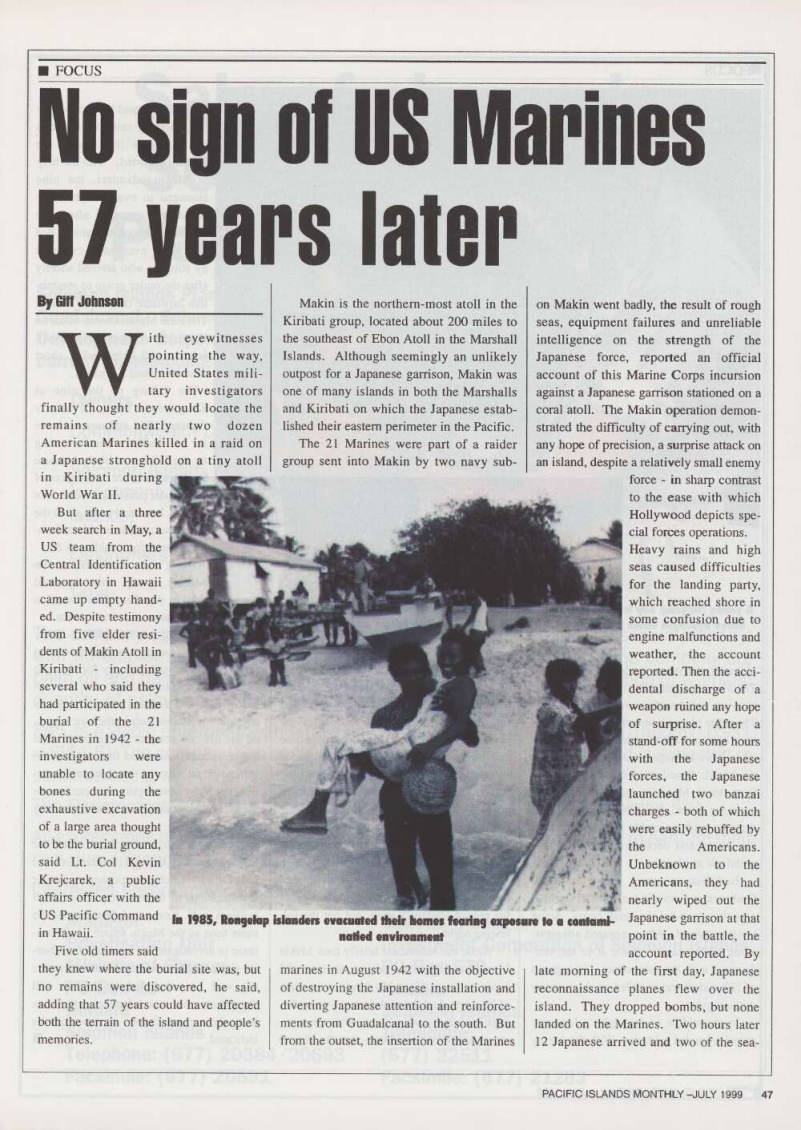
In 1985, Rongelap islanders evacuated their homes fearing exposure to a conlami natied environment
planes in the group landed in the lagoon.
The Marines opened fire on the planes: one blew up and the other crashed on takeoff.
The other planes bombed the island for an hour but most of the ordnance was report ed to have hit Japanese-held territory on the island. Based on information received from local Makin residents, who were assisting them, the Americans believed there was still a sizeable Japanese force on the island and decided that they would withdraw as planned.
But disaster struck the withdrawal.
Outboard engines did not work in the high seas that pounded the small boats. Some boats capsized. After repeated attempts, some of the raiders made it to the ren dezvous with the submarines, but a group of 120 raiders was stranded on shore, many without guns.
In the middle of the night, a Japanese patrol wounded a Marine. With the enemy
apparently still full of fight and his raiders disorganized and weakened, the raiders Commander Carlson decided to surrender.
He sent two Marines out to contact the enemy. They eventually located a Japanese and gave him a note. But, noted the official account, in the meantime, a few exploring raiders killed several Japanese, one of them probably the man with the surrender note.
By dawn, the two man surrender party reported that there appeared to be no orga nized Japanese force left on the island.
Some of the raiders were able to get through the surf in the early morning, while most of the rest of Carlson’s party got out the fol
lowing night.
While the Americans briefly took Makin from the Japanese, taking at least 83 Japanese lives, it cost the Marines the lives of 30 men. And the withdrawal was so dis organized that it wasn’t until after the war more than three years later - that the Marine
Corps discovered that nine of the (30) missing raiders had been left alive on the island, the account reported. With the help of Makin islanders, the nine managed to evade capture for about two weeks after the Japanese re-took the atoll. But they were eventually captured by soldiers who arrived shortly after the raider group to reestab lish Japanese control of Makin.
The nine Marines were taken to Kwajalein Atoll in the Marshall Islands and beheaded a short time later, said Krejcarek.
The killing of the nine at Kwajalein - scene of bloody fighting 1944 and now a center for anti-ballistic missile testing by the US - was likely because the Japanese were running out of food under pressure of American attacks, he noted, adding that the Japanese considered this an hon orable way for a soldier to die.
Among the survivors in the Marine group that attacked Makin was President Franklyn D. Roosevelt’s son, a major.
The attack on Makin likely played a part in the subsequent
Japanese decision to heavily fortify such island bases as Tarawa Atoll, now the cap ital of Kiribati, and the scene of a costly amphibious assault later in the war, report ed the official account of the battle. The historical account noted that despite the trumpeted success of the (Makin) opera tion, the Navy never again attempted to use submarines to conduct raids behind enemy lines.
Krejcarek said that the Defense Department’s Central Identification Laboratory - which was sponsoring similar investigations of the remains of American soldiers in N. Korea and Germany at the same time as the Makin search - will con tinue to investigate the location of the bur ial site on Makin Atoll. Whether another dig will be scheduled on Makin will depend on what new information they can leam from eyewitnesses on the atoll, he indicated. ■
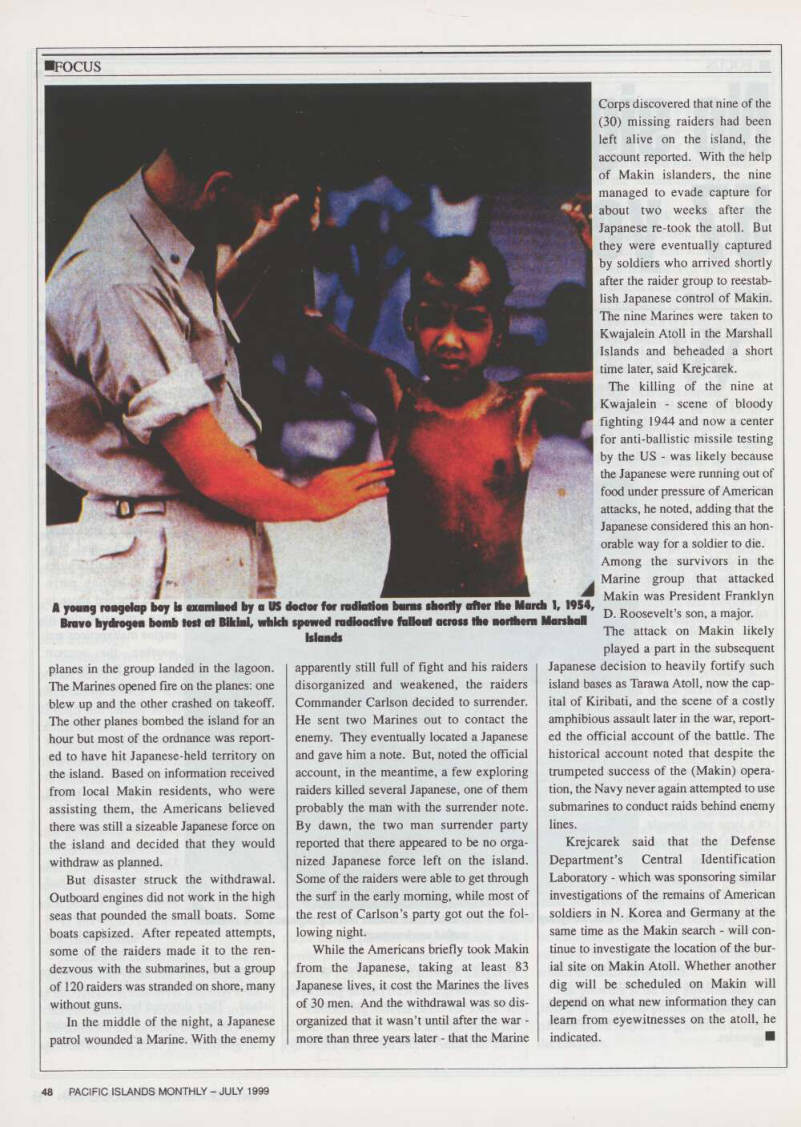
A young rongeap boy b examined by a US doctor for radiation bums shortly after the March 1, 1954, Bravo hydrogen bomb test at Bikini, which spewed radioactive foliout across Hie northern Marshall Islands