New Labour government faces challenge
pp. 45-46 · Read in the full issue
Politics
By Bernadette Hussain
The opening of the first parliamentary session in Fiji after the recent gen eral elections under the new Constitution, got underway with a lot of pomp and ceremony on the morning of June 15.
Although the programme started a few minutes late, due to the late arrival of the President Ratu Sir Kamisese Mara, mem bers of parliament, senators, spouses, members of the diplomatic corps and other invited guests sat in the comfortable Parliament House and took the opportuni ty to catch up.
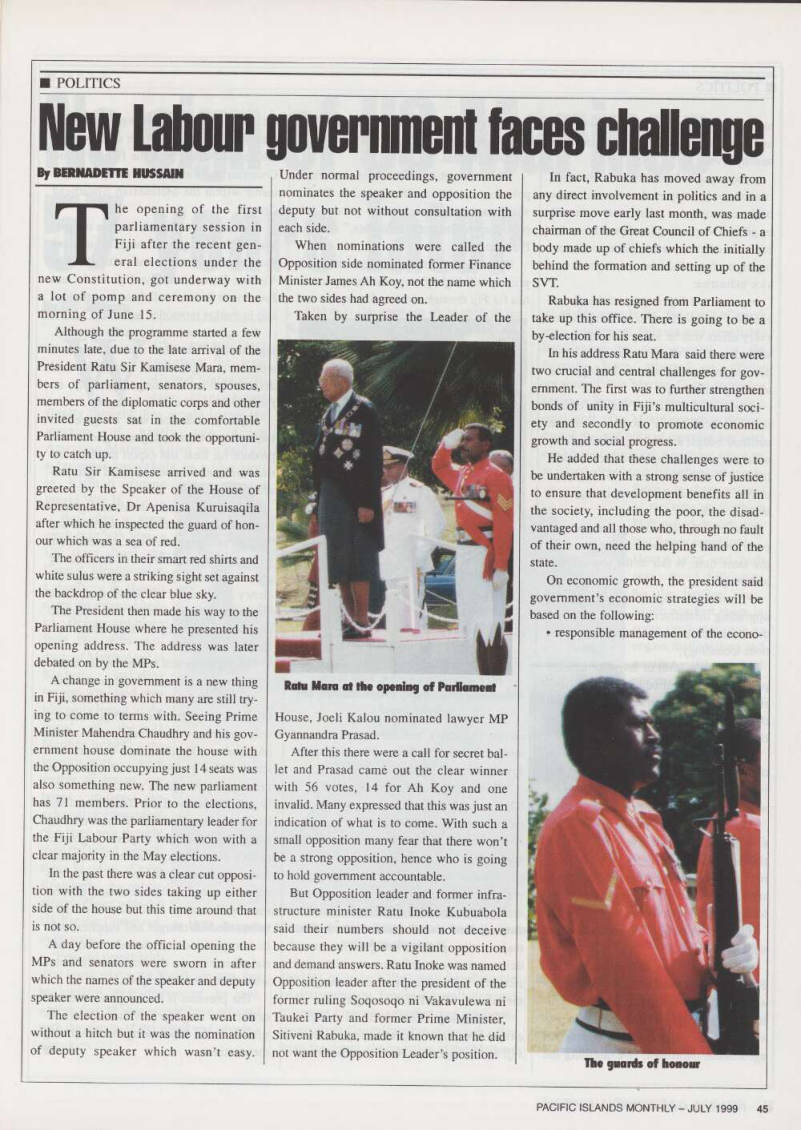
Ratu Sir Kamisese arrived and was greeted by the Speaker of the House of Representative, Dr Apenisa Kuruisaqila after which he inspected the guard of hon our which was a sea of red.
The officers in their smart red shirts and white sulus were a striking sight set against the backdrop of the clear blue sky.
The President then made his way to the Parliament House where he presented his opening address. The address was later debated on by the MPs.
A change in government is a new thing in Fiji, something which many are still try ing to come to terms with. Seeing Prime Minister Mahendra Chaudhry and his gov ernment house dominate the house with the Opposition occupying just 14 seats was also something new. The new parliament has 71 members. Prior to the elections, Chaudhry was the parliamentary leader for the Fiji Labour Party which won with a clear majority in the May elections.
In the past there was a clear cut opposi tion with the two sides taking up either side of the house but this time around that is not so.
A day before the official opening the MPs and senators were sworn in after which the names of the speaker and deputy speaker were announced.
The election of the speaker went on without a hitch but it was the nomination of deputy speaker which wasn’t easy.
Under normal proceedings, government nominates the speaker and opposition the deputy but not without consultation with each side.
When nominations were called the Opposition side nominated former Finance Minister James Ah Koy, not the name which the two sides had agreed on.
Taken by surprise the Leader of the
House, Joeli Kalou nominated lawyer MP Gyannandra Prasad.
After this there were a cal! for secret bal let and Prasad came out the clear winner with 56 votes, 14 for Ah Koy and one invalid. Many expressed that this was just an indication of what is to come. With such a small opposition many fear that there won’t be a strong opposition, hence who is going to hold government accountable.
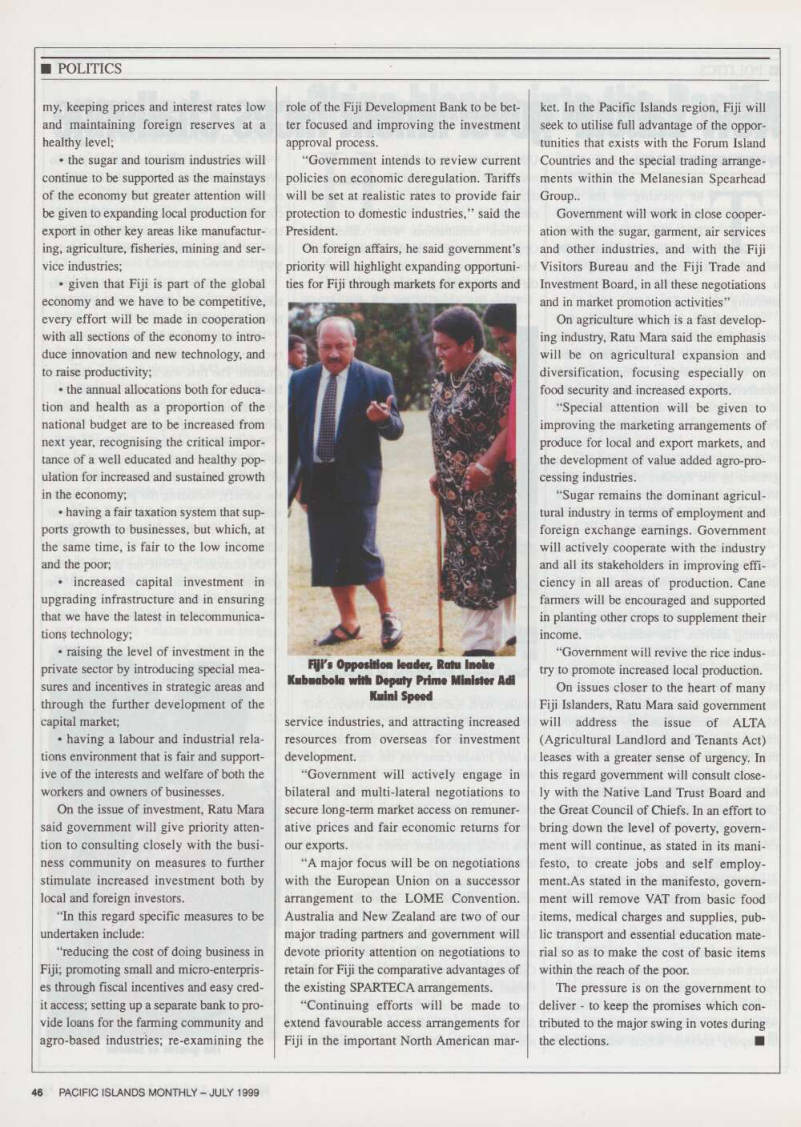
But Opposition leader and former infra structure minister Ratu Inoke Kubuabola said their numbers should not deceive because they will be a vigilant opposition and demand answers. Ratu Inoke was named Opposition leader after the president of the former ruling Soqosoqo ni Vakavulewa ni Taukei Party and former Prime Minister, Sitiveni Rabuka, made it known that he did not want the Opposition Leader’s position.
In fact, Rabuka has moved away from any direct involvement in politics and in a surprise move early last month, was made chairman of the Great Council of Chiefs - a body made up of chiefs which the initially behind the formation and setting up of the
Svt.
Rabuka has resigned from Parliament to take up this office. There is going to be a by-election for his seat.
In his address Ratu Mara said there were two crucial and central challenges for gov ernment. The first was to further strengthen bonds of unity in Fiji’s multicultural soci ety and secondly to promote economic growth and social progress.
He added that these challenges were to be undertaken with a strong sense of justice to ensure that development benefits all in the society, including the poor, the disad vantaged and all those who, through no fault of their own, need the helping hand of the state.
On economic growth, the president said government’s economic strategies will be based on the following: • responsible management of the econo-
Rotu Mora at the opening of Parliament
The guards of honour
my, keeping prices and interest rates low and maintaining foreign reserves at a healthy level; • the sugar and tourism industries will continue to be supported as the mainstays of the economy but greater attention will be given to expanding local production for export in other key areas like manufactur ing, agriculture, fisheries, mining and ser vice industries; • given that Fiji is part of the global economy and we have to be competitive, every effort will be made in cooperation with all sections of the economy to intro duce innovation and new technology, and to raise productivity; • the annual allocations both for educa tion and health as a proportion of the national budget are to be increased from next year, recognising the critical impor tance of a well educated and healthy pop ulation for increased and sustained growth in the economy; • having a fair taxation system that sup ports growth to businesses, but which, at the same time, is fair to the low income and the poor; • increased capital investment in upgrading infrastructure and in ensuring that we have the latest in telecommunica tions technology; • raising the level of investment in the private sector by introducing special mea sures and incentives in strategic areas and through the further development of the capital market; • having a labour and industrial rela tions environment that is fair and support ive of the interests and welfare of both the workers and owners of businesses.
On the issue of investment, Ratu Mara said government will give priority atten tion to consulting closely with the busi ness community on measures to further stimulate increased investment both by local and foreign investors.
“In this regard specific measures to be undertaken include: “reducing the cost of doing business in Fiji; promoting small and micro-enterpris es through fiscal incentives and easy cred it access; setting up a separate bank to pro vide loans for the farming community and agro-based industries; re-examining the
role of the Fiji Development Bank to be bet ter focused and improving the investment approval process.
“Government intends to review current policies on economic deregulation. Tariffs will be set at realistic rates to provide fair protection to domestic industries,” said the President.
On foreign affairs, he said government’s priority will highlight expanding opportuni ties for Fiji through markets for exports and
service industries, and attracting increased resources from overseas for investment
development.
“Government will actively engage in bilateral and multi-lateral negotiations to secure long-term market access on remuner ative prices and fair economic returns for our exports.
“A major focus will be on negotiations with the European Union on a successor arrangement to the LOME Convention.
Australia and New Zealand are two of our major trading partners and government will devote priority attention on negotiations to retain for Fiji the comparative advantages of the existing SPARTECA arrangements.
“Continuing efforts will be made to extend favourable access arrangements for Fiji in the important North American mar
ket. In the Pacific Islands region, Fiji will seek to utilise full advantage of the oppor tunities that exists with the Forum Island Countries and the special trading arrange ments within the Melanesian Spearhead Group..
Government will work in close cooper ation with the sugar, garment, air services and other industries, and with the Fiji Visitors Bureau and the Fiji Trade and Investment Board, in all these negotiations and in market promotion activities”
On agriculture which is a fast develop ing industry, Ratu Mara said the emphasis will be on agricultural expansion and
diversification, focusing especially on
food security and increased exports.
“Special attention will be given to improving the marketing arrangements of produce for local and export markets, and the development of value added agro-pro
cessing industries.
“Sugar remains the dominant agricul tural industry in terms of employment and foreign exchange earnings. Government will actively cooperate with the industry and all its stakeholders in improving effi ciency in all areas of production. Cane farmers will be encouraged and supported in planting other crops to supplement their income.
“Government will revive the rice indus try to promote increased local production.
On issues closer to the heart of many Fiji Islanders, Ratu Mara said government will address the issue of ALTA (Agricultural Landlord and Tenants Act) leases with a greater sense of urgency. In this regard government will consult close ly with the Native Land Trust Board and the Great Council of Chiefs. In an effort to bring down the level of poverty, govern ment will continue, as stated in its mani festo, to create jobs and self employ ment.As stated in the manifesto, govern ment will remove VAT from basic food
items, medical charges and supplies, pub
lic transport and essential education mate rial so as to make the cost of basic items within the reach of the poor.
The pressure is on the government to deliver - to keep the promises which con tributed to the major swing in votes during the elections. ■
Fiji's Opposition leader. Rata Inoke Kubuabola with Deputy Prime Minister Adi Kuini Speed