Book documents experiences
pp. 37-38 · Read in the full issue
By Bernadette Hussain
Abook looking at Fiji
troops at Britain’s Christmas Island nuclear tests was released in Suva, Fiji, by the Pacific Concerns Resource Centre late last month.
The book is based on information pro vided by over 150 former Fijian military personnel who served under British com mand at Christmas Island in the 19505.
The book is an effort by the PCRC to put forward the plight of the servicemen at the time and assist them seeking compensation from the British Government.
The story of these servicemen were never told. No one ever knew the plight of these men - their health problems which they attribute to exposure to radiation from the tests.
Nearly 300 Fijians travelled to Christmas Island for Britain’s nuclear testing pro gramme in the Pacific. They were witnesses to the development of the Britain’s hydro gen bomb at Malden Island and Christmas Island. The atmospheric tests in the Pacific were codenamed Grapple.
At the time the servicemen went to Christmas Island, Fiji was still a British Colony and so was Gilbert and Ellice of which Christmas Island was a part of.
Kirisimasi is published in both English and Fijian and is a contribution to the histo ry of Fiji and the veterans tell the story in their own words.
Chapter two and three of Kirimasi look at these stories.
Kirisimasi looks at the real life experi ences of these servicemen - their time on the island, their life and suffering.
Never before had anyone spoken to these veterans so it was obvious that they were more than happy to talk about the experi ences.
The one thing that comes across very clearly is that some of these veterans were never really given all the information they wanted about the tests.
It is also obvious that the British soldiers had in some cases told them what not to do and not to eat but never really explained why this was so. As a consequence the vet
erans did just this and no attempt was never made on the part of the soldiers to stop them.
In these times if someone was asked to go on such trip than he would have so much access to information because of development but in those days it wasn’t so.
Another thing which comes across clearly is that these veterans are very bitter with the way in which they were treated and they want the British authorities to compensate them for all the pain and suf fering they say they have endured.
Following are excerpts from some interviews which appear in Kirisimasi: Ratu Inoke Bainimara - FRNVR 1104. He served as chief petty officer leading the original FRNVR contingent which travelled to Malden and Christmas Island between March and July 1957. He also witnessed the 1957 tests near Malden Island.
“... When I was recalled there were rumours going around among senior mili tary personnel about the tests on Christmas Island. One thing to note about the men who we took with us on this trip was that the majority had just leji school.
There were not enough jobs around, and they would take whatever job cam their way. When it was said that they would get the chance to go overseas and travel on a British navy ship they were very eager and excited to go. They had no idea what lay ahead...” ”... After three weeks of staying there, we finally had training. While the training was going on, the boys began to realise that there was going to be a nuclear test.
Some came to me asking questions. I said: “Weren’t you told in Fiji?” They replied: “No! We were just told that we were going on the ship for exercises”.
The time of the first bomb was a very difficult time for us. You know, we asked those senior officers at the top a lot of questions. They said not to worry and that it would be done this way and that way. I had asked the assistant commanding what would happen but his assistant on the boat said “Only God knows.” ”... We had this thing on called flash gear. You know, it covered our whole bod-
ies. It covered our whole face. There were goggles provided, hand gloves, boots, there was nothing left 0ut...”
“ ... We had our backs to this thing. We had goggles on and our face covered.
Then we had to press our palms against our eyes. We then had our backs to the bomb. Everytime I recall this moment, I
feel afraid. You know when you go to the war you fight. You prepare yourself and then you fight. If you are shot, you die. Here you do nothing.
You go there and sit down awaiting to die ...”
Paul AhPoy
FRNRV 1140 is another veteran who travelled to Christmas Island at the age of 21 as part of
Fiji’s naval contingent.
“ ... I remembered
vividly the month of April
1958. We were told that
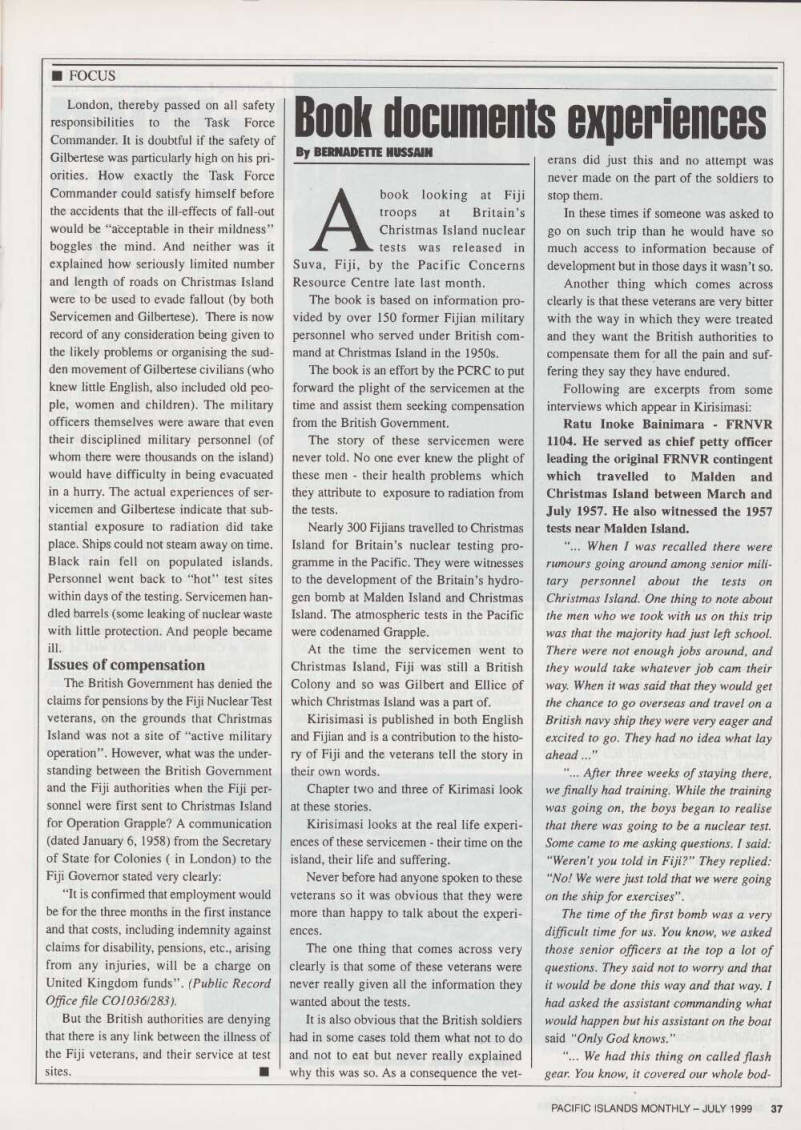
the next test would be the last of the dirty bombs and it was going to be a really big one. Oh boy it looked really dirty with its big black mushroom cloud before it turned white. The last two megaton weapons to be tested were declared clean bombs, in that there would be no fallout...”
"... 0805 Stand up and turn around.
First thing I saw was a big new sun. Then slowly it turned into a giant ice cream come with white cream dripping over its side. Then into a giant mushroom cloud "... 0900 The sun would disappear, strong winds would start to blow and we would be ordered to take cover in our tents, where we would shelter from the rains that followed. Sometimes it would rain for only a few days. Once it did for two weeks ...”
“ ... In 1960 some tuff of my hair began to fall off and fingernails. My gums started bleeding and teeth got loose. I suf fered from migraine headaches until I was about 35 ... One of my knee joints would just swell up whenever I bump something.
Only the right wrist is troubling me up to this day. I have to wear dark glasses most of the time. A doctor in the USA removed 59 round growths from under my skin all my body. It was tested and I was given okay. ”
During AhPoy’s service on Christmas Island, he was not issued any protective clothing, or radiation measuring instru ments. He clothing was standard navy issue (a long sleeve blue shirt, long blue trousers, socks and black shoes.
He has a number of health problems that he attributes to this exposure to radi ation at Christmas Island. As well as the loss of hair and damage to his fingernails soon after the tests, Paul developed a rare skin disease that recurs now and again.
His wife had three miscarriages (1980, 1982, 1984), and his second daughter was bom physically retarded. She only started
walking after two years, and dies at the age of three and a half.
These are just two of the many stories in the book. Some more shock ing than others but nev ertheless said.
Kirimasi is available through the Pacific Concerns Resource Centre, Private Mail Bag, Suva, Fiji. The tele phone contact is (679)304649; fax (679) 304755 and email:
Mas broom eland from Grapple Y lest, 28 April 1958 Source: Kirisimasi
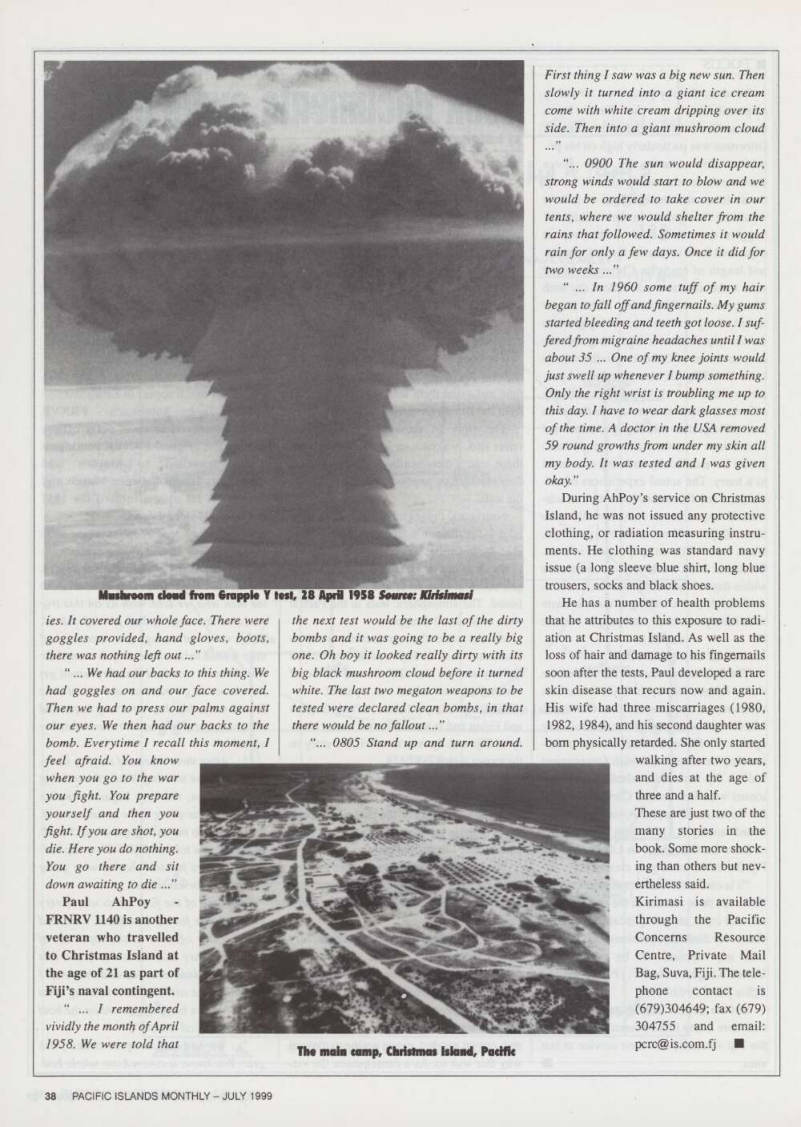
The main camp, Christmas island. Pacific