British nuclear tests in the Pacific
pp. 34-37 · Read in the full issue
Focus
Cutting corners and compensation
By Dr Wadah Harsey
During 1957 and 1958, British conduct ed three nuclear tests at Malden Island, and six tests at Christmas Island. Both these islands were part of the British colony then called the Gilbert and Ellice Islands.
British and New Zealand personnel were exposed to risks of radiation. But so also were 300 Fijians sailors and seamen, as well as the thousands of indigenous I- Kiribati.
A book, Kirisimasi: Fijian troops at Britain’s Christmas Island Nuclear Tests, was launched last month outlining the per sonal case histories of the many Fijians who suffered the ill-effects of radiation at the test sites, as well as the continuing effects on their children.
Included in the long list of names and cases studies are well known ones such as the late and former President of Fiji, Ratu Sir Penaia Ganilau, who died of leukemia and sepsis in 1993. However, the British Government, on technical grounds, has denied the Fijian veterans (and their fami lies) any pensions or compensation for their service at the test sites. After attend ing a recent Commonwealth Parliamentary Association meeting in the United Kingdom, I managed to fit some of my own academic research at the Public records Office in Kew gardens, London. I also managed to read a few interesting files on British nuclear testing in the Pacific.
There was interesting evidence of com promises being made by the British author ities, in safety standards during and after testing. “Danger Zones” were designated
arbitrarily.
There was also a very risky changing of testing site, forced by time constraints on the British testing programme. While the latter certainly resulted in financial bene fits to the British Government, safety was almost certainly compromised. There is
also evidence that the British authorities
promised pensions and compensation for the
Fijian soldiers, when they were being sent to the nuclear testing sites.
What was the danger area?
On November 19, 1956, Air Vice- Marshall Oulton (Commander of Task Force Grapple) circulated a Top Secret paper on how the “Danger Area” was to be defined (Public Records Office file CO 1036/280).
The paper stated that there was a level B of radio-activity as which a “small tempo rary but observable physiological effects would be produced in a small fraction (less than one per cent) of a population exposed to it”. The paper declared that for “primitive peoples’, who did not wear boots and cloth ing and did not wash, the corresponding level of activity was somewhat lower, at B’.
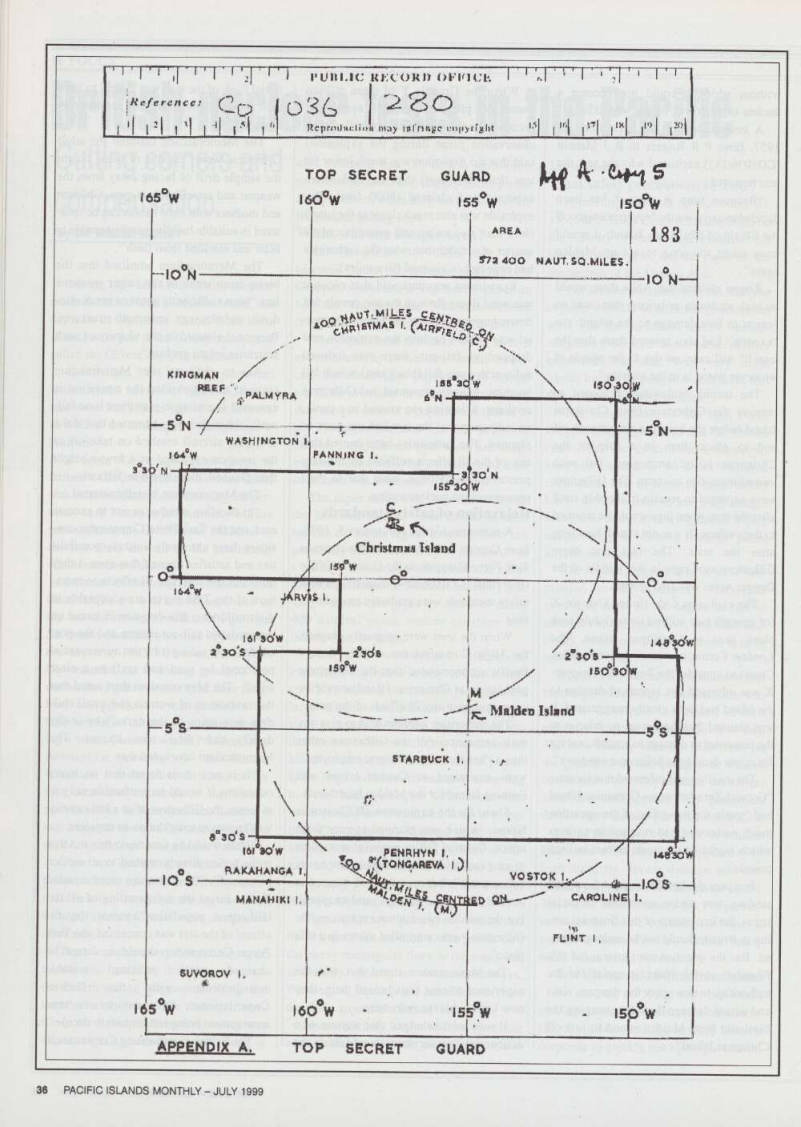
The paper stated that “it is desirable that the declared Danger Area should at least enclose the whole region in which there is a possibility that level B’ may be produced” as a result of accidental surface bursts at either Christmas Island or Malden Island. These danger areas were given by circles of radius 400 nautical miles, centres on these two islands (see the map).
These circles were given in reference to explosions equivalent to only 150 kilotonnes (of TNT). Most of the actual explosions were larger than this, and one was of close to three million tonnes. When the Danger Area was demarcated by the two circles, the authorities blandly claimed that “such an area is patent ly too large and has been reduced” according to some “basic principles”. And what were these principles? Populated islands (other than Christmas and Malden) must not be included; boundaries should be lines of lati tude and longitude; and the total area should not greatly exceed that of the US Danger Area (in their tests at Bikini).
These arbitrary “principles” meant that the Danger Area advised to the public (see the heavy rectangular lines in the map) was artificially drawn to exclude Palmyra, Washington, Fanning and Jarvis Islands from the circle around Christmas Island.
Also artificially excluded from the circle around Malden Islands were Penrhyn and
Jarvis Islands.
What safety precautions to Take?
A meeting was held on November 27, 1956, at St Giles Court (C01036/280), on the Safety Precautions planned for Operation Grapple, and the paper on the declaration of the Danger Area.
The minutes recorded that the Minister of Supply should be informed (through the text) that the radiation levels “recom mended by the ICRP would be necessarily exceeded” but that “only very slight health hazard to people would arise and that only to primitive peoples”.
The Commander of the Task Force Grapple (Oulton) claimed that “all known craft in that part of the Pacific were pow ered and capable of 10 knots”. Oulton declared, in case of accident, craft “would have sufficient time to leave the danger area ahead of the advancing fallout if they act promptly on warning from the patrol aircraft as planned”.
The meeting agreed that in their sub mission to the ministers, “reference should be made to the degree of risk to members of the Task Force, and to its nec essary acceptance if the operation is to be mounted”.
There is no record in the notes of this meeting whether any consideration was given to Gilbertese (I-Kiribati) in their native craft, powered by paddles or sail.
And how exactly were the Gilbertese, on the ground or at sea, going to be warned by the patrol aircraft, to leave the danger
area? By loud-speaker? By pamphlets
thrown from the air? For what destination.
Three tests were conducted at Malden Island and while they were supposed to be high airbursts, severe damage was sus tained by animal and birdlife on the island.
The PCRC book indicates that Fiji person nel went on to the contaminated island, including Ratu Penaia without safety boots (none could fit him).
Test site moved to Christmas Island At the end of 1957, with the world moving towards a moratorium on atmos pheric nuclear testing, Britain became desperate to quickly test hydrogen bombs,
without which it could not become a nuclear super-power, on par with US.
A communication of September 20 1957, from P R Rogers to R J Minnitt (CO 1036/283) explained why the test site was removed: “Because time is short it has been decided to carry out the November tests off the SE tip of Christmas Island; it would have taken too long to set up Malden
again”.
Rogers claimed that while there would be high air bursts as before, there was no reason to fear damage to the island: the “experts” had also assured them that the tests will carry no risk to the people of whatever island is in the vicinity”.
The testing authorities proposed to remove the Gilbertese from Christmas Island before the bombing aircraft took off and to place them in a ship in the Christmas Island anchorage, but with immediate notice to steam. The Gilbertese were expected to remain in the ship until after the test, when they would be returned to their village. It was not stated, how long after the tests. The fact that these Gilbertese were right in the middle of the Danger Areas was also ignored.
The explosion code-named Grapple-X
(of strength two million tonnes) duly took place next to Christmas Island. The London Committee meeting (at St Giles Court) to consider the Report on Grapple- X was informed that reports of damage to the island had been greatly exaggerated. It was claimed that there were no injuries to the personnel or damage to aircraft “except for minor damage to helicopter windows”.
The meeting was informed that locating “Ground Zero” close to Christmas Island had “made the mounting of the operation much easier and had resulted in savings which might be as much as two million
pounds”.
In a period when Britain and the pound sterling was under enormous financial stress, the importance of this financial sav ing to Britain should not be under-estimat ed. But the question also arises, did this financial saving make it easier for the authorities to downplay the dangers, risks and actual damage done by changing the blast site from Malden island to just off Christmas Island?
When the Grapple Y of three million tonnes took place in April 1958, eyewitness accounts (including that of a pilot flying an
observation plane during the explosion)
said that the explosion was much lower (at less than 1000 feet) than the authorities expected and claimed (8000 feet). The explosion was also much closer to the island (less than two miles and possible only a quarter of a mile) than what the authorities had expected or claimed (five miles).
Eyewitness accounts said that coconut tree went flying through the air; people fell down; huge amounts of sea and land mater ial was sucked up into the explosion and dropped as fall-out; there was induced radio-active rain-fall (black rain), which fell on ships, military personnel and Gilbertese civilians. Scientists ran around in a panic, an indication that the test had not gone as planned. The authorities have denied that any of the ill effects suffered by military personnel or civilians, were due to their presence at the nuclear testing.
Relaxation of safety standards A memorandum of November 5, 1958, from Captain J G T Western (Headquarters Task Force Grapple) to the Colonial Office (H P Hall) (CO 1036/284) makes clear how safety standards were gradually eroded over time.
When the tests were originally planned, the High Commissioner of the Western Pacific recommended that the Gilbertese population at Christmas Island should be evacuated from any ill-effects of the tests.
The authorities were not able to give any such assurance. All the Gilbertese other than a “handful of government employees” were evacuated to Canton Island and Fanning Island for the Malden Island tests.
Then, for the explosions off Christmas Island, “which was planned at very short notice, Colonial Office approval was given to an evacuation into a ship a few hours before a test”. But even this was stopped in general (except for the high yield weapons).
For the smaller two kiloton explosions, the Gilbertese “were martialled ashore in a safe
place”.
The Memorandum stated that, with the experience of nine tests behind them, they now knew what the risks were.
It was acknowledged that anyone who deliberately or accidentally observed the
initial flash of the test, was “likely to have
their eyesight temporarily or permanently
impaired”.
The Memorandum claimed the adult Gilbertese were “capable of being taught the simple drill of facing away from the weapon and covering their eyes. Children and mothers with their babies can be mus tered in suitable buildings unsusceptible to blast and shielded from flash”.
The Memorandum admitted that the blasts from some of the larger weapons had “been sufficiently great to break win dows and damage unvented structures.
Personnel situated in the vicinity of such structures might get hurt”.
As to fallout, the Memorandum claimed that “provided the operation is executed according to plan there is no fall out”, although it was admitted that if the dropping aircraft crashed on take-off or the weapon exploded at a lower height than planned, there might be fall out.
The Memorandum blandly asserted: “In deciding whether or not to execute each test the Task Force Commander con
siders these extremely unlikely possibili
ties and satisfies himself that even if they do occur the resultant ill effects to mem bers of the Task Force are acceptable in their mildness. His decision is based on the predicted fall-out pattern and the pos sibility of avoiding it by the movement of personnel by road and craft to a clear area”. The Memorandum then noted that the evacuation of women and small chil dren into ships in the dark (why in the dark?) had their own hazard. The Memorandum concluded that: “it is now considered that on many occasions it would be preferable only to evacuate the Gilbertese after a fall-out risk was known to exist due to an accident.
There would be time to do this and this is the policy already applied to all service personnel”. The committee recommended that as far as the safeguarding of all the Gilbertese population against the ill effects of the test was concerned, the Task Force Commander should in future be charged with making suitable arrangements with the District Commissioner, “the nature of these arrangement being left for him to decide”.
The British Coordinating Committee in
London, thereby passed on all safety responsibilities to the Task Force Commander. It is doubtful if the safety of Gilbertese was particularly high on his pri orities. How exactly the Task Force Commander could satisfy himself before the accidents that the ill-effects of fall-out would be “acceptable in their mildness” boggles the mind. And neither was it explained how seriously limited number and length of roads on Christmas Island were to be used to evade fallout (by both Servicemen and Gilbertese). There is now record of any consideration being given to the likely problems or organising the sud den movement of Gilbertese civilians (who knew little English, also included old peo ple, women and children). The military officers themselves were aware that even their disciplined military personnel (of whom there were thousands on the island) would have difficulty in being evacuated in a hurry. The actual experiences of ser vicemen and Gilbertese indicate that sub stantial exposure to radiation did take place. Ships could not steam away on time.
Black rain fell on populated islands.
Personnel went back to “hot” test sites within days of the testing. Servicemen han dled barrels (some leaking of nuclear waste with little protection. And people became ill.
Issues of compensation The British Government has denied the claims for pensions by the Fiji Nuclear Test veterans, on the grounds that Christmas Island was not a site of “active military operation”. However, what was the under standing between the British Government and the Fiji authorities when the Fiji per sonnel were first sent to Christmas Island for Operation Grapple? A communication (dated January 6, 1958) from the Secretary of State for Colonies ( in London) to the Fiji Governor stated very clearly; “It is confirmed that employment would be for the three months in the first instance
and that costs, including indemnity against
claims for disability, pensions, etc., arising
from any injuries, will be a charge on United Kingdom funds”. (Public Record Office file CO10361283).
But the British authorities are denying that there is any link between the illness of the Fiji veterans, and their service at test sites. ■