US accused of dragging
pp. 36-37 · Read in the full issue
Developments
US accused of dragging its feet over obligations
By Giff Johnson
THE Marshalls foreign
minister has lashed out at the Clinton Administration for drag ging its feet when it comes to America’s obligations to this central Pacific island nation. He said the US is “unwilling to meet even the most basic needs of the Marshall Islands”.
The failure of the US government to meet obligations spelled out in the Compact of Free Association is under mining efforts of the Marshall Islands to boost its economic development, said foreign minister Phillip Muller. He made the comments May 11 to the US House Resources Committee, which oversees budget and other matters for
the islands. Muller’s strongly worded criticism of the Clinton Administration comes as both countries are gearing for the start-up of talks to negotiate contin uation of economic provisions of the Compact that are to expire in 2001.
Marshalls leadership has been lob bying key Congressional leaders, including Resources Committee Chair Don Young, a Republican from Alaska, to press the Clinton Administration to address a series of development and defense-related issues. The Marshall Islands wants action before the Compact economic talks begin in October.
Muller described the Marshalls’ relationship with the US as “unique and unprecedented”. He added that the Marshalls “remains proud of the fact
that no other country supports the US strategic interests to the same extent that it has, and does.”
Yet Muller said a one-sided pattern has emerged where the Marshalls “has always” acted quickly to accommodate emerging US military needs but the US administration is not reciprocating.
“The US has locked-in security rights under the Compact of Free Association,” he said. “And yet, when it comes to performing its correspond ing obligations such as providing eco nomic development support or to facil itating the most menial of air transit approvals, the Marshall Islands govern ment encounters delays.”
This lack of US action is occurring although when the US requests addi tional islands to use in its missile test ing programs, the Marshall Islands is quick to oblige, he said. Under the Compact, the US uses Kwajalein Atoll in the Marshall Islands to develop offensive missiles and anti-missile defense weapons. In return, it provides funding that accounts for about 60 per cent of the annual national budget in the islands, including rental payments for Kwajalein amounting to about $l2 million annually.
But Muller said that the Clinton Administration’s “failure to implement economic provisions in the Compact undermines popular support in the Marshall Islands for the US and its ongoing requests to the Marshall Islands for new security benefits.”
The Foreign Minister pointed to a provision in the Compact that recognis es that “sustained economic advance ment is a necessary contributing ele ment to the mutual security goals expressed in (the) agreement”. Muller said that the Compact has many provi sions aimed at boosting economic development but the island government
“is having great difficulty in imple
menting these provisions. Regrettably,
these provisions provide some of the most basic services to the Marshallese
people”. Among a variety of concerns,
the Marshalls has become particularly upset with deteriorating air service.
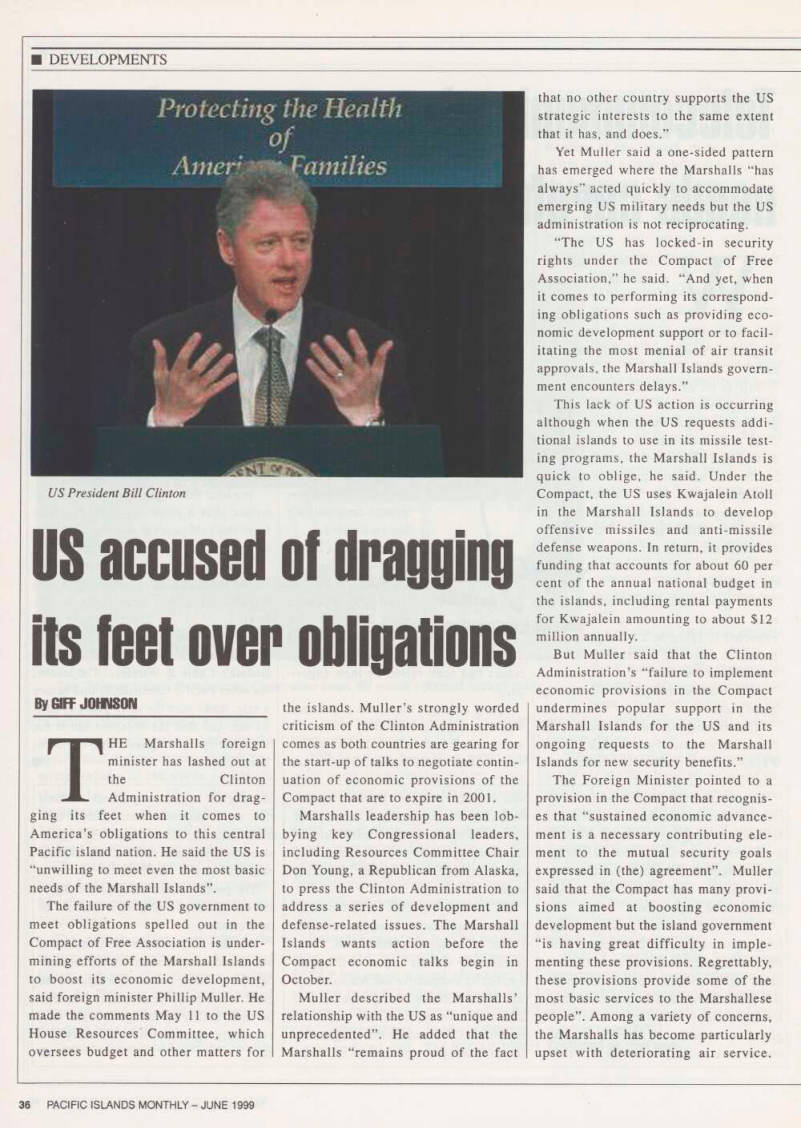
US President Bill Clinton
Protecting the Health of American Families
Continental Micronesia reduced the number of flights to just two each week. Moreover, despite approval from the assistant secretary of defense level last February - for landing rights at Johnston Island - Aloha Airlines has been hindered in its operation there. Its new air service to the Marshalls and Federated States of Micronesia has been delayed months past its May tar get. The blame is being placed on bureaucracy at the Defense Department that has prevented the order from being
implemented.
Muller cited a number of concerns, including what he said was: - A US failure to deliver on a promised development fund of $2O mil lion intended to compensate the Marshalls for key economic provisions that were removed from the Compact by the US after Marshall Islands voters had approved it in 1983. The Marshalls has received only $2 million of this promised fund. “It is clear that the Marshall Islands’ economic growth is stifled by the unilateral removal from the Compact of essential economic benefits,” he said.
- Squalor and “horrific” water, san itation, health and education facilities for islanders who were removed by the US military to make way for missile tests at the Kwajalein missile range.
The original population of 256 islanders has swelled to 2,500 people “forced to share the same, confined liv ing area,” he said. When American officials moved the people from their islands in 1965, “they were promised that their housing, power and water would be taken care of,” Muller said.
The Clinton Administration wants the Marshalls to produce “written proof of these promises before any action can be taken,” he said. But, said Muller, “it is unfair to demand such a strictness in producing records when the US Trust Territory documents are not in our pos session. It is not fair that a population should experience acute poverty because they relinquished their lands in support of the US missile defense test
ing programs.”
- Serious impediments to employ ment in the US, a privilege guaranteed by the Compact. Since the Compact went into effect in 1986, Marshall
Islanders have enjoyed visa-free entry privileges to live, work and study in the United States. But a recently passed US law now requires Marshall Islanders to get work-authorisation approvals. It is a lengthy process often resulting in islanders losing job offers or being ter minated by employers unwilling to wait for a drawn-out, bureaucratic process, Muller said, adding that this problem needs action.
Muller said that he looked to House Resources Committee Chair Young and members of the Congress for action on these problems.
He said there was “a growing gap between the burdens assumed by the Marshall Islands and its people under the Compact and the associated bene fits enjoyed by the US. All of the issues I raised today are in both of our nations’ best interests to resolve”.
During Young’s visit to the Marshalls in February, he indicated his committee’s intention to play an active role in the upcoming negotiations and in pressing the Clinton Administration for action on a variety of defense-relat ed concerns. ■