Bridging the
pp. 32-35 · Read in the full issue
Technology
Bridging the information gap A21st Century challenge
Reports and pictures by
Sophie Foster Hildebrand
ASK an islander about surf ing and they may point you towards the nearest reef breaking the tide of the vast Pacific ocean.
"Surf the net?". What a crazy idea!
While this may seem like a gross exag geration, in a time of vast technological
innovation, there is no doubt that Pacific coun tries and many other developing nations, have sadly been left behind.
Indeed, so great is the information gap that, while the Internet, mobile phones and video confer encing are literally child's play in developed nations, in the Pacific many adults don't know how to use a mobile phone, let alone switch on a computer.
Many island children have never seen a computer.
Radio telephone stations are still used to send mes sages; and most people wouldn't know what's happening in the outside
world if it was not for public radio sta tions.
The Pacific has always been known for its isolation, cut off mainstream develop
ment and the pace that characterises the western world. Indeed, tourism operators often stress coming to the Pacific to "get away from it all."
But in an increasingly global trade environment, the Pacific can no longer afford the "out of touch" label.
Fortunately, the same developments that led to rapid growth in the western world, now present the region with an opportunity to ride the wave of informa-
tion and communication technology.
Fiji's outgoing minister for foreign affairs and external trade, Berenado Vunibobo explains.
"Telecommunications and information technology have facilitated interdepen dence and now allow massive amounts of information to be transferred across boarders at ever increasing speeds, and at increasingly economical rates. In today's marketplace, transactions are effected on line, in real-time, and the implications are now part of a globally inter-linked eco nomic system," he says.
He told the Forum Communications Policy Minister's meeting in Suva, Fiji, recently that traditional views of national independence were being challenged in such a globalised industry. "Hie reality is that ideally effective solutions may involve some breaking down of old walls and a recognition that global partnerships rather than exclusivity or monopolies may perhaps be the way forward," he said.
After decades of being out of the run ning, the Pacific, it seems, is ready to make a come-back.
But while the communication ministers recognised the "critical importance" of telecommunications in development, they agreed that there were constraints imposed by the relatively high cost of telecommunications for island countries.
In particular, there was con cern about the current Internet charging regime.
The 55th session of the Economic and Social Commission of Asia and The Pacific (ESCAP) attempted to highlight these issues.
One of the papers presented at the session was titled 'Asia and the Pacific into the
Twenty-first Century:
Information Technology,
Globalisation, Economic Security and Development'.
It said that recent technologi cal developments had led to lower costs and the dramatic shortening of economic "dis tances".
This microelectronic revolu tion, it said, allowed faster
and cheaper movements of goods and ser vices.
"Advances in telecommunications and transport, for example, have helped to
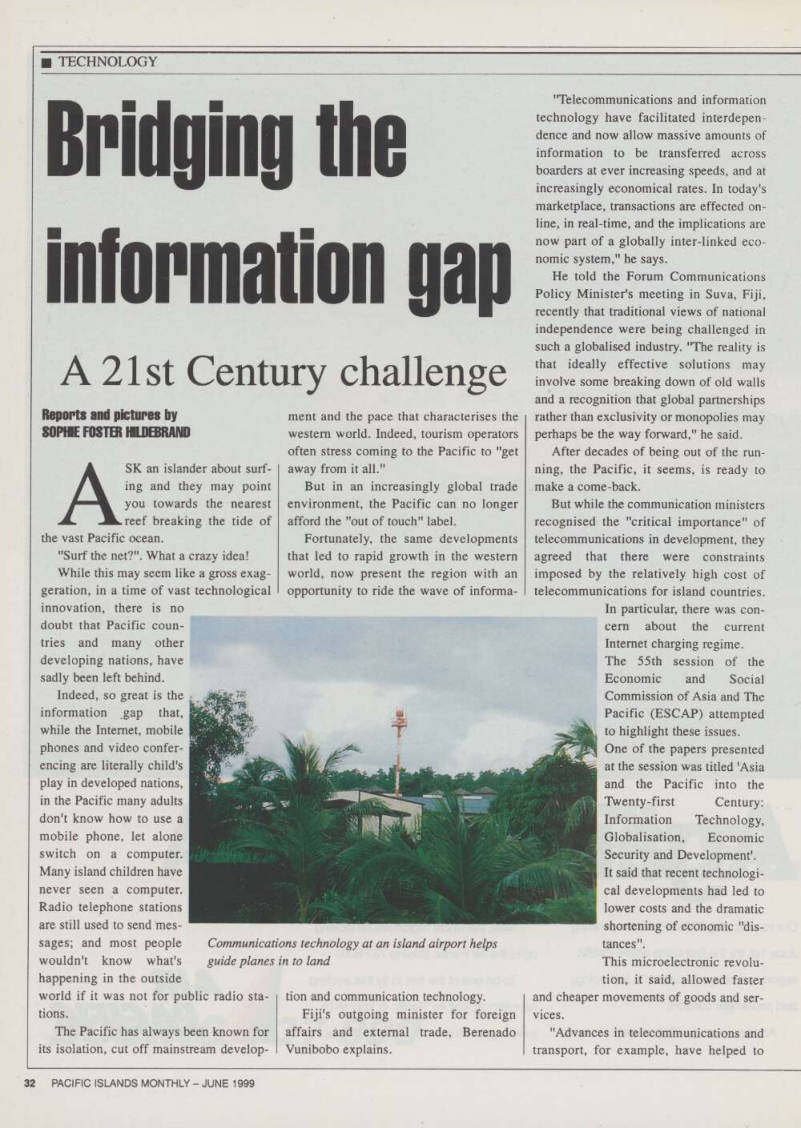
Communications technology at an island airport helps guide planes in to land
lower the costs of communi cation and transportation while the emergence of fax and global computer net works has drastically reduced the economic sig nificance of geography. At the same time, systematic rationalisation of procedures and documentation for inter national trade, together with wider and easier dissemina tion of prices of traded goods, has contributed to the convergence of market prices, resulting in fewer distinct markets," it said.
In many developing countries, such technology is primarily targeted at the privileged and the business community because of the current, relatively high, cost of connectivity.
In a paper to the commu nication ministers in April, the Pacific Islands News Association (PINA) said that there was an important case to be made for bringing
down telecommunication costs.
"If we are to remain competitive with the rest of the world, we must close the gap in communication costs between our Small Island states and the rest of the world. Telecommunication facilities should be seen as part of our basic infra structure like roads, water and hospitals," the PINA statement said.
"Many of our members live in nations
with far-flung populations. Catering for
their needs is a major exercise and requires help from telecom organisations and yet we are asked to pay huge costs ...
Often well above the 'break even' point.
This has bankrupted many Pacific Island
broadcasting organisations."
Even the United Nations has been dragged into the debate.
Last month the UN's Committee on Information was told that public informa tion activities at the United Nations should work to bridge the information gap between developed and developing coun tries.
Ahmad Kamal, the UN Pakistani repre sentative, said that information remained an indispensable part of the critical input for development, as was evident from the wide gaps in the level of progress around the world.
That inherent link between information and development in a world of informa tion superhighways, where competing interests were in a constant race for time and attention, must be stressed, he said.
Unfortunately, the imbalances in the availability of information and in the capacity of different nations and organisa tions to use it have continued to grow.
Kamal said that information had become the lifeblood of domestic and global markets. Market-oriented policies had become almost universal, and all countries were now competing in a single, global market economy. As that process gradually accelerated, the competitive edge of nations was now gauged more by their effectiveness in information process ing than by the traditional notions of
goods and services, he said.
To increase the use of the Internet by the rest of the population, ESCAP says, low-cost links were
required.
"Recent developments in satellite technology have facilitated reliable, high
quality, rapid communica
tions services to remote areas. These systems use hybrid terminals which share the antenna and trans ceiver sections, thus greatly reducing capital investment and the heavy installation costs associated with fixed line networks. This leading
edge technology could
allow rural areas to connect quickly and cheaply to the rest of the world," it says.
But while offering such solutions, the Economic and Social Survey of Asia and the Pacific 1999 admits that there were still certain basic problems that needed to be addressed.
"Many least developed countries and island developing countries have particu lar difficulties in developing their infor mation infrastructure because of lack of funds, experience and expertise, and the unavailability of qualified human resources," it said.
Because of this, many international bodies are promoting the private sector, in cooperation with government, as an effec tive tool for information infrastructure
development.
ESCAP says that the Maldives had used such an approach to telecommunica tions with some success.
Before 1988, domestic telecommunica tions in the Maldives were operated by the Department of Posts and Telecommunications, which was unab’e to meet the level of funds necessary to realise the country's development poten tial.
Continued overleaf
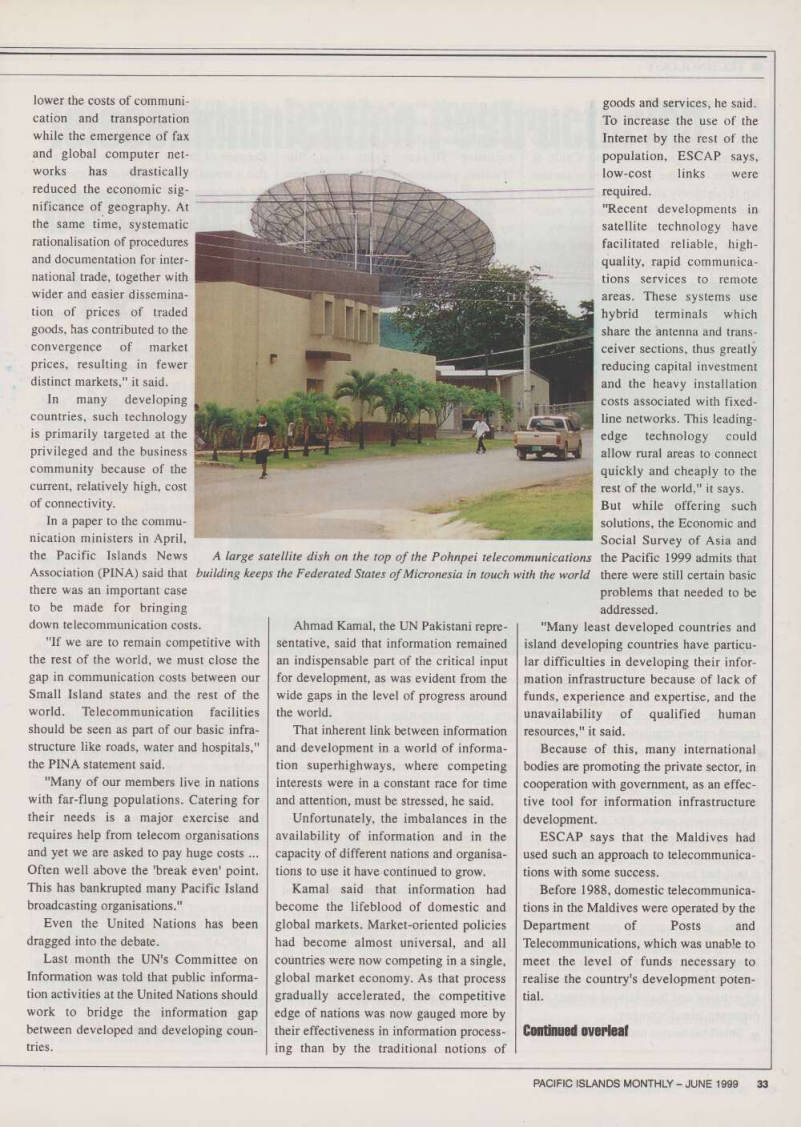
A large satellite dish on the top of the Pohnpei telecommunications building keeps the Federated States of Micronesia in touch with the world
From previous page
A joint venture company was set up between the government and Cable & Wireless, with the government maintain ing the majority share, to encourage fur ther investment and to ensure the avail ability and use of the latest technology.
The new company was granted exclu sive rights of operation for 10 years and,
in return, the government was able to
impose certain regulations, including the
requirement that a national network per mitting access to the whole population should be set up. The role of the Department of Posts and Telecommunications, ESCAP says, then changed from operator to regulator.
The growth of the Internet in Maldives, it said, had increased the use of computers for information gathering, processing and dissemination.
The private sector, particularly the tourism industry, which is the second largest industry after fisheries, started using the Web as a cost-effective way of advertising and maintaining contact in a dispersed island economy.
Small businesses had started to provide
Web page publishing, e-mail servicing and also, to some extent, voice and facsimile servicing through the Internet. With the exclusive 10-year rights over, the Maldives government, ESCAP says, now intended to evaluate opening up the sector to competition. Its target is basic telepho ny access for all inhabited islands of Maldives by the turn of the century.
For their part, Forum member countries
are now promoting access to basic telecommunications as a right.
"While efforts have been made over many years there remain serious short comings in some islands. Only by equity of access will all island peoples have equal opportunities for social and eco nomic development. Universal access will achieve a market expansion that can only improve the efficiency of services," a forum communication ministers statement says.
But while countries may be eager to jump on the information bandwagon, ESCAP has issued a word of caution. It says that in an ICT-intensive world, it is necessary for governments to consider the new vulnerabilities local businesses would be faced with. The ESCAP 1999
survey says that the role of foreign trans national corporations was likely to become stronger and more pervasive.
Because of this, it said, there was a risk that it would be more difficult to stimulate the development of local businesses.
The Pacific Islands News Association, whose members include broadcasters, newspapers and magazine publishers around the region, has also voiced these
concerns.
"The digital and satellite revolu tions, while offering enormous opportunities, also bring with them some tangible threats. In particular, we see potential danger
in the increasing ability of large
media operators to 'beam in' prod ucts from larger countries around us ... while enjoying cheaper access to these telecommunica tion facilities than Pacific Island operators do," an organisation statement said.
And while the same situation can be applied to other industries, PINA took the issue to the Forum communication ministers, citing the example of the Afristar pro ject.
It said that an American consor tium developed the ability to beam multiple radio channels to the entire African continent that were received direct on the
ground by radio receivers with minute satellite dishes.
"This points the way to a future which could see the 'big boys' of the world sit ting in Auckland, the city with the largest Polynesian population in the world, and beaming in a product that could seriously damage local operators," PINA warned.
Moreover, under the rules governing WTO (Agreement on Trade-related Aspects of Investment Measures), govern ments cannot provide wide-ranging pro tection for local enterprises.
ESCAP says that while, in the past, governments could use measures such as local content requirements or trade-bal ancing requirements, this was no longer possible under WTO.
Continued on next page
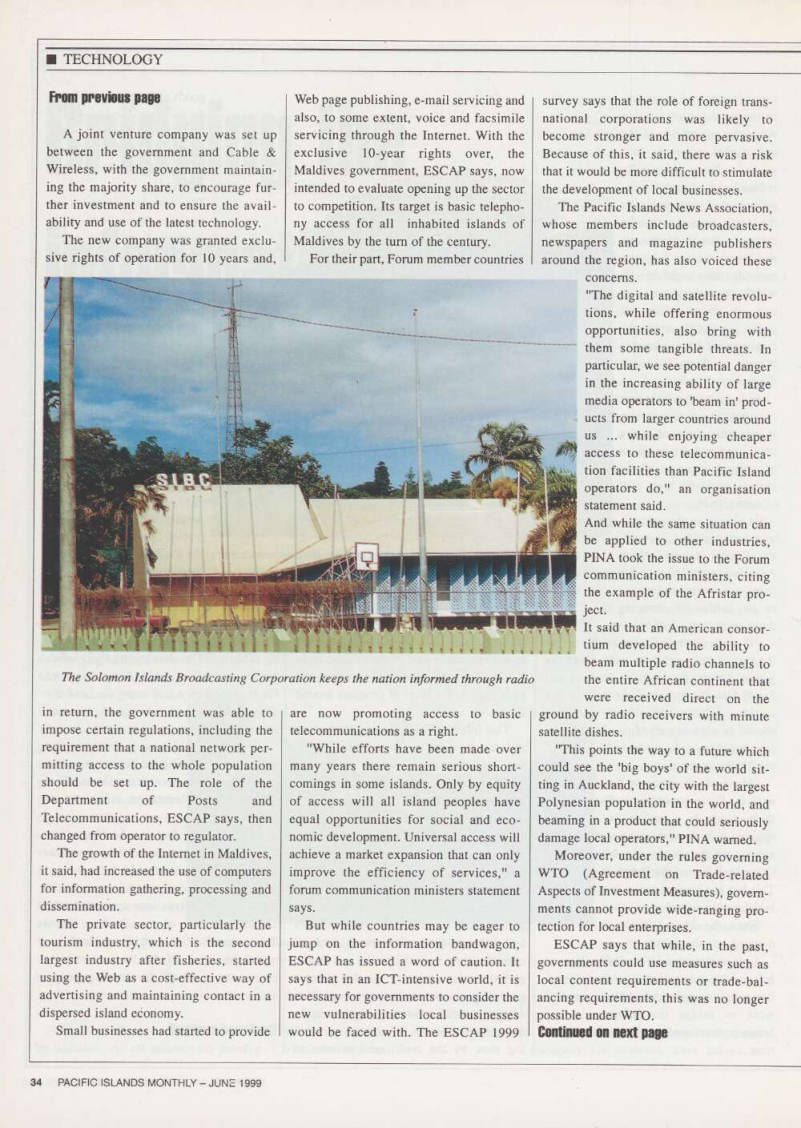
The Solomon Islands Broadcasting Corporation keeps the nation informed through radio
Instead, measures such as provision of credit, infrastructure and transportation facilities, training and retraining will need to be strengthened to allow local entrepre neurs to become competitive or to devel op cooperative relationships with foreign
trans-national corporations.
ESCAP says that the broad challenge for governments in the 21st century is to find a new balance between an ICT-domi
nated highly competitive and quite ruth
less global market and the preservation of local societies. "The tensions between globalisation and social cohesion are real, and they are unlikely to disappear of their
own accord," it says. The irony is that while there is concern about the effect of such developments, the Pacific Islands must keep up with these changes if they are to survive in a rapidly shrinking world.
"ICT is a tool; it is not a threat in itself.
Rather, its application determines whether it is an advantage or a problem. ICT may be currently viewed as part of the prob lem, but its imaginative use is also a large part of the solution. Enlightened policy initiatives can enhance the economic impact of ICT to reduce the marginalisa tion of developing countries in the Asian
and Pacific region, regardless of their size, and to minimise disruptions to eco nomic security," ESCAP says. The region al body says, "the tasks ahead are not easy, but there is very little alternative".
The people of the vast Pacific Ocean are being swept along by a tide not of their creation.
Whether they conquer the elements of information and communication technol ogy, just as their ancestors conquered the great ocean many years before, depends on their ability to navigate, teach and, eventually, agree on the inevitability of it all. ■