Crossing Fiji's
pp. 26-29 · Read in the full issue
Cover Story
Can Chaudhry succeed where others have floundered?
Reports and pictures by
Sophie Foster Hildebrand
TO say that the nation was stunned - when the Fiji Labour Party won an
overwhelmingly majority
in the country’s House of Representatives - may be an under statement. But it was nothing com pared to the reaction that greeted the announcement, May 19, that Labour leader Mahendra Chaudhry had been sworn in as prime minister.
To outsiders, this may not seem like such a big deal, but in Fiji, where race has
determined political dom inance since indepen dence, it was a landslide.
For this is the same country that, 12 years ago, was thrust into chaos when outgoing prime minister Sitiveni Rabuka led a military coup to overthrow another Labour government. The issue then was one of race.
For many Fiji Islanders (as the country’s year-old constitution col lectively calls its citizens) the current situation is like deja vu - a Labour government, a split in the Fijian vote, and Indians on the other side of the House. But, many people
in this country, once known as “the way the world should be”, hope that this is where the similarities end.
On the first day of counting, it was obvi ous Fiji’s voters were after a change. By the
third day, Rabuka had presented his resig nation to the President, Ratu Sir Kamisese Mara, and conceded defeat. His Soqosoqo ni Vakavulewa ni Taukei (SVT) party had won just seven seats, losing many in areas which were once considered SVT strong holds.
This time around, even Rabuka has had to concede defeat in the face of nation-wide support for the Labour-led People’s Coalition (including partners, the Fijian Association and the Party of National
Unity). Distributing preferences to each other, the People’s Coalition amassed 52 seats in a 71-seat House. Of this number, Labour amassed 37, enough to rule on its own if it wished.
In its landslide victory, the SVT was not the only casualty. The most noticeable, for
its failure to win a single seat, is the long-serving National Federation Party.
Founded before indepen dence, the party had fought the 1999 elections in a coalition with the out going SVT/UGP govern ment.
Commenting on the fail ure of their coalition, Rabuka said “we were bad for each other”.
“The result of the election and especially the orches trated bloc voting by the
Indian community clearly
shows how far apart we still are racially,” he said.
In 1993, a local newspa per quoted NFP leader, Jai
Ram Reddy, as saying
multiracialism could not work in Fiji.
“Multiracialism is unrealistic. History proves it does not work. If you look back at the history of Fiji since 1965, at the first Constitutional Conference we were told
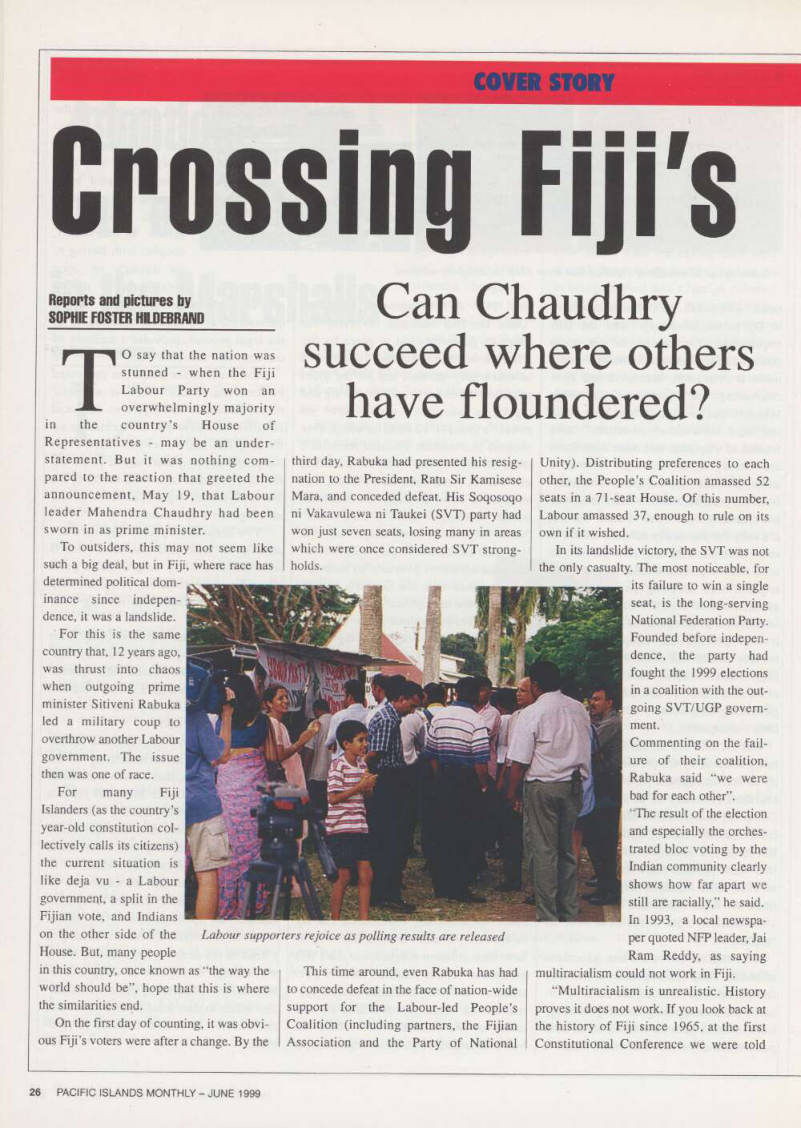
Labour supporters rejoice as polling results are released
that it was wishful thinking,” Reddy said.
“I have learnt over a period of 30 years that the type of multiracialism Mr Chaudhry is dreaming about will not hap pen. I believe that better men have tried and have not succeeded,” he said.
Six years later, in his first press state ment after being installed as prime minister, Chaudhry was overwhelmed by the support
that Labour had received. He said, “we have witnessed what can only be described as a People’s revolution”.
He described the events of 1987 as “unfortunate”, saying “we must put the past behind us”.
Although Labour has managed to win a majority in parliament against what seemed like insurmountable odds, a bigger task
awaits them - bridging the racial divide. It is a vision that Reddy once said was unreal istic, Rabuka attempted to promote, and is
now Chaudhry’s greatest challenge.
The cards, though, may be stacked in their favour.
The FLP was set up to challenge what was seen as anti-worker policies of the gov ernment of the day. Founded on principles of multiracialism, the Labour worked to “restore the faith of our people in democra cy, in the government of the day, and above all, in Fiji”, one of its founders. Dr Timoci Bavadra said in 1986.
It was this multiracial approach which led to a swing in voting patterns, propelling Labour to victory in 1987.
Twelve years later, Labour has again managed to swing the vote in their favour once more propelling them to power. The multiracial focus, it seems, is still being
pushed.
“Our emphasis now must shift to that of building a secure multiracial foundation for our country and not on propagating com munal politics,” Chaudhry said in his first statement as PM.
“The Fiji Labour Party is truly humbled by the magnitude of this support - it is over whelming and the fact that it comes from a good cross section of our people confirms our faith in Fiji as a truly multiracial soci ety,” he said.
Others though, do not see it that way.
Addressing indigenous Fijians, in a speech
after his resignation as prime minister, Rabuka said, “we must find a way to come together to allow our collective voice to be heard and to be a force in shaping the future of our country”.
“We have allowed ourselves to splinter into different groups working against our common interests. A house divided amongst itself cannot stand,” he said. The deep dis-
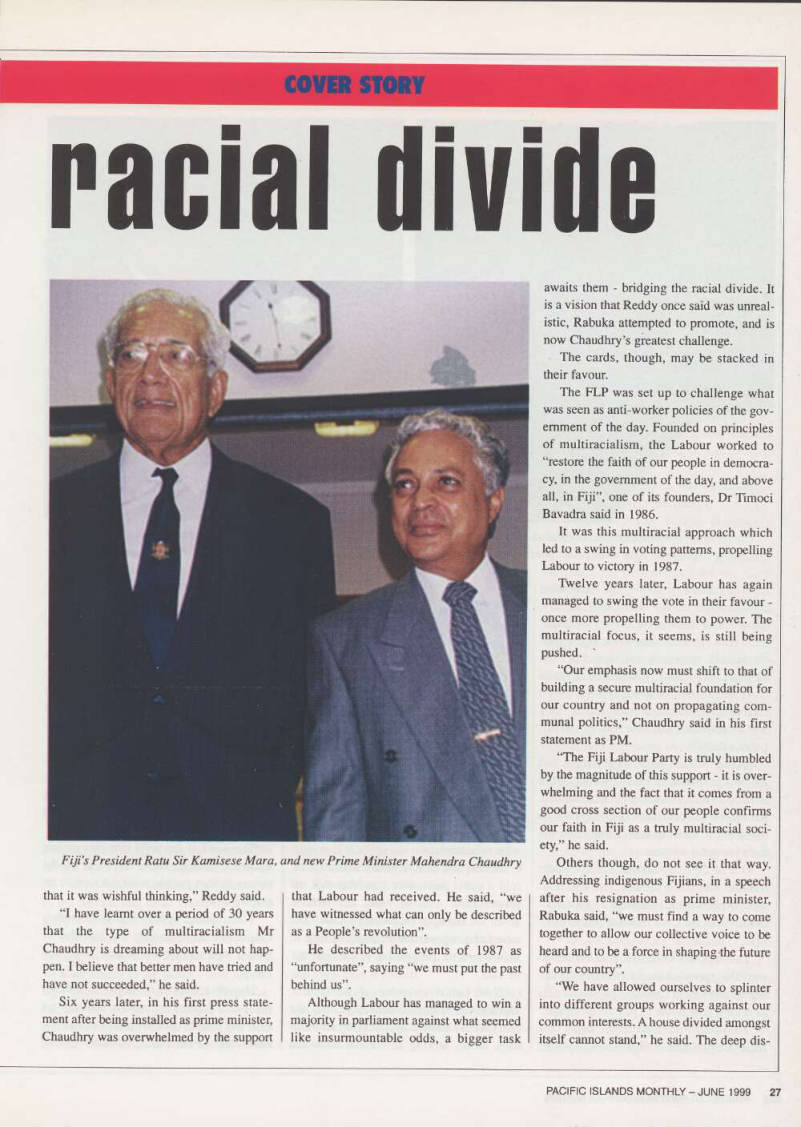
Fiji’s President Ratu Sir Kamisese Mara, and new Prime Minister Mahendra Chaudhry
trust of Indians, it seems, had once more been brought to the surface. Chaudhry, though, has made swift efforts to dispel these fears. In a message to the Fijian peo ple, he said, “you have nothing to fear from the Fiji Labour Party. Your special rights as an indigenous community are well entrenched in the new constitution, they will be respected and observed by the Fiji
Labour Party”.
Labour’s trade union beginnings, and the background of its leader can only work in their favour in crossing the racial divide.
Known for his confrontational approach to unionism, Chaudhry has championed the fight for many workers.
One of the first Acts that the new prime minister has said FLP will pass will rein state workers made redundant by the corpo ratisation of the Civil Aviation Authority of
Fiji.
The People’s Coalition also intends to stop the privatisation of publicly owned enterprises which Chaudhry says is as silly as selling your house to pay the mortgage.
The coalition manifesto says they believe “strategic utilities such as water,
electricity, telecommunications and civil aviation facilities must remain in public hands as viable units. We also believe that the overall control of the exploitation of natural resources such as forestry and fish eries must remain in State hands to main tain their sustainability. We will, therefore, reverse all moves to restructure and priva tise them. They will be reorganised and streamlined to make them more efficient and responsive.”
It was this promise which swung many votes their way - especially when the SVT government had signed the lay-off of hun dreds of workers, with more to come if they were reinstated.
History scientist Professor Stewart Firth told a panel discussion late May that the privatisation process was unavoidable given the financial problems in Asia. “The new Labour government might be able to slow down the process but not reverse it,” he said.
New Labour member of parliament, Doctor Ganeshwar Chand says that the party would analyse restructuring issues as they arose, talking to the International
Monetary Fund and the World Bank before agreeing to any kind of international policy.
Doctor Bob Norton told the panel that there was great potential for the new gov ernment to survive if it made quick and practical decisions. He said although the SVT and NFP had banked on gaining more support based on what they had done for the Constitution, there were other bread and-butter issues that bedevilled voters.
Professor Firth said Labour succeeded
because they promised people things they
wanted to hear such as the scrapping of Value-added Tax on certain essential food items.
The word at the polls was that people wanted a change. Now, the word on the streets is that people want Labour to be given a chance.
When cracks appeared in the People’s Coalition after Chaudhry was installed as PM, it seemed that a repeat of 1987 was
likely.
However, Labour managed to weather that storm and has managed to not only get FAP and PANU back on side, but also the Christian Democratic Alliance (VLV)
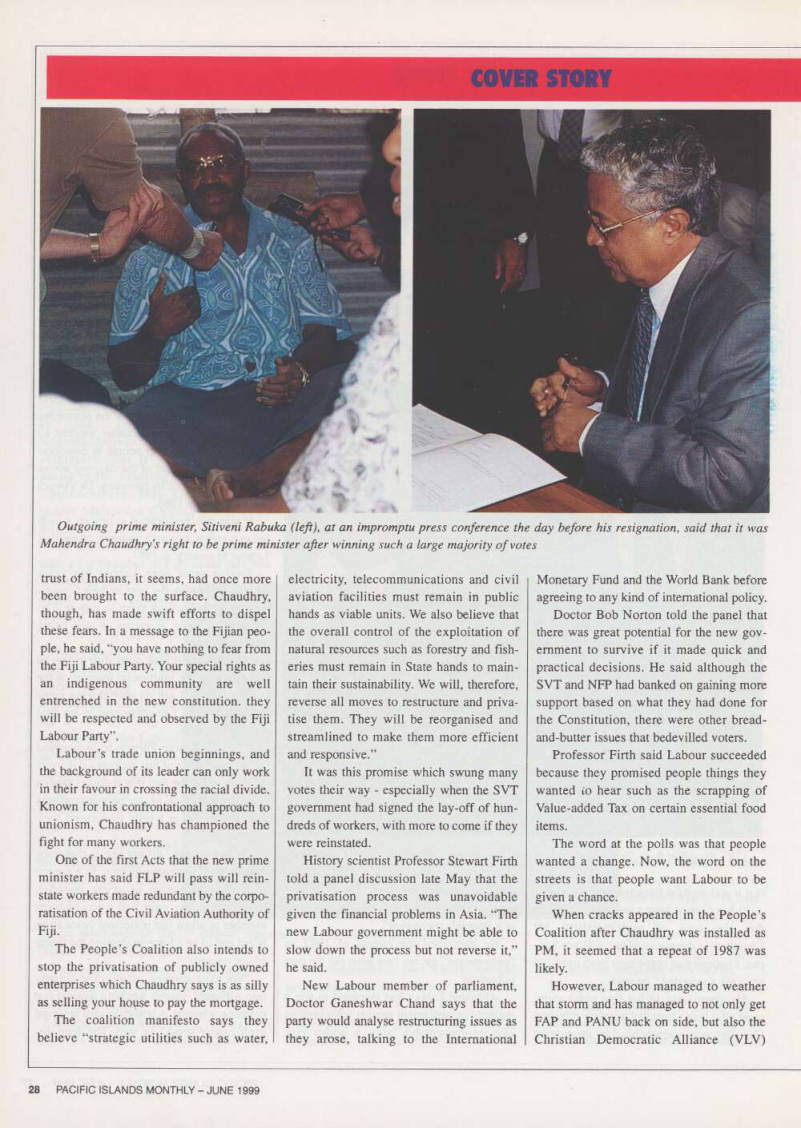
Outgoing prime minister, Sitiveni Rabuka (left), at an impromptu press conference the day before his resignation, said that it was Mahendra Chaudhry’s right to be prime minister after winning such a large majority of votes
which is seen as a Christian fundamentalist party. The FLP used its chance to make inroads in multiracial representation, through the application of clauses in the new Constitution which call for a multi party cabinet. Under the constitution, the Prime Minister is obliged to invite any party with eight or more seats in the House to join him in cabinet.
Chaudhry, though, has taken this a step further and invited not just the parties that have eight or more seats, but also those that have less.
In his 1999 line-up, Chaudhry has given two positions to the Christian Democratic Party (VLV) and the Party of National Unity (PANU) even though they did not have the requisite number of seats. The FAP has been given a Deputy Prime Ministership, two cabinet positions and an Assistant Minister post.
With a view to eradicating underlying distrust that some Fijians have of Indian intentions, Chaudhry has allocated the port folios which centre of Fijian interests to Fijians - most of whom are not Labour members. FAP leader, Adi Kuini Vuikaba Speed has been given the important portfo lio of Minister of Fijian Affairs, and she will now chair the Great Council of Chiefs
meetings.
Poseci Bune of the VLV has been given the Ministry of Agriculture, Fisheries and Forests, which concerns the resources
owned by Fijian mataqali.
The tourism portfolio which often involves the use of Native land to establish hotels and tourism facilities, has been given to Adi Koila Mara Nailatikau, the daughter of the President and a VLV member.
Chaudhry is playing smart politics by
adopting such an approach, but it seems that he still has a few more trump cards to play.
As PM, he makes a number of appointments to the Senate, and these members are also allowed to be members of cabinet.
With such a magnanimous mood pre vailing, he may even appoint NFP leader, Jai Ram Reddy to the senate - thus appeas ing those voters who are bitterly disappoint ed that NFP did not get a single seat in the House of Representatives. Even if this does not eventuate, Chaudhry has already shown
that he is putting to good use his experience in politics and collective bargaining. Even though Labour has won an outright majori ty in the House, the party has shown sensi tivity in its first few days of power.
There is no doubt that Fiji’s 1999 elec tions will go down in history books as a
turning point in the country’s independent
journey.
For the first time, a person of Indian her itage was made prime minister.
For the first time, almost nine per cent of the House is made of women.
And for the first time, voters have realised that their vote has power.
Perhaps, too, for the first time, someone will succeed in crossing Fiji’s racial divide, and even bury it forever.
And if any lessons are leamt, the 2004 elections could see the rise of several new multi-racial parties, and a return to “the way the world should be”. ■
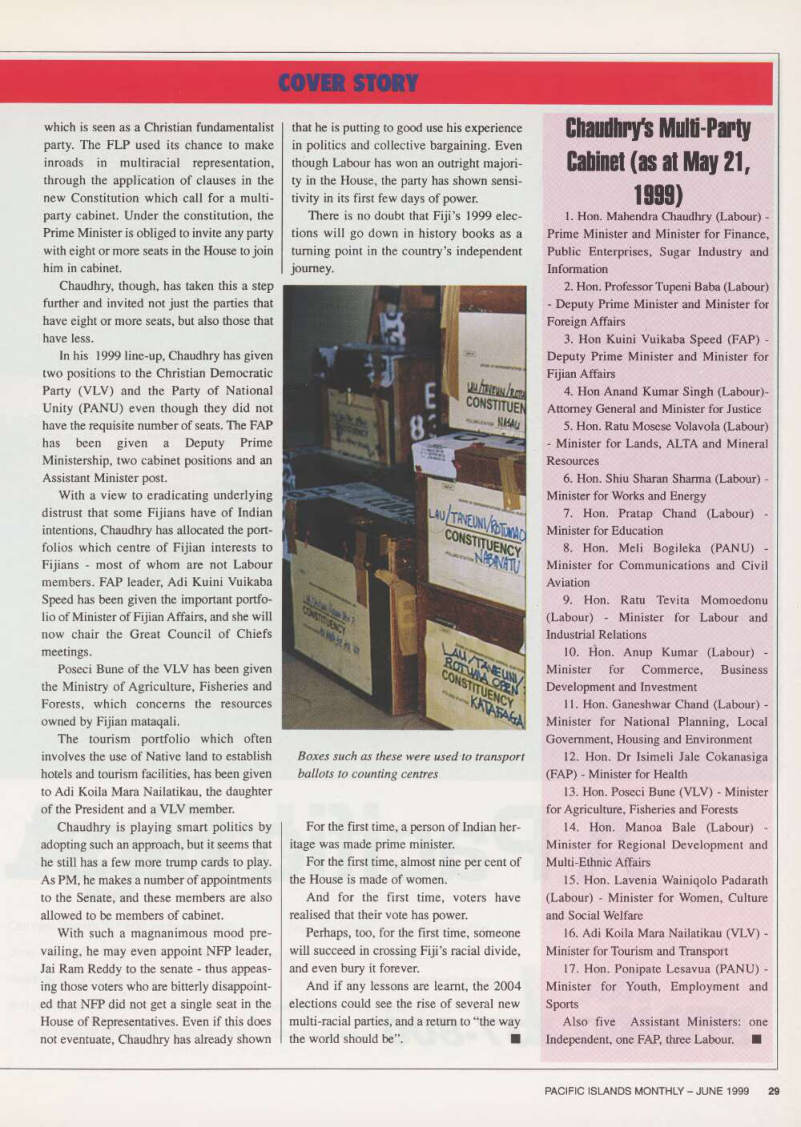
Boxes such as these were used to transport ballots to counting centres