Adoptions are
pp. 24-25 · Read in the full issue
"out of control" in the Marshalls
By Giff Johnson
LIKE one of those Wall Street business graphs with the line shooting off the chart, the number of Marshallese babies adopted by Americans continues to skyrocket with no downturn in sight. It’s definitely a
growth industry.
But the Marshall Islands government, which believes off-island adoptions are out of control, is in the final stages of completing an investigation that is expected to lead to stricter regulations
governing adoptions.
Meanwhile, the US Immigration and Naturalization Service has announced plans to require that all babies being adopted by Americans be “orphans” and have US visas (because of a Compact of Free Association with the US, Marshall Islanders have visa-free travel to America) that must be issued from Manila.
The real problem, however, is the growing number of adoptions that are cir cumventing the Marshalls’ legal system adoptions that the INS proposal and stricter regulations by the Marshall Islands would increase rather than con trol by making it more difficult to adopt through the system in the Marshalls, say critics. Fueling what some are labeling “black market” adoptions is the lucrative nature of the baby trade. According to some, adoption arrangers or brokers can charge as much as $20,000 to locate a baby for adoption. Today, there are half a
dozen US-based adoption agencies and I
legal offices adver tising the availability of Marshallese chil dren to American parents; several have web pages on the Internet.
And while the major ity of these agencies are legitimate, licensed programs, there are others that are not and are clear ly avoiding the legal
process in the Marshalls, which requires a home study of the prospective parents, with police report, from a licensed adop tion agency.
With nearly three babies from Majuro being adopted each week in 1998 and thus far this year, the issue has become highly visible and emotionally charged in the islands. In 1997, the High Court in Majuro handled applications for 63 adop tions; last year the number more than
doubled to 143. That does not include the many more adoptions I handled through the courts on I Ebeye, the Marshalls second fl major urban center, and what are J| apparently dozens more pregnant ga women and newborn babies JH being flown to Hawaii for adoption through the Hawaii courts. mggggKt In February, the Cabinet directed the Ministry of - fl Foreign Affairs to launch a M fast-track probe of the adop- B|hK tion situation and report back in 90 days. A report, V with recommendations, is expected to be filed with the mk country’s leadership in June, * Public hearings sponsored by H the Foreign Ministry have pro- H duced mixed and often conflict- H ing testimony, but they have ** underlined the point that the Me growing out-flow of fee Marshallese children is an ad emotionally charged issue that
is worrying many people in the commu nity. “We want to understand the situa tion and have some control over it,” said
Foreign Secretary Marie Maddison.
“Right now, things are out of control.”
She indicated that it is not the level of complaints but rather the sheer numbers that have triggered the government’s concern. “What are the hidden ramifica tions of overseas adoptions? We do not want to be in a situation 10 years from now where kids are saying they were abused, or complain that they had no say in being adopted into a foreign culture.”
But local attorneys involved in pro cessing adoptions say that this concern is misplaced and should be directed at the adoptions that are avoiding rather than going through the legal system.
American attorney David Strauss, who lives in Majuro, handled 81 of the 143 adoptions in 1998. He told a public hearing recently that many of the babies and children that he is processed for adoption are now much healthier, and their rate of growth has improved, since being adopted by their new American families who are able to provide better
nutrition and medical care for the children.
'% ■ The lawyers and the gov ■ ernment agree in one area: IP they both object to the pro ill posed US INS plan to inter- Hf vene in Marshallese adop *f.i tions. The Ministry of
■ Foreign Affairs has officially
requested that the INS hold off t implementing its new visa requirement until the Marshall Islands has finished its investi gations and proposed a plan of action. “It would be wrong for the INS to do it,” said Ik W Majuro attorney John Silk, who handled the adoption ■n of 31 children in 1998. ■ “First of all, why does a *. H Marshallese child need a BIRiB US visa to go to the US but ildren I don’t?” He and other Majuro-based attorneys say te that the INS plan will kill
adoptions through the
Marshall Islands legal system, fueling a black market baby industry. “If this goes through, there won’t be any more adop-
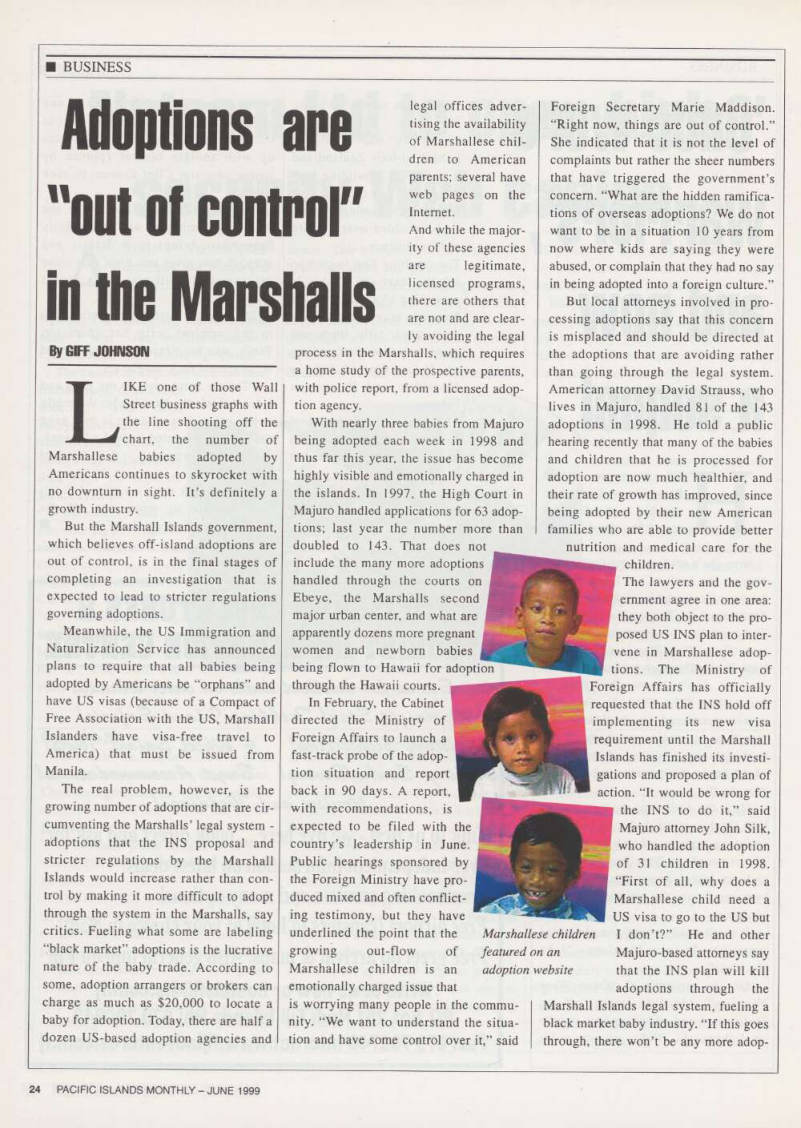
Marshallese children featured on an adoption website
tions,” Silk added. “It’s already expensive to fly to the Marshalls” and the INS requirement for babies to get visas through the US Embassy in Manila would make it even more expensive and time consuming for Americans to adopt Marshallese, he said. “There’s so much red tape with other countries,” said Strauss of why more and more Americans are turning to the Marshall Islands to
adopt. It’s relatively inexpensive to adopt
from the Marshalls and as Marshallese do not currently need visas to enter the US, it’s easy for the newly adopted babies to enter America with their new parents, he said. The Marshall Islands High Court requires that adopting parents have a detailed home study conducted by a licensed adoption agency in the US before it will process the adoptions. These include police and related reports. The High Court instituted these requirements of its own accord as Marshall Islands law governing adoptions is outdated and of little consequence.
But the INS has decided that children being adopted by US parents do not qual ify as non-immigrants (as all natural bom Marshall Islanders do as a result of the Compact) and therefore must get visas from Manila - before entering the US.
But there is a second condition that the INS wants put into place that would have an even more dramatic impact on adop tions: the requirement that to be adopted, a Marshallese child would have to be an “orphan.”
This definition would ban adoptions unless the child has no parents or has only one parent who relinquishes control, vir
tually eliminating the possibility of adop
tions even if parents wanted it. If both parents are alive the INS would refuse a
visa, even if both agree to adoption.
“Once the INS becomes involved, the adoption guidelines put in place by the government of the Marshall Islands will be essentially useless, and all the giant steps they’re taking toward reviewing and regulating adoptions would have no effect,” a group of 22 families which have adopted Marshallese children wrote in a letter to the Marshall Islands Journal in mid-March. American Marie Parson, who adopted a child through the Marshall Islands courts, said that INS involvement “will only drive the adoptions into Hawaiian courts where they will become domestic adoptions governed by state law and Hawaiian state law does not require home studies, background checks, etc.”
One American woman, who is assist ing a Marshallese woman attempting to gain the return of her child adopted through what they say were false pretens es, says that Marshallese babies are some times literally picked up at curbside at Honolulu International Airport after their mothers step off the plane from Majuro.
“One more practice recently implemented by a US agency,” said American Kathryn Staton-Smith, “(involves) procuring young pregnant women, through Marshallese arrangers, flying them to Hawaii to give birth to their children, and placing the newborns for US-finalised
adoptions.”
With unrestricted travel privileges under the Compact, Marshallese can fly to Hawaii (or elsewhere in the US) to have their children adopted, but does this give them - or the Marshall Islands gov ernment - the same assurance that the sys tem in the Marshalls provides for the safety of the children? And while the Marshall Islands High Court requirements
may seem minimal, the fact that adoptive par ents must have a home study, with a police report, prepared by a licensed adoption agency, available for review by the court, coupled with having to go through an open legal process during
which the Marshallese parents can be questioned as to their understanding of the legal process, provides a measure of certainty and accountability.
Moreover, unlike adoptions processed in American states, there is a public record available in Majuro to the local families who have put their children up for adoption. Majuro lawyers believe that the people sending Marshallese to the US for adoptions and otherwise avoiding the Marshall Islands legal system are giving all adoptions a bad name.
“I’ve heard some people criticise these adoptions,” Silk said last year. “But if someone is willing to provide a good home for these children, you can’t stop Marshallese parents from making their own decisions.”
He added that an important concern for many Marshallese parents putting chil dren up for adoption is their land rights in the islands. “Even if they are adopted and go to live in the US, they still retain their land rights,” Silk said.
Adoptions have skyrocketed in the past two years with little scrutiny. In the past three months, that’s taken a dramatic change, with both the Marshall Islands and US governments planning to institute stricter regulations. But whether those efforts to regulate adoptions offer better protections to Marshallese children or will instead stimulate an explosion of uncontrolled, black market adoptions remains an open question. One thing, however, is certain. Events are coming to a head in the next several months, which will change the nature of adoptions of Marshallese children by American fami lies which to date have been without any intervention or interference by govern ments. ■
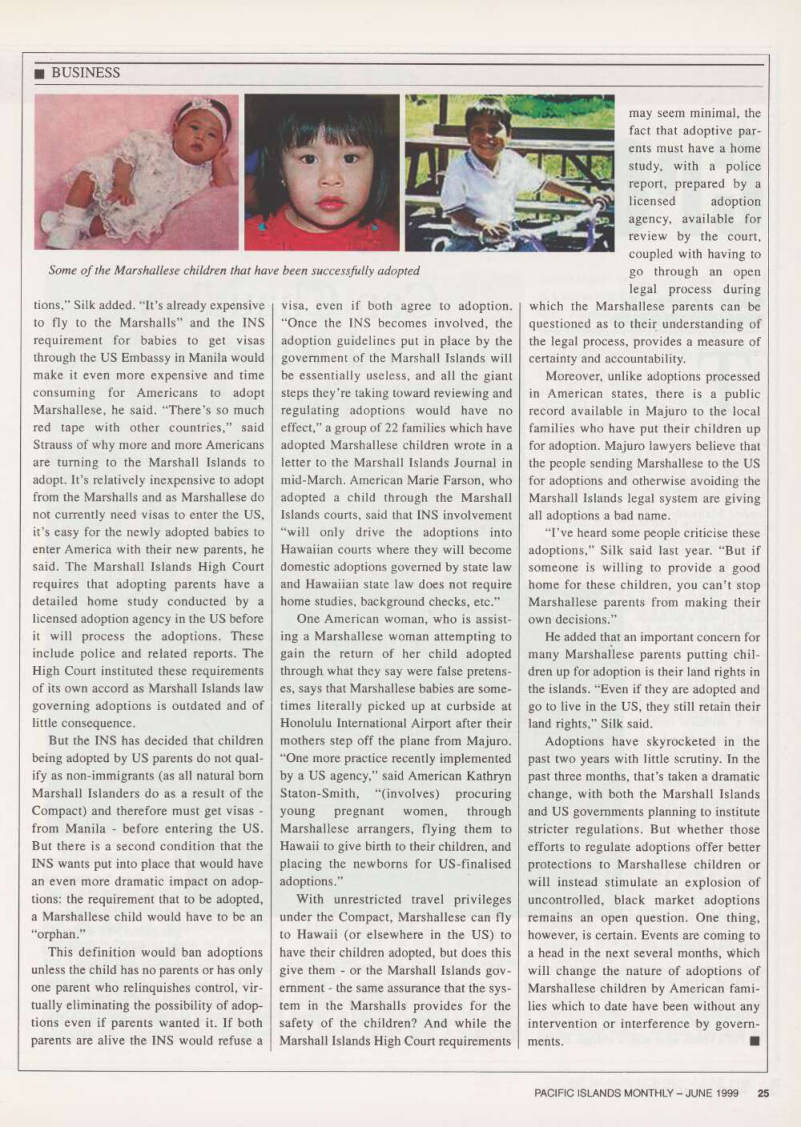
Some of the Marshallese children that have been successfully adopted