reality in PNG
p. 21 · Read in the full issue
Iridium makes global mobile phones a reality in PNG
By Brian Tobia
IMAGINE dialling up an interna tional telephone number direct from a very remote area that lacks telecommunication services or links through cable or repeater stations.
The introduction of a new global mobile telephone service has made this a reality in Papua New Guinea.
It is now easier for company executives with international connections (engaged in explorations for mineral resources, log ging, and agriculture) to get information
of value across to their organisations located anywhere in the world faster.
Or vice-versa, direct com munications from anywhere in the world to PNG without ’|k jj/k rushing to the office to make an international call is now a reali- J ty in PNG. ) The country's advanced BB| telecommunication network under the monopoly of 100 per cent gov- V ernment-owned Telikom (PNG) % Limited has introduced a new product 18 to further boost communication links between the country and the world.
Telikom launched the global mobile satellite telephones - which can be used to reach the rest of the world from anywhere in the country - last month.
Telikom (PNG) in conjunction with Pacific Iridium Telecommunication Company of Taiwan launched the premi um global mobile telephone service in PNG. The new global mobile telephone service has immediately attracted over whelming interest from potential cus tomers.
Already a total 1000 customers (main ly from the mineral resource sector and other industries) have applied to get the new mobile phones. Telikom executives anticipate more expressions of interest in the new product. Managing director, Thomas Tulin, expressed optimism that the potential market base for these new global mobile telephones includes chief executives of both the public and private sectors and resource companies (particu
larly in mining and petroleum, forestry
and agriculture) operating in most rural
settings.
He said the new global mobile tele phone service and any other service pro vided by Telikom would not survive without customers HI from these important sec tors.
Public Enterprises and
9k Communications
Jk Minister, Dr. Fabian Pok, also urged ■A. consumers from these important ft sectors to use the new ■k service for
Ba develop-
Hk ing pro- Hk jec t s mk t h e i*s!k rural areas ot Papua New Guinea. He said was amazing that a customer can B make a phone call using the same tele- B phone and same " number anywhere in the world.
Telecommunication is a key component of any development programme and govern ments and businesses cannot operate with out instant communications in both the urban and rural sectors, he added. Telikom (PNG) now has one of the world's most advanced telecommunication systems fol-
lowing the introduction of this new ser vice into the country.
PANGTEL director general Philip Aeava added that his organisation, as a regulatory body, is willing to cooperate with the industry for the benefit and inter est of everyone.
"This is critical to the development of the telecommunications and broadcasting industry and realisation of national devel
opment goals and objectives ... launching
of Iridium services in PNG is an exam ple," he added.
The Iridium Global Mobile Personal Communication Satellite Service (GMPCS) will have the advantage of using only one number and one phone bill thus enabling customers from PNG to ring anywhere in the world.
Iridium, an American company, has about 67 satellites circling the world.
Sources in the know said initially one thousand subscribers will be connected to the service.
Unlike the cellular system, users do not have to be near a repeater station or an exchange.
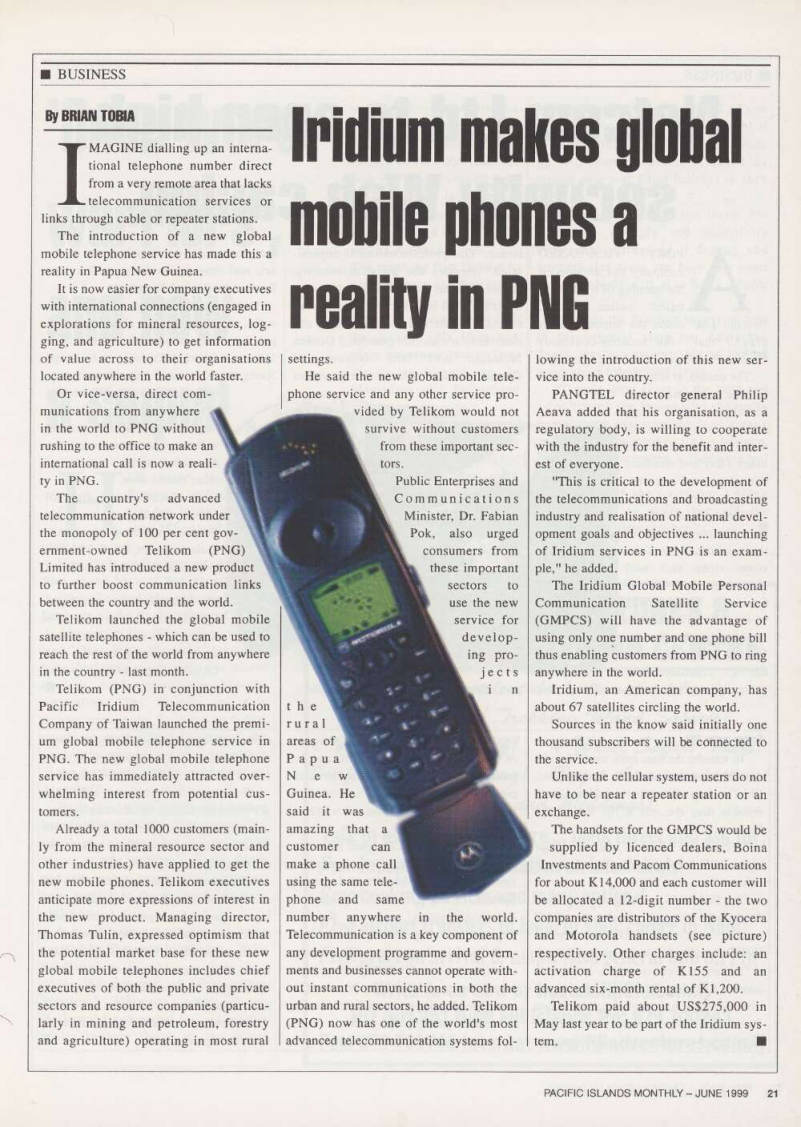
The handsets for the GMPCS would be I supplied by licenced dealers, Boina Investments and Pacom Communications for about K 14,000 and each customer will be allocated a 12-digit number - the two companies are distributors of the Kyocera and Motorola handsets (see picture) respectively. Other charges include: an activation charge of K 155 and an advanced six-month rental of K 1,200.
Telikom paid about U 55275,000 in May last year to be part of the Iridium sys tem. ■