FATERA will eventually
pp. 18-19 · Read in the full issue
By Sophie Foster Hildbrand
ANEW Fiji/Australia
Trade and Economic Relations Agreement (PATERA) will eventu ally replace SPARTECA’s (South Pacific Regional Trade and Economic Cooperation Agreement) role in trade between the two countries.
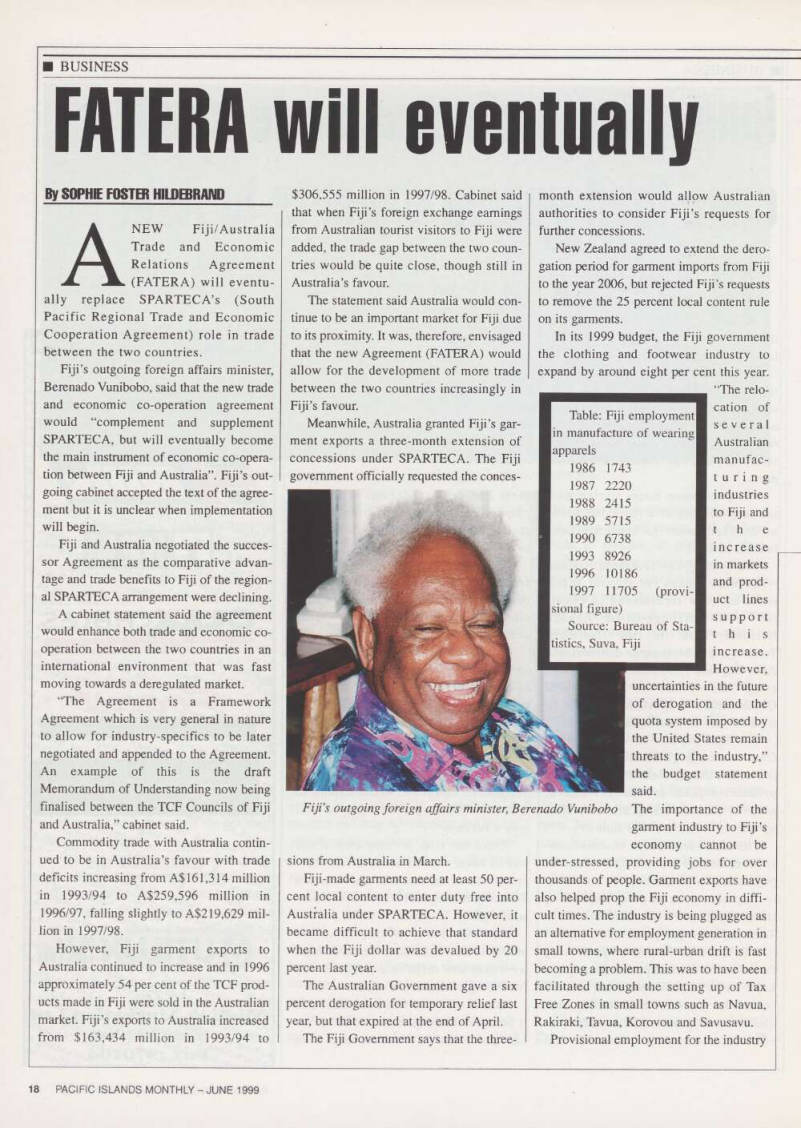
Fiji’s outgoing foreign affairs minister,
Berenado Vunibobo, said that the new trade and economic co-operation agreement would “complement and supplement SPARTECA, but will eventually become the main instrument of economic co-opera tion between Fiji and Australia”. Fiji’s out going cabinet accepted the text of the agree ment but it is unclear when implementation will begin.
Fiji and Australia negotiated the succes sor Agreement as the comparative advan tage and trade benefits to Fiji of the region al SPARTECA arrangement were declining.
A cabinet statement said the agreement would enhance both trade and economic co operation between the two countries in an international environment that was fast moving towards a deregulated market.
“The Agreement is a Framework Agreement which is very general in nature to allow for industry-specifics to be later negotiated and appended to the Agreement.
An example of this is the draft Memorandum of Understanding now being finalised between the TCF Councils of Fiji and Australia,” cabinet said.
Commodity trade with Australia contin ued to be in Australia’s favour with trade deficits increasing from A$ 161,314 million in 1993/94 to A 5259,596 million in 1996/97, falling slightly to A 5219,629 mil lion in 1997/98.
However, Fiji garment exports to Australia continued to increase and in 1996 approximately 54 per cent of the TCF prod ucts made in Fiji were sold in the Australian market. Fiji’s exports to Australia increased from $163,434 million in 1993/94 to
$306,555 million in 1997/98. Cabinet said
that when Fiji’s foreign exchange earnings
from Australian tourist visitors to Fiji were added, the trade gap between the two coun tries would be quite close, though still in Australia’s favour.
The statement said Australia would con tinue to be an important market for Fiji due to its proximity. It was, therefore, envisaged that the new Agreement (PATERA) would allow for the development of more trade between the two countries increasingly in Fiji’s favour.
Meanwhile, Australia granted Fiji’s gar ment exports a three-month extension of concessions under SPARTECA. The Fiji government officially requested the conces-
sions from Australia in March.
Fiji-made garments need at least 50 per cent local content to enter duty free into Australia under SPARTECA. However, it became difficult to achieve that standard when the Fiji dollar was devalued by 20 percent last year.
The Australian Government gave a six percent derogation for temporary relief last year, but that expired at the end of April.
The Fiji Government says that the three
month extension would allow Australian authorities to consider Fiji’s requests for further concessions.
New Zealand agreed to extend the dero gation period for garment imports from Fiji to the year 2006, but rejected Fiji’s requests to remove the 25 percent local content rule on its garments.
In its 1999 budget, the Fiji government the clothing and footwear industry to expand by around eight per cent this year.
Table: Fiji employment in manufacture of wearing apparels 1986 1743 1987 2220 1988 2415 1989 5715 1990 6738 1993 8926 1996 10186 1997 11705 (provi sional figure) Source; Bureau of Sta tistics, Suva, Fiji
“The relo cation of several Australian manufac tur i n g industries to Fiji and t h e increase in markets and prod uct lines support this increase.
However,
uncertainties in the future of derogation and the quota system imposed by the United States remain threats to the industry,” the budget statement said.
The importance of the garment industry to Fiji’s economy cannot be
under-stressed, providing jobs for over thousands of people. Garment exports have also helped prop the Fiji economy in diffi cult times. The industry is being plugged as an alternative for employment generation in small towns, where rural-urban drift is fast becoming a problem. This was to have been facilitated through the setting up of Tax Free Zones in small towns such as Navua, Rakiraki, Tavua, Korovou and Savusavu.
Provisional employment for the industry
Fiji’s outgoing foreign affairs minister, Berenado Vunibobo
last year showed that about 11,000 people were directly employed. The government believes the industry has the potential to add 3,000 people to the workforce yearly.
The industry was also allocated F 5745,000 in the 1999 budget for the imple mentation of the Textile, Clothing and Footwear Industry Plan. In addition, the Garment Training School is in the process of being transferred to the Fiji National Training Council, which all employers are obliged to make contributions to.
Early this year, brassiers were added to the growing list of garments manufactured in Fiji for export. This followed a decision by Sara Lee Intimates of Australia to trans fer its bra production from South-East Asia to the Kalabo Tax Free Zone, outside Suva..
“Close proximity to Australia, in addi tion to tax concessions, duty free importa
tion under SPARTECA and low wages are the key reasons for transferring bra produc tion from South East Asia to Fiji,” said Alan Blake, a senior executive of Sara Lee.
When fully developed bra production was expected to create 200 jobs, generate additional export revenue of F 52.5 million and will result in additional investment of Fsl.2 million.
Senior executive of Sara Lee Intimates, Alan Blake said the decision was made after a successful development programme last ing 12 months involving three local compa nies.
“Since bra production is more compli cated than the other garments currently made in Fiji, we had to satisfy ourselves that Fiji can produce bras to our standard before approving the transfer,” said Mr Blake. He said the development programme
did not proceed as quickly as the company hoped because of lack of appropriate skills.
This problem is being addressed by the deployment of an expert in the production of bra to be located in Fiji for three years.
The local companies involved in the devel opment programme are currently producing nearly 1,000 units of bra a day earning export revenue of F$ 175,000 a month.
There is no doubt that the garment indus try in Fiji is fast replacing other manufac turing sectors as a top employer and foreign exchange earner. But its future hinges on various trade agreements and concessions that Fiji has with Australia, New Zealand and the United States. How well such agree ments are negotiated by the relevant author ities will probably determine whether the industry remains a success story or causes horrible nightmares. ■