competent authorities
p. 33 · Read in the full issue
Mad Cow disease, tuna and competent authorities
WHEN Mad Cow Disease hit the cattle in Europe and Britain, there was mass uproar in Europe.
Health and sanitation standards and authorities were publicly blamed for what was seen as a failure to do their jobs right.
As a result, health and sanitation author ities and veterinary experts in the EU have tightened up on the standards that are required in order for not just goods to be sold, but for actual factories to stay open.
Almost ten years ago, in 1991,
European authorities began this process of reforming their approach to health stan dards of goods within the region.
For the fishing industry which included factories, fishermen, and the authorities, it began a time of increased frustration as new laws were put in place and producers had to adapt their businesses to suit or be put out of business. For the Pacific, Mad Cow Disease did not cause too much of a
scare. But Pacific exporters are now find ing that they too have to adapt their busi nesses and staff if they want export to Europe.
Now the same process of reform is being adopted throughout Pacific Island countries.
An ACP-EU industrial Partnership Meeting on the Tuna Industry, held in Fiji in February, attempted to explain the processes to exporters wishing to export to the lucrative EU market.
Hosted by the Brussels-based Centre for
the Development of Industry, the
Interpartnership Meeting brought
together island exporters, European business people and experts on EU laws regarding food importation.
Dr Roland Vanthuyne, a veterinarian |by training, was one of the experts at the meeting. |He said that when Europeans started I the reforms ten years ago, they had ithe same frustrations that Pacific operators were now facing.
I “They also had the same frustra itions. We had the same problems in nhe factories and with the competent
I authorities.
(“We had to write letters to say okay jyou don’t comply, you have to do (this, you have to do this, and you (have six months time and then we’ll (visit again. We had to say we’ll close lyour factory if you don’t do this and this. Give us your action plan, we
don’t allow you to work without action plan. You have to know this, and you have to do this,” he said.
“If you do not do this, you spoil your product, you contaminate your product for this you have only one month’s time, for the rest you have four months’ time”.
He made the comment after South Pacific operators and competent authorities at the meeting expressed frustration at the
number of measures which they had to comply with and the changes that were nec essary for them to export to the EU.
“We did the same exercise and we had the same reaction - why do you do these things? Nobody’s dying from our prod ucts,” he said.
Dr Roland said the advantage that Europe had was that they had more time to work on the problem because they started earlier.
He was critical of the state of factories that he had visited in the Pacific, saying that they needed a lot of work before they would reach compliance levels.
“In fact, they are not factories.
Sometimes it’s a shed with one door that’s always open. Most factories are packing places - putting fish in a box and then clos ing the box. There’s no flow in these facto ries, the ceilings, walls, in fact few things
are complying in Fiji”.
He said even if EU officials turned a blind eye to certain things in the factories, not one factory would comply.
The EU system works by placing the onus on the exporter and the island officials to check that the products exported to Europe comply with health standards there.
EU officials would visit a designated competent authority such as Fiji’s ministry of health, or ministry of fisheries, to check if they are capable of picking up on things that breach EU health legislation.
“It is not the job of the Commission to inspect the factories one by one. It is the job of the Competent Authority,” says Dr Roland.
Officials from the EU visit the compe tent authorities and then randomly pick a number of factories that are exporting to the EU and check them out.
If their factories fail their sanitation tests then the Competent Authority is held
responsible.
Countries such as Fiji and the Solomons are already working on getting their legis lation in tune with the EU health and sani tation standards to facilitate compliance.
Dr Roland says that the good news is that once the factories are compliant, they will be world-class operators. ■
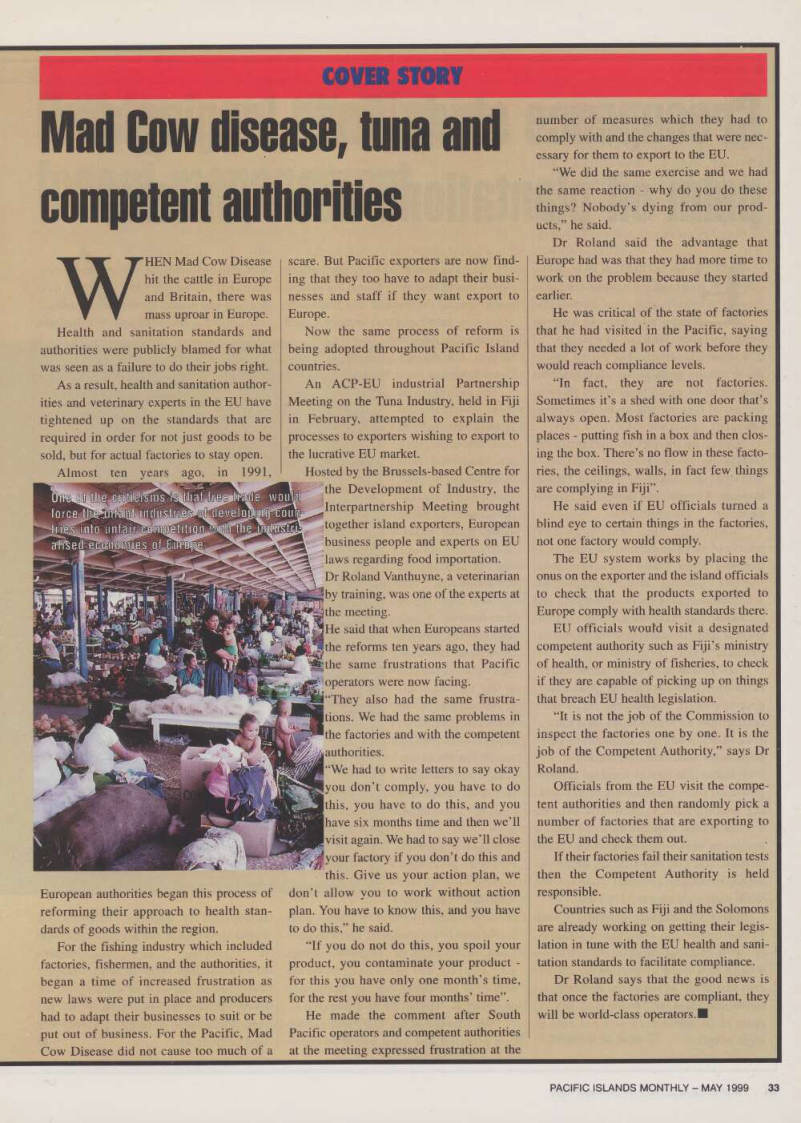
One of the criticisms in that free trade would force the infant industries of developing coun tries into unfair competition with the industri alised economies of Europe