WTO, EU and the Pacific
pp. 30-32 · Read in the full issue
Cover Story
Why the region is under pressure to create a Free Trade Area
Bv Sophie Foster Hildebrand
WHEN the World
Trade Organisation
was created in 1995, the globe’s most powerful trading countries had signed up for a journey that would change the face of international trade forever.
For the people of the Pacific, this devel opment did not create much of a splash. But little did they know just how much power the WTO wielded, and that it would one day force their countries to change too.
WHEN Fiji’s sugar industry faltered last year, and a large percentage of the year’s
crop failed, it seemed that all was lost. Yet, the farmers whose cane made it to the mill, have since received the highest per tonne payment that they have ever had.
The reason: The majority of the sugar produced by Fiji last year was sold to the European Union under the special preferen tial treatment given to ACP countries.
In a paper titled; ‘The impact of Lome development assistance on Pacific ACP budgets’, analyst David Lorsyth says, “Fiji’s exports of sugar to the European Union, as a result of the advantageous terms of the Sugar Protocol and the Special Preferential Sugars allocation, are sold at a price well above that available in the ‘free
market’ for sugar”.
Because the crop was about half of what it usually is, most of it was sold to the EU under the preferential system and so a high er price could be paid overall to the farm ers.
But on Lebruary 29, 2000, now a mere nine months away, a WTO waiver that allows the Lome IV Convention to exist under WTO law, will expire. Although the EU has indicated that it will pursue another five year waiver until 2006, the days of the Lome IV Convention are clearly numbered.
ACP countries and the EU have begun negotiations on future trading arrangements to take the place of Lome IV.
A paper, by Roman Grynberg and Michael White, titled EU tuna preferences in the post-Lome environment’, states that the EU in its Green Paper on the future of its relations with the ACP has “made it clear that the trade preference arrangements cur rently available for ACP states cannot be assumed to exist after the year 2000”.
“The Lome preferences, by virtue of the
fact that they offer ACP countries lower rates of tariff than other non- ACP developing coun tries, are in clear viola tion of the Article I pro visions of the WTO,” it says.
Forum Secretariat economist Roman ,Grynberg, in a paper [called ‘ The EU’s Green Paper - a Pacific [response’, says a new Lome convention must “confront the reality of [the completion of the Uruguay Round and what this has meant for the Lome Convention.
In many ways the World Trade
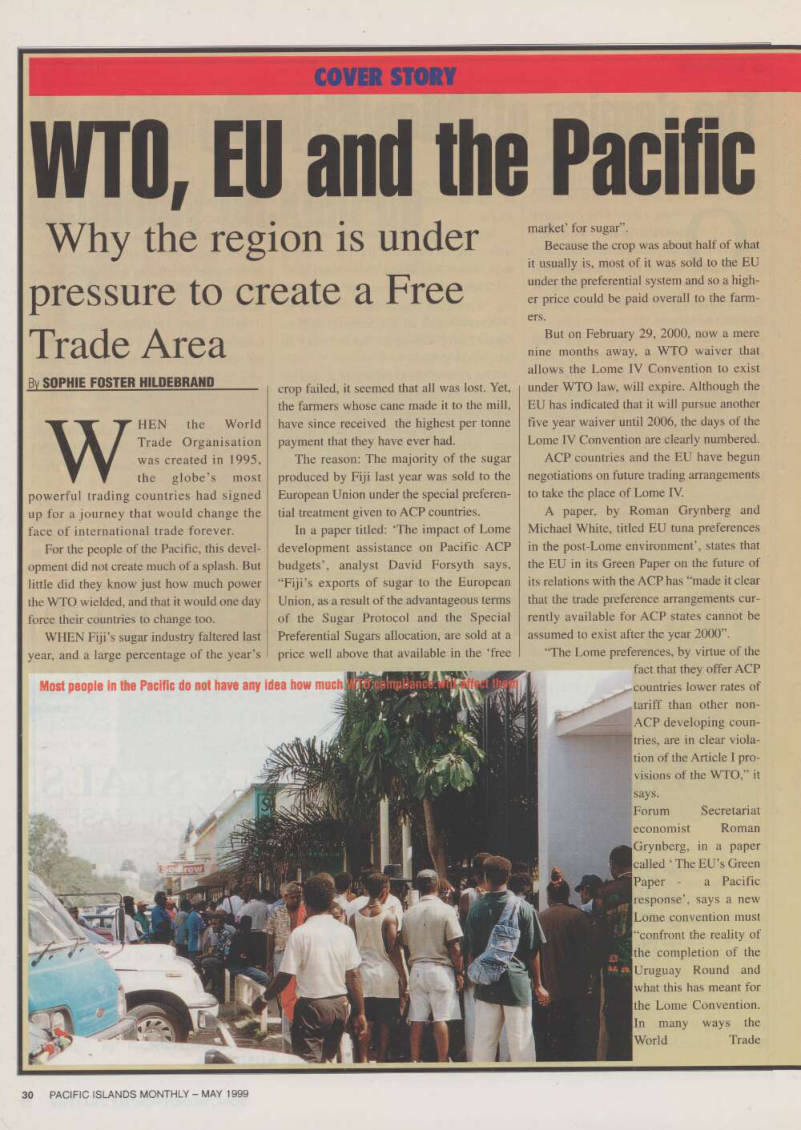
Most people in the Pacific do not have any idea how much WTO compliance will affact them
either the desires of the European Union or pressure from the ACP group”.
He says the Uruguay Round had several effects that would bear directly on any trade regime created by the Convention.
The rules of the WTO prohibit trade dis crimination against members unless certain conditions are met.
White and Grynberg say that there are three options for the EU to take regarding preferential treatment for ACP countries.
The first is that the EU trade with a free trade area; the second that it extend trade preferences to all developing economies; and the third is that it get a waiver from
Wto.
The third option can be ruled out after 2006, according to most observers. The sec ond option would thrust Pacific exporters to the EU in direct competition with exporters from Asia. For example, according to Forsyth’s paper, this would place a compa ny like Solomon Taiyo in direct competition with processing plants in Thailand, Indonesia and the Philippines, against whom Pacific canned tuna cannot compete in price terms.
The only other way to get around WTO, it seems, is for the Pacific to set itself up as a free trade area.
This is the position that the European
In a recent meeting with trade officials from South Pacific Forum countries, the EU said it was committed to negotiating a reci procal Free Trade arrangement.
What this means is that any successor arrangement to Lome IV would have to be reciprocal, thus allowing EU exporters the same access privileges to the ACP that the ACP would get to the EU.
According to White and Grynberg, the option of a free trade area, which would effectively require the ACP states to grant reciprocity, is not politically feasible.
They say Pacific Island states “could not grant trade reciprocity to the European Union without simultaneously granting rec iprocity to Australia and New Zealand which have offered trade preference regimes under Pactra and Sparteca”.
But there has also been concern raised over how the Pacific industries would sur vive in a climate of trade reciprocity with the EU, and maybe even Australia and New Zealand too.
In June last year when the early word was that the EU would back Free Trade Areas to succeed Lome, there was outcry from non government organisations.
The NGOs said that under a system of regional FTAs, the advantage would lie with the EU’s globalised exporters, not the
(Liz Clemens of the UK
Presidency Project, an
umbrella group linking development NGOs in Britain, said: “The current proposals for free trade areas would transform Lome into a battering ram I for free trade, forcing the jinfant industries of the developing countries in I the ACP into unfair com jpetition with the industri alised economies of Europe”.
The European Centre for
Development Policy
Management, an indepen dent foundation based in Maastricht in the Netherlands, has also crit icised the ETA proposal.
In a Lome Negotiating
Brief titled: ‘What future for ACP-EU Trade Relations?’, the ECDPM said that the EU’s free trade area proposal “is perceived by some as being premature. Proponents of this view argue that the EC (EU) overesti mates the readiness of ACP groupings for regional integration and proposes a time frame which conflicts with what is politi cally and technically feasible”.
According to the ECDPM, the current EU proposal for free trade areas to be set up is too open-ended.
“Without any reform to the EU’s Common Agricultural Policy (CAP), free trade agreements with the EU would not improve market access for exporters in the ACP. It would however improve market access for EU exporters,” the Centre said.
NGOs argued that the ACP states, trad ing individually or as part of regional FTAs, were not equipped to compete with the mar
keting power and price advantage enjoyed
by EU exporters, many of whom are heavi ly subsidised under CAP.
Discount EU beef, paid for by EU tax payers to maintain farmers incomes, then dumped on the markets of the Sahel states of Africa, nearly wrecked its domestic cattle trade.
The impact of CAP-subsidised produce is blamed for the loss of 2,000 jobs in the
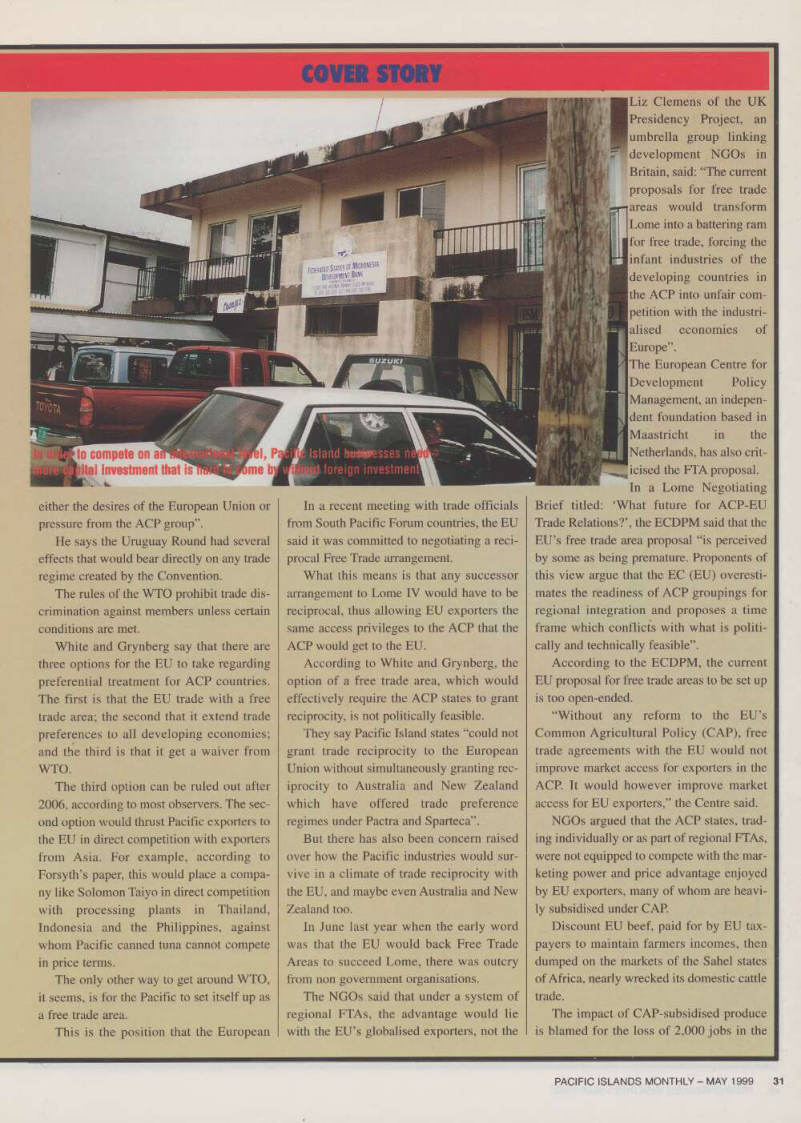
In order to compete on an international level, Pacific Islands businesses need more capital investment that is hard to come by without foreign investment
South African fruit industry; EU canned tomatoes already undercut South African produce in Europe, Asia and even in South Africa itself.
ACP-EU Joint Assembly co-president Lord Plumb has often digressed on the imbalance that exists and is being perpetu ated by the WTO.
“The World Trade Organisation is enforcing rules that make it impossible for small countries or weaker regions to isolate themselves from
world trends. The only way to face up to these challenges is to develop resilient economies that can stand up to market fluctuations.
This is easy to enun ciate but very diffi cult to achieve,” he said.
In March last year, Lord Plumb headed the first joint
ACP-EU delegation
to visit the Forum Secretariat in Suva,
Fiji.
After the visit, the Secretary-General of the Forum Secretariat, Noel Levi said “we acknowledge that a future ACP-EU partner ship will require ACP countries to reform their economies to promote integration into the world economy. Such reform needs to be pursued with caution partly because of the many problems faced by the ACP such as vulnerability, scarce resources and lack of trained manpower”.
The Forum noted the EU’s offer to extend Lome preferences to all Least Developed Countries. It said this would mean that the Pacific would be competing against much larger economies in other regions for a share of the benefits.
Lord Plumb said that in the world fora, the ACP as a group counted for very little but he encouraged the ACP governments to explore the possibility of concerted action “which would certainly be more effective than individual effort”.
He said the next Convention would have
“as one of its main aims” the gradual inser tion of ACP economies in the world eco nomic structure.
But this, he said, could not be achieved at once.
“It is necessary to lay sound financial bases and to prepare emerging economies for the shock of global competition. Some countries will probably not succeed. Yet I am convinced that very many ACP coun tries have the necessary natural and human
resources, and the essential know-how, to make the difficult transition and to find their places in their world marketplace”.
For its part, the Pacific is now at a cross roads.
In June, the Forum trade ministers will be meeting in Suva to consider the possible creation of a Free Trade Area across the Forum Island Countries. Many experts have said that this will be one of the most impor tant ministerial meetings in the history of the Forum.
The Forum secretary-general, Noel Levi said: “Negotiations on a free trade area rep resent the region’s best chance of maintain ing the current market access into the EU, as well as future market opportunities”.
He warned that “if in June Forum Trade Ministers decide not to proceed with the free trade area among Forum Island Countries then they could forfeit their best chance for maintaining their current mar
ket access into the EU. The price of this choice could be many job losses in the can nery sector but more importantly the loss of future market access opportunities”.
However, Grynberg says that “the Pacific ACP should not lose sight of the fact that association with Africa has benefited the region enormously: Africa remains important in the European geopolitical cal culus and the Pacific Islands do not”.
The EU, he says, has suggested that the
ACP be broken up into three subgroupings of the Caribbean, sub-Saharan Africa and the Pacific. If the EU’s plan to have several free trade areas in the ACP goes ahead, then the ACP will be bro ken up into three or perhaps five
separate regions.
Each of these
groupings would
then have
Regional Economic Partnership Arrangments (REPA) with the EU which would be negotiated separately.
If, as Lord Plumb said, the ACP group counted for very little in the world fora, then it seems unlikely that the split ACP will be any different. Early meetings amongst senior Forum trade officials, on the subject of a free trade area with Europe, have shown that the region is cautious about throwing themselves into REPA unpre pared. Participants at a meeting in Suva in March to discuss post-Lome IV trade arrangements said that unless the REPA was ‘Lome-plus’ - “constituting a substantial improvement over the existing trade arrangements in Lome IV” - there would be no benefit in granting the EU increased access to ACP markets.
Whether Pacific politicians and bureau crats can hold their own with this argument, in the international arena, is the key to how well the region emerges from this historic
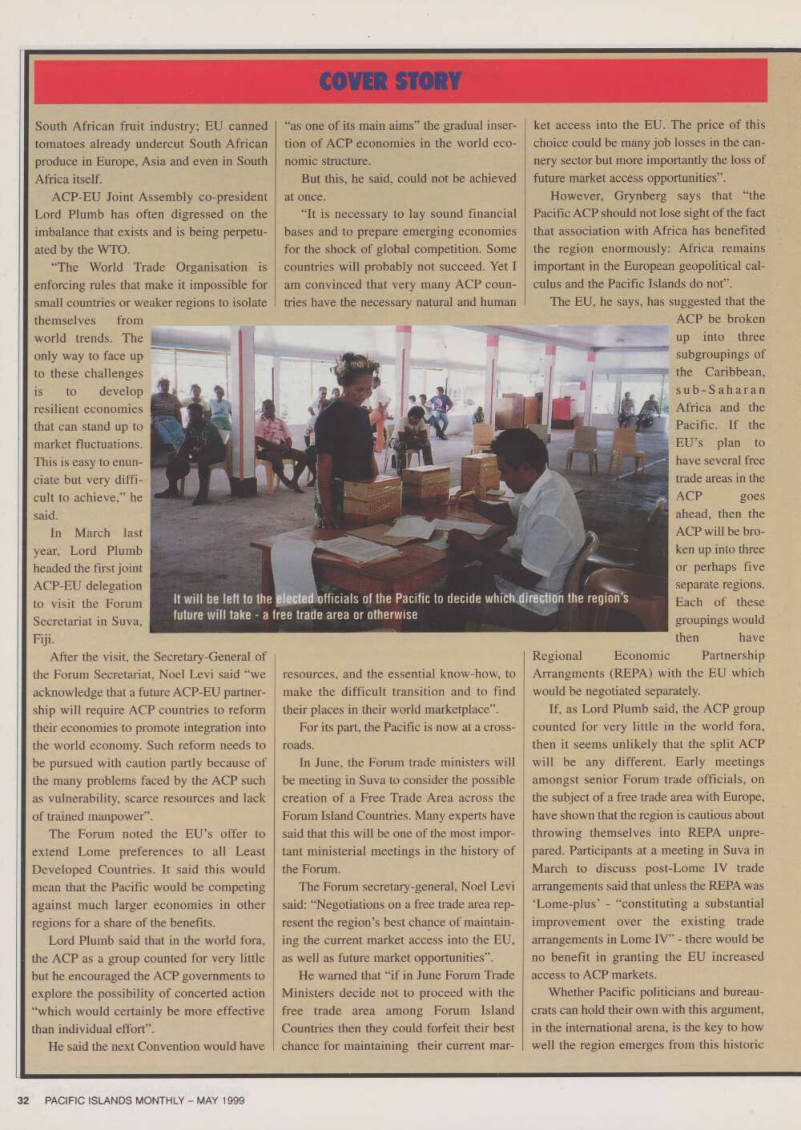
It will be left to the elected officials of the Pacific to decide which direction the region’s future will take - a free trade area or otherwise