Environmental lobby
pp. 34-35 · Read in the full issue
Business
Greenpeace study finds longing and palm oil plantations not economic
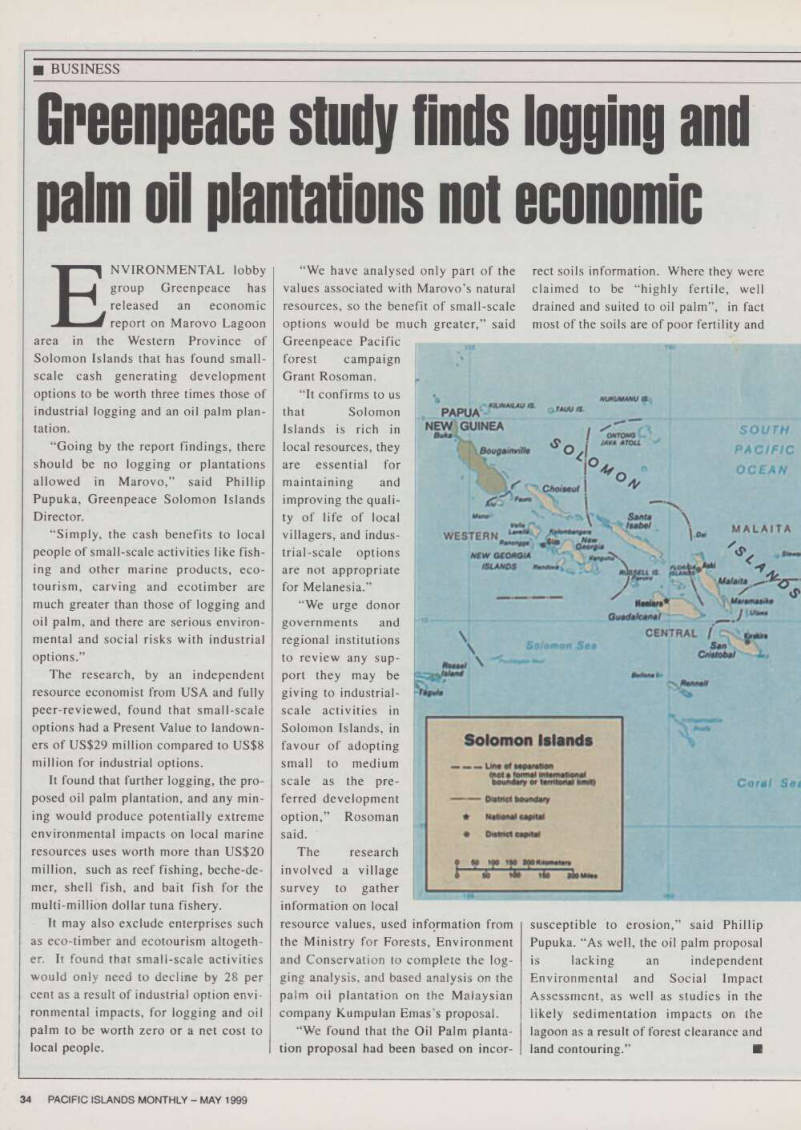
group Greenpeace has released an economic report on Marovo Lagoon area in the Western Province of Solomon Islands that has found small scale cash generating development options to be worth three times those of industrial logging and an oil palm plan tation.
“Going by the report findings, there should be no logging or plantations allowed in Marovo,” said Phillip Pupuka, Greenpeace Solomon Islands Director.
“Simply, the cash benefits to local people of small-scale activities like fish ing and other marine products, eco tourism, carving and ecotimber are much greater than those of logging and oil palm, and there are serious environ mental and social risks with industrial options.”
The research, by an independent resource economist from USA and fully peer-reviewed, found that small-scale options had a Present Value to landown ers of US$29 million compared to US$B million for industrial options.
It found that further logging, the pro posed oil palm plantation, and any min ing would produce potentially extreme environmental impacts on local marine resources uses worth more than US$2O million, such as reef fishing, beche-de mer, shell fish, and bait fish for the multi-million dollar tuna fishery.
It may also exclude enterprises such as eco-timber and ecotourism altogeth er. It found that small-scale activities would only need to decline by 28 per cent as a result of industrial option envi ronmental impacts, for logging and oil palm to be worth zero or a net cost to local people.
“We have analysed only part of the values associated with Marovo’s natural resources, so the benefit of small-scale options would be much greater,” said
Greenpeace Pacific forest campaign Grant Rosoman.
“It confirms to us that Solomon Islands is rich in local resources, they are essential for maintaining and improving the quali ty of life of local villagers, and indus trial-scale options are not appropriate for Melanesia.”
“We urge donor governments and
regional institutions
to review any sup port they may be giving to industrial scale activities in Solomon Islands, in favour of adopting small to medium scale as the pre
ferred development
option,” Rosoman said.
The research involved a village survey to gather information on local
resource values, used information from the Ministry for Forests, Environment and Conservation to complete the log ging analysis, and based analysis on the palm oil plantation on the Malaysian company Kumpulan Emas’s proposal.
“We found that the Oil Palm planta tion proposal had been based on incor
rect soils information. Where they were claimed to be “highly fertile, well drained and suited to oil palm”, in fact most of the soils are of poor fertility and
susceptible to erosion,” said Phillip Pupuka. “As well, the oil palm proposal is lacking an independent Environmental and Social Impact Assessment, as well as studies in the likely sedimentation impacts on the lagoon as a result of forest clearance and land contouring.” ■