Marshalls shifts reform from cuts
pp. 12-13 · Read in the full issue

cuts to private sector boost
By Giff Johnson
THE Marshall Islands government reform program supported by the Asian Development Bank has shifted away from slashing the ranks of government workers to boosting the pri vate sector, with a push to get private businesses to take over operation of government-run utilities and other services that have ‘traditionally’ been government-operated.
In March, the Nitijela (parliament) approved Chamber of Commerce-backed legislation that slashed import duties as one step in the govern ment 1 s effort to revitalize an economy that has been in a three year tailspin. The next step is pri vatization of many government services.
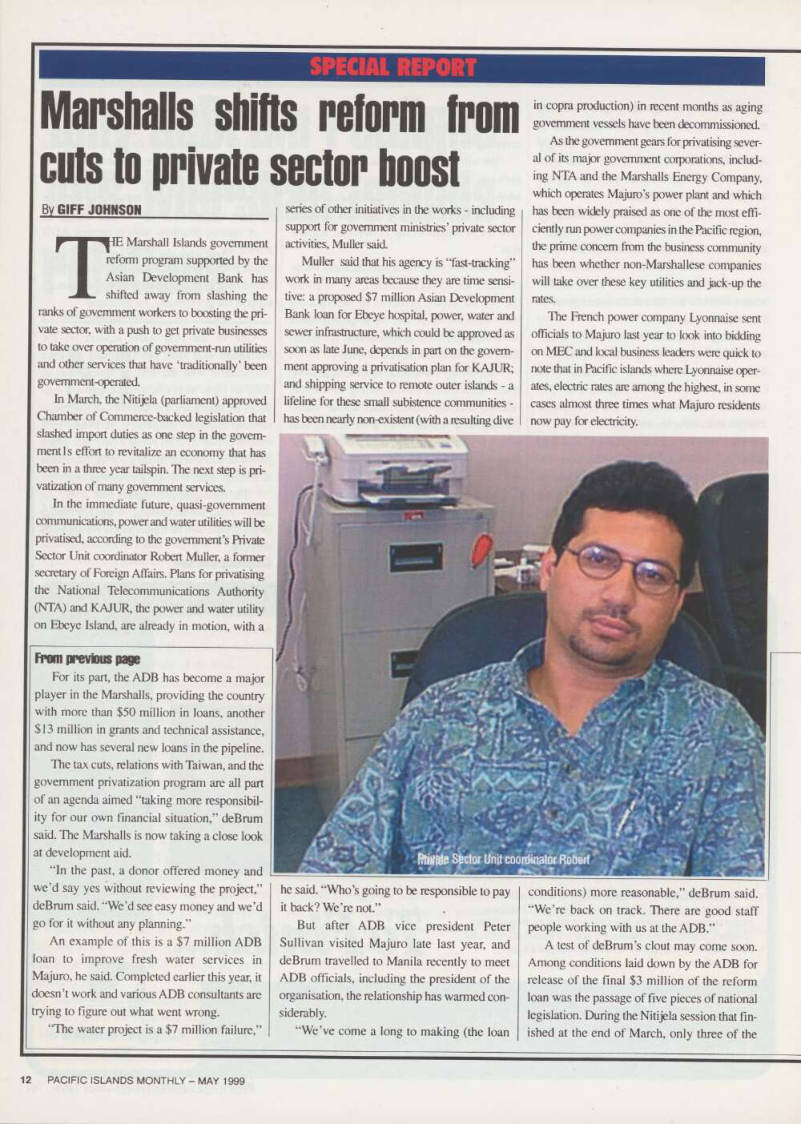
In the immediate future, quasi-government communications, power and water utilities will be privatised, according to the government’s Private Sector Unit coordinator Robert Muller, a former secretary of Foreign Affairs. Plans for privatising the National Telecommunications Authority (NTA) and KAJUR, the power and water utility on Ebeye Island, are already in motion, with a
series of other initiatives in the works - including support for government ministries’ private sector activities, Muller said.
Muller said that his agency is “last-tracking” work in many areas because they are time sensi tive: a proposed $7 million Asian Development Bank loan for Ebeye hospital, power, water and sewer infrastructure, which could be approved as soon as late June, depends in part on the govern ment approving a privatisation plan for KAJUR; and shipping service to remote outer islands - a lifeline for these small subistence communities has been nearly non-existent (with a resulting dive
in copra production) in recent months as aging government vessels have been decommissioned.
As the government gears for privatising sever al of its major government corporations, includ ing NTA and the Marshalls Energy Company, which operates Majuro’s power plant and which has been widely praised as one of the most effi ciently run power companies in the Pacific region, the prime concern from the business community has been whether non-Marshallese companies will take over these key utilities and jack-up the rates.
The French power company Lyonnaise sent officials to Majuro last year to look into bidding on MFC and local business leaders were quick to note that in Pacific islands where Fyonnaise oper ates, electric rates are among the highest, in some cases almost three times what Majuro residents now pay for electricity.
Muller comments that the PSU is coasidering a range of options and that each agency will be considered in turn. Only the recommendation for KAJUR’s privatization is fairly certain: PSU is recommending to the government that it use a ‘concession model’ for the Ebeye utility compa ny, through which the government will retain the power plant and desalination facility but the oper ation of the utility will be bid competitively to the
private sector.
For NTA, the PSU - with ADB funding - is hiring a high-powered group of consultants expert in legal, financial, technical and other aspects of telecommunications. They will be ‘on-the ground’ in Majuro in June to assist the PSU and NTA draw up recommendations that will be made to the government for privatising NTA operations, Muller said.
NTA has been given top priority because it has all the ingredients for turning it into a private ly-run company, Muller said. "The political will is there to privatise NTA,” said Muller of the gov ernment’s backing.
In addition, a Supreme Court ruling has con firmed that phone company is a private company and it already has private shareholders, although the government remains by far the laigest, he said.
Preliminary discussions with the NTA board and management have begun on privatization.
“We’re looking at options to reduce or eliminate altogether government’s share holdings in NTA,”
he said. Any major changes agreed to by govern ment and NTA shareholders - such as allowing foreign ownership of NTA stocks - will require passage of legislation by the parliament, so PSU is working to present options to the government so a plan can be approved in advance of the August Nitijela session, Muller said.
“NTA is a complex privatisation undertaking.
But if it's done properly, it will have a positive nationwide impact on the economy as well as telecommunications services.”
This PSU project is paid for by a technical
assistance grant from the ADB. “The main advan tage to the government is that (all the advice and assistance) is free of charge,” Muller said.
But it’s not alone NTA anbd KAJUR that are on the list. Tobolar, the government-subsidised copra processing plant, the Marshalls Energy Company, Air Marshall Islands and the Majuro Water and Sewer Company are all in the privati zation plan. Getting businesses involved in pro viding such other services as road maintenance, garbage collection and certain health services are also in the works. ■