Tony deBrum realigns
pp. 10-13 · Read in the full issue

Special Report
Tony deBrum realigns ADB-Marshall Islands relations
By Giff Johnson
MOST Pacific countries ini tially jumped at the oppor tunity to get low interest, long term loans from the Asian Development Bank. But for some, such as the Marshall Islands, the burdens of increas ingly difficult-to-meet conditions put on each succeeding loan engendered ill-will and anger.
Early last year, leading MPs in the Marshall Islands Nitijela (parliament), includ ing President Imata Kabua, denounced ADB loan conditions and said they weren’t going to let the ADB encroach on their sovereignty. By mid-1998, relations with the ADB reached their lowest point, as the Marshalls missed deadlines for meeting conditions agreed to in a $l2 million ADB-supported government reform loan - and the ADB steadfastly refused to release the second phase of the loan.
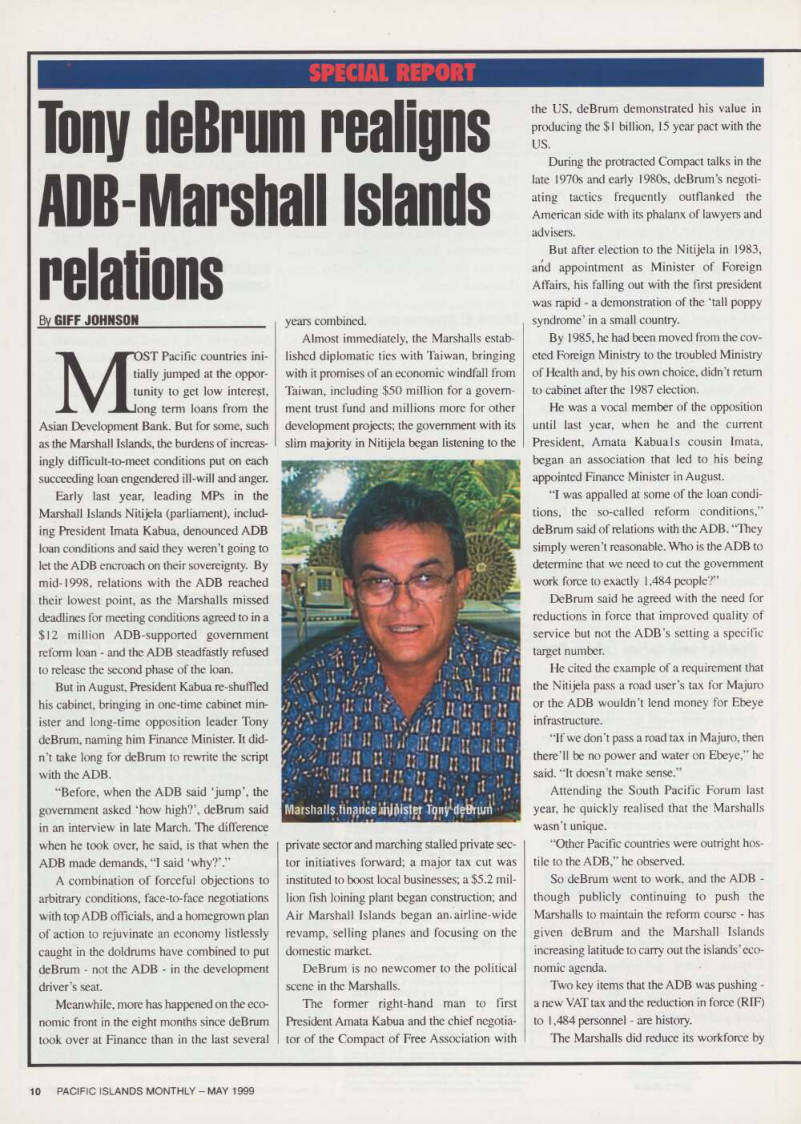
But in August, President Kabua re-shuffled his cabinet, bringing in one-time cabinet min ister and long-time opposition leader Tony deßrum, naming him Finance Minister. It did n’t take long for deßrum to rewrite the script with the ADB.
“Before, when the ADB said ‘jump’, the government asked ‘how high?’, deßrum said in an interview in late March. The difference when he took over, he said, is that when the ADB made demands, “I said ‘why?’.”
A combination of forceful objections to arbitrary conditions, face-to-face negotiations with top ADB officials, and a homegrown plan of action to rejuvinate an economy listlessly caught in the doldrums have combined to put deßrum - not the ADB - in the development driver’s seat.
Meanwhile, more has happened on the eco nomic front in the eight months since deßrum took over at Finance than in the last several
years combined.
Almost immediately, the Marshalls estab lished diplomatic ties with Taiwan, bringing with it promises of an economic windfall from Taiwan, including $5O million for a govern ment trust fund and millions more for other development projects; the government with its slim majority in Nitijela began listening to the
private sector and marching stalled private sec tor initiatives forward; a major tax cut was instituted to boost local businesses; a $5.2 mil lion fish loining plant began construction; and Air Marshall Islands began an. airline-wide revamp, selling planes and focusing on the domestic market.
Deßrum is no newcomer to the political scene in the Marshalls.
The former right-hand man to first President Amata Kabua and the chief negotia tor of the Compact of Free Association with
the US, deßrum demonstrated his value in producing the $1 billion, 15 year pact with the US.
During the protracted Compact talks in the late 1970 s and early 1980 s, deßrum’s negoti ating tactics frequently outflanked the American side with its phalanx of lawyers and advisers.
But after election to the Nitijela in 1983, and appointment as Minister of Foreign Affairs, his falling out with the first president was rapid - a demonstration of the ‘tall poppy syndrome’ in a small country.
By 1985, he had been moved from the cov eted Foreign Ministry to the troubled Ministry of Health and, by his own choice, didn’t return to cabinet after the 1987 election.
He was a vocal member of the opposition until last year, when he and the current President, Amata Kabuals cousin Imata, began an association that led to his being appointed Finance Minister in August.
“I was appalled at some of the loan condi tions, the so-called reform conditions,” deßrum said of relations with the ADB. “They simply weren’t reasonable. Who is the ADB to determine that we need to cut the government work force to exactly 1,484 people?”
Deßrum said he agreed with the need for reductions in force that improved quality of service but not the ADB’s setting a specific target number.
He cited the example of a requirement that the Nitijela pass a road user’s tax for Majuro or the ADB wouldn’t lend money for Ebeye infrastructure.
“If we don’t pass a road tax in Majuro, then there’ll be no power and water on Ebeye,” he said. “It doesn’t make sense.”
Attending the South Pacific Forum last year, he quickly realised that the Marshalls
wasn’t unique.
“Other Pacific countries were outright hos tile to the ADB,” he observed.
So deßrum went to work, and the ADB though publicly continuing to push the Marshalls to maintain the reform course - has given deßrum and the Marshall Islands increasing latitude to carry out the islands’ eco nomic agenda.
Two key items that the ADB was pushing a new VAT tax and the reduction in force (RIF) to 1,484 personnel - are history.
The Marshalls did reduce its workforce by
about 25 percent through last year, but deßrum announced that the RIF program has ended.
Meanwhile, the VAT - which was strongly opposed by the business sector - has been replaced by the beginnings of a new tax regime instigated by the private sector.
Meanwhile, after a year of holding up release of loan money because reform progress had come to a virtual standstill, the ADB issued the second $3.5 million installment of the reform loan after deßrum came on the scene - without the Marshalls meeting all of the “required” conditions.
Nothing exemplifies deßrum’s short tenure as Finance Minister more than the new rela tions with the private sector. The Chamber of Commerce was asked at the beginning of 1999 to provide recommendations and research for changes to existing tax legislation.
When the government introduced and then passed legislation actually improving upon the Chamber proposal - which slashed import duties by more than 50 percent on many items and most importantly streamlined the importa tion process, a source of friction for years for many business - the private sector was delight fully shocked.
That, of course, was deßrum’s point.
The tax cut was intended to “shock” the economy back to life, he said.
“We will continue to discuss our tax reform package with the private sector,” he said, adding that a reduction in income taxes is also anticipated later this year. “We want to elimi nate the problems in the current tax legisla tion.”
In addition to government-business coop eration in the tax cut legislation, “we’ve gotten the private sector involved in determining loans from the ADB, and we’re getting direct ADB support for the private sector. It’s some thing that was never pushed before.”
The primary complaint from the opposition is that deßrum isn’t forthcoming with infor mation, that his exhortations about ‘trans parency’ in government are more hot air than action - that he’s doing many of the same things in government that he complained about when he was in the opposition.
But deßrum responds that he’s straighten ing out the Ministry of Finance to insure more open operations and strengthening relations between the government and the private sec tor. As reason for delay in offering up some
financial data, deßrum notes that “we’re still trying to figure out opening and closing bal ances for fiscal years as far back as three to four years ago.” And that, he adds, is part of the problem: The ADB has based many of its assumptions about government reform on faulty or incomplete information.
A serious problem with accepting ADB advice as gospel is that the ADB had set requirements for reducing the public service based on the Marshalls’ lack of resources to support the government, he indicated.
But, deßrum said, “we’re not broke”.
One of the first ADB reports on the Marshalls said that the Compact of Free Association with the United States ends in 2001 so there won’t be any money and cut backs are necessary. The overall Compact rela tionship continues indefinitely; economic pro visions expire in 2001, with a two year grace period of guaranteed funding for the Marshalls as a hedge against lengthy renegotiations.
“The relationship continues past 2001,” he said. “What we’re making in the upcoming negotiations is fine adjustments on areas of concern.”
Continued overleaf
From previous page For its part, the ADB has become a major player in the Marshalls, providing the country with more than $5O million in loans, another $l3 million in grants and technical assistance, and now has several new loans in the pipeline.
The tax cuts, relations with Taiwan, and the government privatization program are all part of an agenda aimed “taking more responsibil ity for our own financial situation,” deßrum said. The Marshalls is now taking a close look at development aid.
“In the past, a donor offered money and we’d say yes without reviewing the project,” deßrum said. “We’d see easy money and we’d go for it without any planning.”
An example of this is a $7 million ADB loan to improve fresh water services in Majuro, he said. Completed earlier this year, it doesn’t work and various ADB consultants are trying to figure out what went wrong.
“The water project is a $7 million failure,”
he said. “Who’s going to be responsible to pay it back? We’re not.”
But after ADB vice president Peter Sullivan visited Majuro late last year, and deßrum travelled to Manila recently to meet ADB officials, including the president of the organisation, the relationship has warmed con
siderably.
“We’ve come a long to making (the loan
conditions) more reasonable,” deßrum said.
“We’re back on track. There are good staff people working with us at the ADB.”
A test of deßrum’s clout may come soon.
Among conditions laid down by the ADB for release of the final $3 million of the reform loan was the passage of five pieces of national legislation. During the Nitijela session that fin ished at the end of March, only three of the
five bills made it - including legislation for the new government trust fund, a Majuro road user’s tax, and an airport authority.
Bills to streamline and make more trans parent procedures for foreign investment did n't pass.
Deßrum said that although the ADB had indicated that the two pieces of legislation that didn’t pass were ‘required’ to get release of the final $3 million, “we can work around the last two by administrative procedures and Cabinet action”.
The Attorney General and the Private Sector Unit have already been directed to look at ways of streamlining these procedures affecting the private sector.
Whether that will satisfy the ADB isn’t yet clear. But deßrum’s proactive style has already brought a realignment of the relation ship with ADB, a fact that has changed the playing field in favor of this north Pacific island group. ■