greets loining plant
p. 14 · Read in the full issue
Marshalls 'new look' fisheries agency greets loining plant
By Giff Johnson
Construction of a PM&O Line/Star Kist tuna loining plant got off the ground in late March after the Marshall Islands Marine Resources Authority (MIMRA) guar anteed a $2 million loan needed to complete the $5.2 million deal.
While the plant is expected to open 300
new jobs later this year, as well as draw in the American purse seiner fleet to Majuro, its symbolic value may greatly outweigh these tangible eco nomic benefits to the Marshall Islands.
The government support of the foreign j investment - one of j only a handful in the I Marshalls - is demon- j stration of how the Marshalls can remove its ‘high risk’ label and improve the busi ness environment to attract future invest ments, said the gov ernment’s Private Sector Unit coordina tor Robert Muller.
The new loining I
plant will process, cook
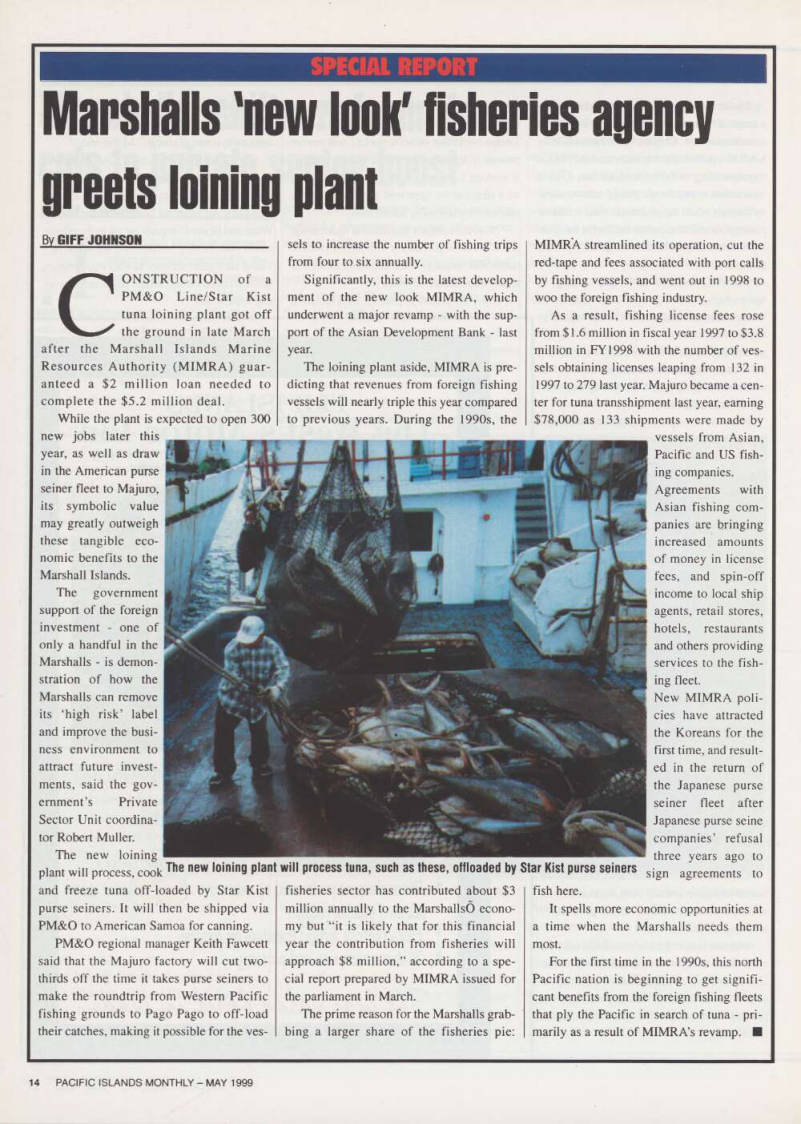
and freeze tuna off-loaded by Star Kist purse seiners. It will then be shipped via PM&O to American Samoa for canning.
PM&O regional manager Keith Fawcett said that the Majuro factory will cut two thirds off the time it takes purse seiners to make the roundtrip from Western Pacific fishing grounds to Pago Pago to off-load their catches, making it possible for the ves
sels to increase the number of fishing trips from four to six annually.
Significantly, this is the latest develop ment of the new look MIMRA, which underwent a major revamp - with the sup port of the Asian Development Bank - last year.
The Joining plant aside, MIMRA is pre dicting that revenues from foreign fishing vessels will nearly triple this year compared to previous years. During the 19905, the
fisheries sector has contributed about $3 million annually to the MarshallsO econo my but “it is likely that for this financial year the contribution from fisheries will approach $8 million,” according to a spe cial report prepared by MIMRA issued for the parliament in March.
The prime reason for the Marshalls grab bing a larger share of the fisheries pie:
MIMRA streamlined its operation, cut the red-tape and fees associated with port calls by fishing vessels, and went out in 1998 to woo the foreign fishing industry.
As a result, fishing license fees rose from $ 1.6 million in fiscal year 1997 to $3.8 million in FY1998 with the number of ves sels obtaining licenses leaping from 132 in 1997 to 279 last year. Majuro became a cen ter for tuna transshipment last year, earning $78,000 as 133 shipments were made by
vessels from Asian, I Pacific and US fish- I ing companies.
I Agreements with i Asian fishing com- I panics are bringing increased amounts of money in license fees, and spin-off income to local ship s agents, retail stores, hotels, restaurants and others providing l services to the fish- I ing fleet.
I New MIMRA poli- I cies have attracted I the Koreans for the I first time, and result- I ed in the return of I the Japanese purse I seiner fleet after I Japanese purse seine companies’ refusal 1 three years ago to sign agreements to
fish here.
It spells more economic opportunities at a time when the Marshalls needs them most.
For the first time in the 19905, this north Pacific nation is beginning to get signifi cant benefits from the foreign fishing fleets that ply the Pacific in search of tuna - pri marily as a result of MIMRA’s revamp. ■
The new joining plant will process tuna, such as these, offloaded by Star Kist purse seiners