The end
pp. 30-33 · Read in the full issue
Cover Story
The end of an era
By Sophie Foster Hildebrand
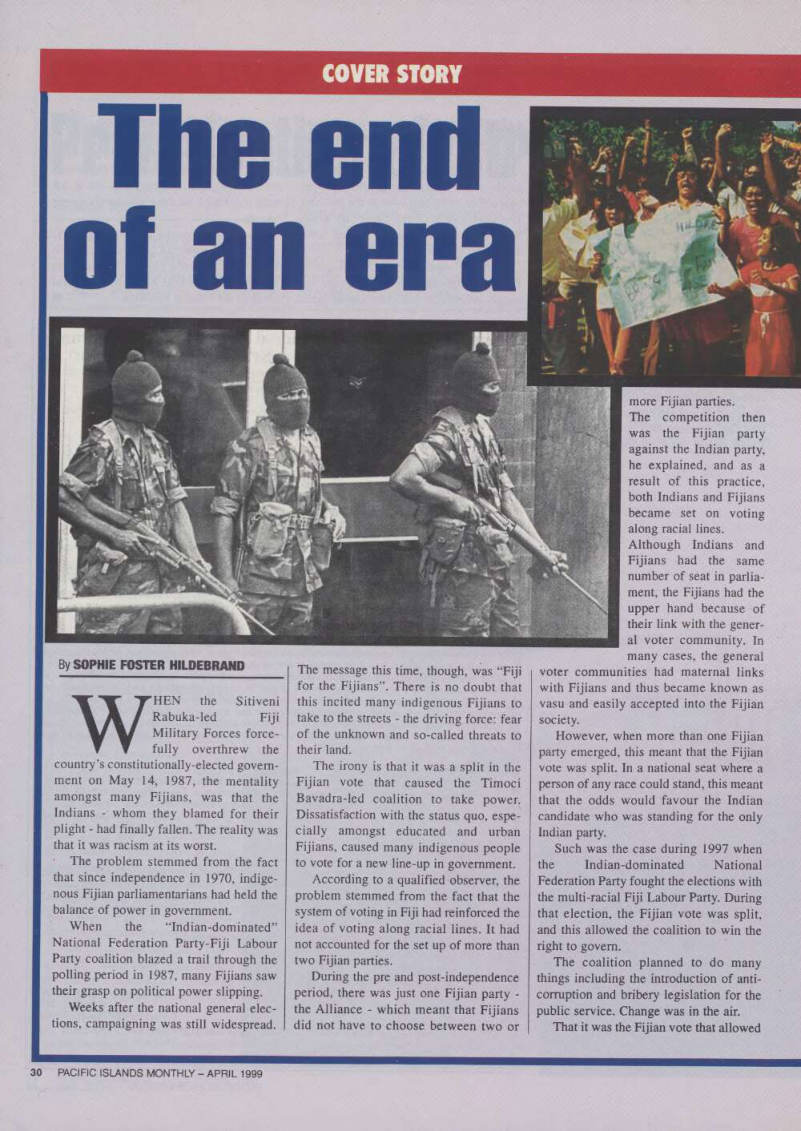
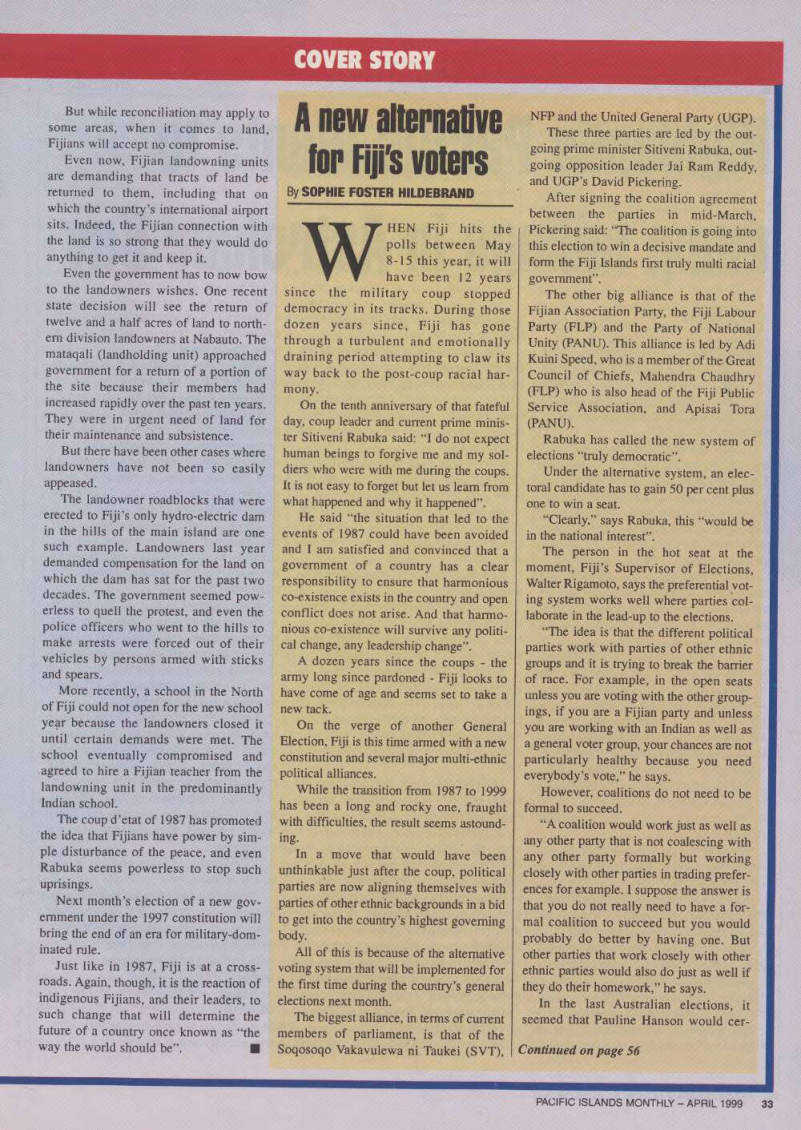
WHEN the Sitiveni Rabuka-led Fiji Military Forces force fully overthrew the country’s constitutionally-elected govern ment on May 14, 1987, the mentality amongst many Fijians, was that the Indians - whom they blamed for their plight - had finally fallen. The reality was that it was racism at its worst.
The problem stemmed from the fact that since independence in 1970, indige nous Fijian parliamentarians had held the balance of power in government.
When the “Indian-dominated”
National Federation Party-Fiji Labour Party coalition blazed a trail through the polling period in 1987, many Fijians saw their grasp on political power slipping.
Weeks after the national general elec tions, campaigning was still widespread.
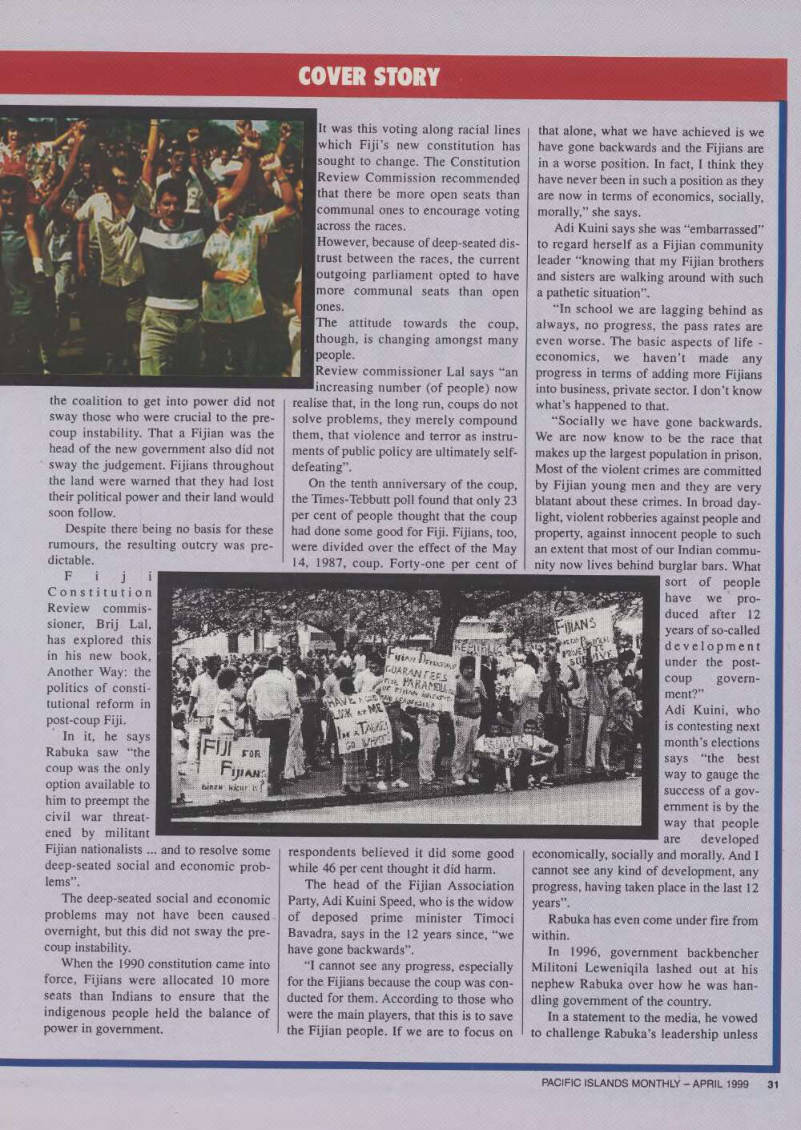
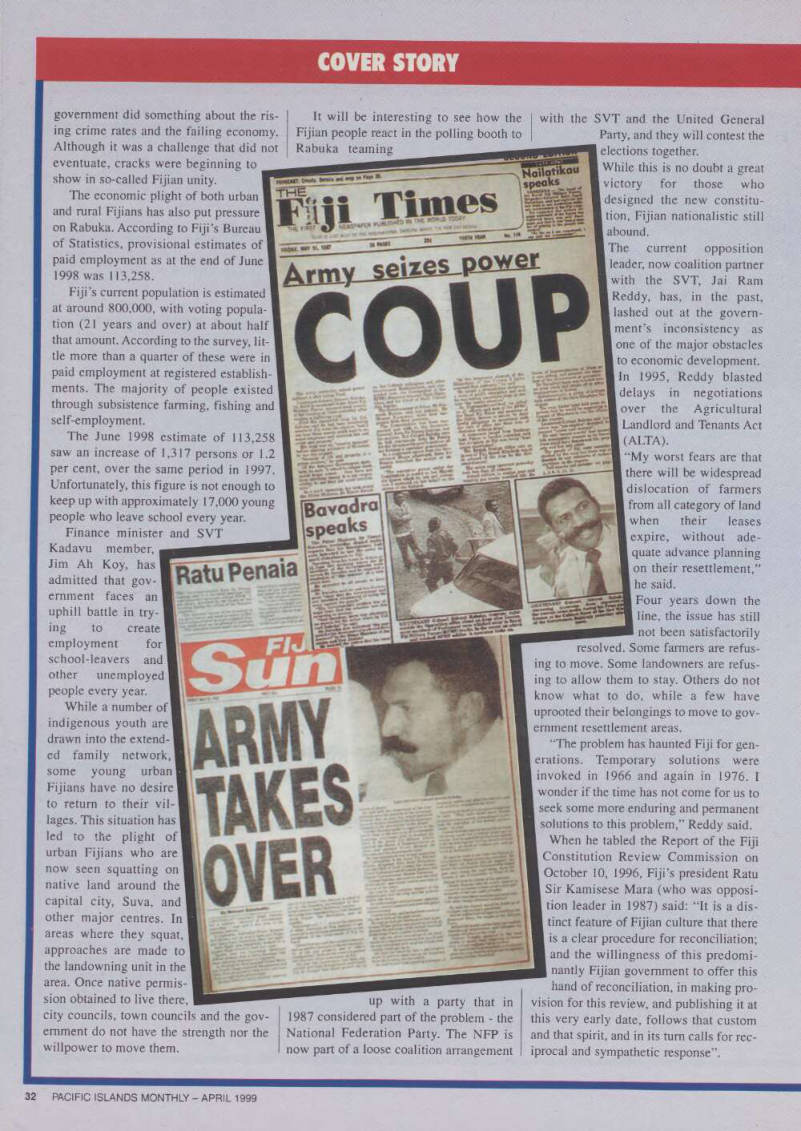
The message this time, though, was “Fiji for the Fijians”. There is no doubt that this incited many indigenous Fijians to take to the streets - the driving force: fear of the unknown and so-called threats to their land.
The irony is that it was a split in the Fijian vote that caused the Timoci Bavadra-led coalition to take power.
Dissatisfaction with the status quo, espe cially amongst educated and urban Fijians, caused many indigenous people to vote for a new line-up in government.
According to a qualified observer, the problem stemmed from the fact that the system of voting in Fiji had reinforced the idea of voting along racial lines. It had not accounted for the set up of more than two Fijian parties.
During the pre and post-independence period, there was just one Fijian party the Alliance - which meant that Fijians did not have to choose between two or
more Fijian parties.
The competition then was the Fijian party against the Indian party, he explained, and as a result of this practice, both Indians and Fijians became set on voting along racial lines.
Although Indians and Fijians had the same number of seat in parlia ment, the Fijians had the upper hand because of their link with the gener al voter community. In many cases, the general
voter communities had maternal links with Fijians and thus became known as vasu and easily accepted into the Fijian society.
However, when more than one Fijian party emerged, this meant that the Fijian vote was split. In a national seat where a person of any race could stand, this meant that the odds would favour the Indian candidate who was standing for the only Indian party.
Such was the case during 1997 when the Indian-dominated National Federation Party fought the elections with the multi-racial Fiji Labour Party. During that election, the Fijian vote was split, and this allowed the coalition to win the right to govern.
The coalition planned to do many things including the introduction of anti corruption and bribery legislation for the public service. Change was in the air.
That it was the Fijian vote that allowed
the coalition to get into power did not sway those who were crucial to the pre coup instability. That a Fijian was the head of the new government also did not
sway the judgement. Fijians throughout
the land were warned that they had lost their political power and their land would soon follow.
Despite there being no basis for these rumours, the resulting outcry was pre dictable.
Fiji Constitution Review commis sioner, Brij Lai, has explored this in his new book, Another Way; the politics of consti tutional reform in post-coup Fiji.
In it, he says Rabuka saw “the coup was the only option available to him to preempt the civil war threat ened by militant
Fijian nationalists ... and to resolve some deep-seated social and economic prob lems”.
The deep-seated social and economic problems may not have been caused overnight, but this did not sway the pre
coup instability.
When the 1990 constitution came into force, Fijians were allocated 10 more seats than Indians to ensure that the indigenous people held the balance of power in government.
jit was this voting along racial lines jwhich Fiji’s new constitution has [sought to change. The Constitution [Review Commission recommended [that there be more open seats than [communal ones to encourage voting [across the races.
However, because of deep-seated dis trust between the races, the current outgoing parliament opted to have more communal seats than open ones.
The attitude towards the coup, though, is changing amongst many people. [Review commissioner Lai says “an increasing number (of people) now
realise that, in the long run, coups do not solve problems, they merely compound them, that violence and terror as instru ments of public policy are ultimately self
defeating”.
On the tenth anniversary of the coup, the Times-Tebbutt poll found that only 23 per cent of people thought that the coup had done some good for Fiji. Fijians, too, were divided over the effect of the May 14, 1987, coup. Forty-one per cent of
respondents believed it did some good while 46 per cent thought it did harm.
The head of the Fijian Association Party, Adi Kuini Speed, who is the widow of deposed prime minister Timoci Bavadra, says in the 12 years since, “we have gone backwards”.
“I cannot see any progress, especially for the Fijians because the coup was con ducted for them. According to those who were the main players, that this is to save the Fijian people. If we are to focus on
that alone, what we have achieved is we have gone backwards and the Fijians are in a worse position. In fact, I think they have never been in such a position as they are now in terms of economics, socially, morally,” she says.
Adi Kuini says she was “embarrassed” to regard herself as a Fijian community leader “knowing that my Fijian brothers and sisters are walking around with such a pathetic situation”.
“In school we are lagging behind as always, no progress, the pass rates are even worse. The basic aspects of life economics, we haven’t made any progress in terms of adding more Fijians into business, private sector. I don’t know what’s happened to that.
“Socially we have gone backwards.
We are now know to be the race that makes up the largest population in prison.
Most of the violent crimes are committed by Fijian young men and they are very blatant about these crimes. In broad day light, violent robberies against people and property, against innocent people to such an extent that most of our Indian commu nity now lives behind burglar bars. What
sort of people have we pro duced after 12 years of so-called
development
under the post coup govern ment?”
Adi Kuini, who is contesting next month’s elections says “the best way to gauge the success of a gov ernment is by the way that people are developed
economically, socially and morally. And I cannot see any kind of development, any progress, having taken place in the last 12 years”.
Rabuka has even come under fire from within.
In 1996, government backbencher Militoni Leweniqila lashed out at his nephew Rabuka over how he was han dling government of the country.
In a statement to the media, he vowed to challenge Rabuka’s leadership unless
government did something about the ris ing crime rates and the failing economy.
Although it was a challenge that did not
eventuate, cracks were beginning to show in so-called Fijian unity.
The economic plight of both urban I ' and rural Fijians has also put pressure B on Rabuka. According to Fiji’s Bureau B " of Statistics, provisional estimates of B paid employment as at the end of June B 1998 was 113,258. I
Fiji’s current population is estimated B
at around 800,000, with voting popula-1 tion (21 years and over) at about half I that amount. According to the survey, lit-1 tie more than a quarter of these were in I
paid employment at registered establish-1
ments. The majority of people existed through subsistence farming, fishing and
self-employment.
The June 1998 estimate of 113,258 saw an increase of 1,317 persons or 1.2 per cent, over the same period in 1997.
Unfortunately, this figure is not enough to keep up with approximately 17,000 young people who leave school every year.
Finance minister and SVT
Kadavu member, Jim Ah Koy, has B . admitted that gov-Bfi ernment faces an ■ uphill battle in try- * ing to create * employment for* school-leavers and ■IS other unemployed B people every year. ■ While a number of* indigenous youth are* drawn into the extend-■ ed family network,*! some young urban* Fijians have no desire* to return to their vil-J lages. This situation has ■ led to the plight of* urban Fijians who are I now seen squatting on B native land around the I capital city, Suva, and I other major centres. In I areas where they squat, I approaches are made to the landowning unit in the area. Once native permis sion obtained to live there,
city councils, town councils and the gov ernment do not have the strength nor the willpower to move them.
It will be interesting to see how the Fijian people react in the polling booth to Rabuka teaming
up with a party that in 1987 considered part of the problem - the National Federation Party. The NFP is now part of a loose coalition arrangement
with the SVT and the United General
Party, and they will contest the I elections together.
I While this is no doubt a great B victory for those who ■ designed the new constitu ■ tion, Fijian nationalistic still ■ abound.
The current opposition leader, now coalition partner Iwith the SVT, Jai Ram I Reddy, has, in the past, I lashed out at the govern-
Iment’s inconsistency as
I one of the major obstacles
I to economic development.
■ln 1995, Reddy blasted ■ delays in negotiations ■ over the Agricultural '■ Landlord and Tenants Act
:■ (Alta).
'■ “My worst fears are that "■ there will be widespread ■ dislocation of farmers from all category of land pßwhen their leases U expire, without ade- I quate advance planning ■ on their resettlement,”
B he said. 3SB Four years down the CS B line, the issue has still not been satisfactorily
resolved. Some farmers are refus ing to move. Some landowners are refus ing to allow them to stay. Others do not know what to do, while a few have uprooted their belongings to move to gov ernment resettlement areas. 1 “The problem has haunted Fiji for gen- I erations. Temporary solutions were I invoked in 1966 and again in 1976. I I wonder if the time has not come for us to I seek some more enduring and permanent I solutions to this problem,” Reddy said.
B When he tabled the Report of the Fiji I Constitution Review Commission on I October 10, 1996, Fiji's president Ratu ■ Sir Kamisese Mara (who was opposi ■ tion leader in 1987) said; “It is a dis- I tinct feature of Fijian culture that there ■ is a clear procedure for reconciliation; II and the willingness of this predominantly Fijian government to offer this hand of reconciliation, in making pro vision for this review, and publishing it at this very early date, follows that custom and that spirit, and in its turn calls for rec iprocal and sympathetic response”.
But while reconciliation may apply to some areas, when it comes to land, Fijians will accept no compromise.
Even now, Fijian landowning units are demanding that tracts of land be returned to them, including that on which the country’s international airport sits. Indeed, the Fijian connection with the land is so strong that they would do anything to get it and keep it.
Even the government has to now bow to the landowners wishes. One recent state decision will see the return of twelve and a half acres of land to north ern division landowners at Nabauto. The mataqali (landholding unit) approached government for a return of a portion of the site because their members had increased rapidly over the past ten years.
They were in urgent need of land for their maintenance and subsistence.
But there have been other cases where landowners have not been so easily appeased.
The landowner roadblocks that were erected to Fiji’s only hydro-electric dam in the hills of the main island are one such example. Landowners last year demanded compensation for the land on which the dam has sat for the past two decades. The government seemed pow erless to quell the protest, and even the police officers who went to the hills to make arrests were forced out of their vehicles by persons armed with sticks and spears.
More recently, a school in the North of Fiji could not open for the new school year because the landowners closed it until certain demands were met. The school eventually compromised and agreed to hire a Fijian teacher from the landowning unit in the predominantly Indian school.
The coup d’etat of 1987 has promoted the idea that Fijians have power by sim ple disturbance of the peace, and even Rabuka seems powerless to stop such uprisings.
Next month’s election of a new gov ernment under the 1997 constitution will bring the end of an era for military-dom inated rule.
Just like in 1987, Fiji is at a cross roads. Again, though, it is the reaction of indigenous Fijians, and their leaders, to such change that will determine the future of a country once known as “the way the world should be”. ■