Privatisation electrifies PNG
pp. 28-29 · Read in the full issue
Industry
By Brian Tobia
PRIVATISATION or deregula tion of state businesses is a phenomenon sweeping across the world as many govern ments pursue economic reforms to boost socio-economic development of their coun tries.
This is no different for the Papua New Guinea government which is already look ing at corporatisation and eventual privati sation of most public enterprises. These include the national flag carrier Air Niugini, Telikom, Post PNG, Civil
Aviation, Electricity Commission, Harbours Boards and other service providing institutions.
The idea of privatising the power sector in PNG is slowly com ing to realisation with the state owned PNG electricity Commission corporatised in prepa ration for privatisation in the future.
The aim is to provide cheap elec tricity in abundance more effective ly and efficiently.
Elcom, as it is commonly known in PNG, is solely responsible for the generation and supply of electricity for both domestic and industrial use throughout the country.
It is a requirement for Elcom to make available electricity services to everyone in the country despite the costs involved and negative returns.
It obtains loans and receives government funding to achieve these goals and the question of profit margin is irrelevant as long as electricity is provided to those in need.
Elcom owns and operates vari ous hydro power plants by damming abundant water resources.
And for the first time since colo nial rule, doors have been opened for private companies to build, operate and supply power to meet I growing demand.
The power purchases agreement signed between PNG Elcom and a
Korean consortium, Hanjung-Daewoo - for the construction of a K6O million 24 megawatt power station in Port Moresby in 1996 - was the beginning of this new gov ernment initiative to encourage private sec tor to take part in this industry.
The private power station, which has already been completed and is being oper ated on a trial basis, is capable of meeting about one third of Port Moresby’s present power demands.
It is a Build, Operate and Transfer (EOT) project that would be transferred to the PNG government in 15 years after the Korean consortium has recouped the
money it has spent in developing the pro ject. Electricity from the private-owned diesel generating plant (a move away from hydro-power generation) is expected to help boost power supply to Port Moresby after its inauguration, which is expected in June this year.
The current high cost of power to con sumers would decline substantially when the project begins supplying power to Elcom.
Hanjung Power officials said the power plant is ready to supply electricity into Elcom’s grid. The EOT contract for the power plant was awarded by the govern-
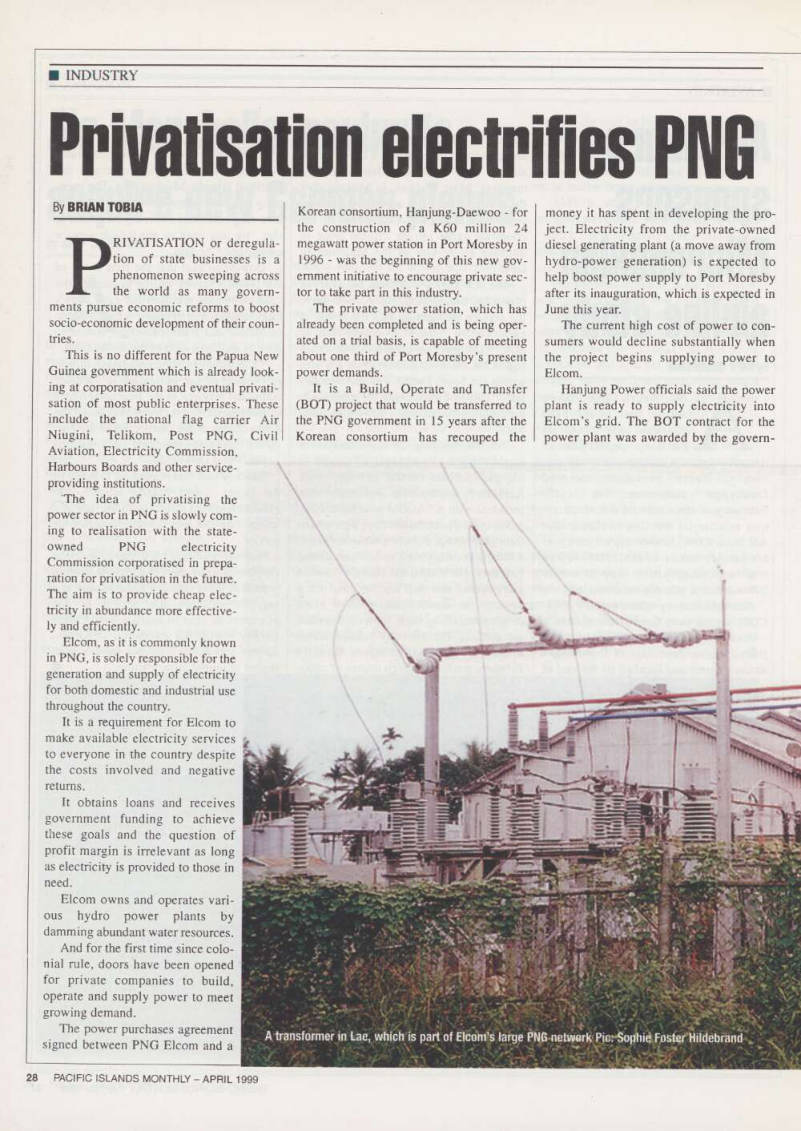
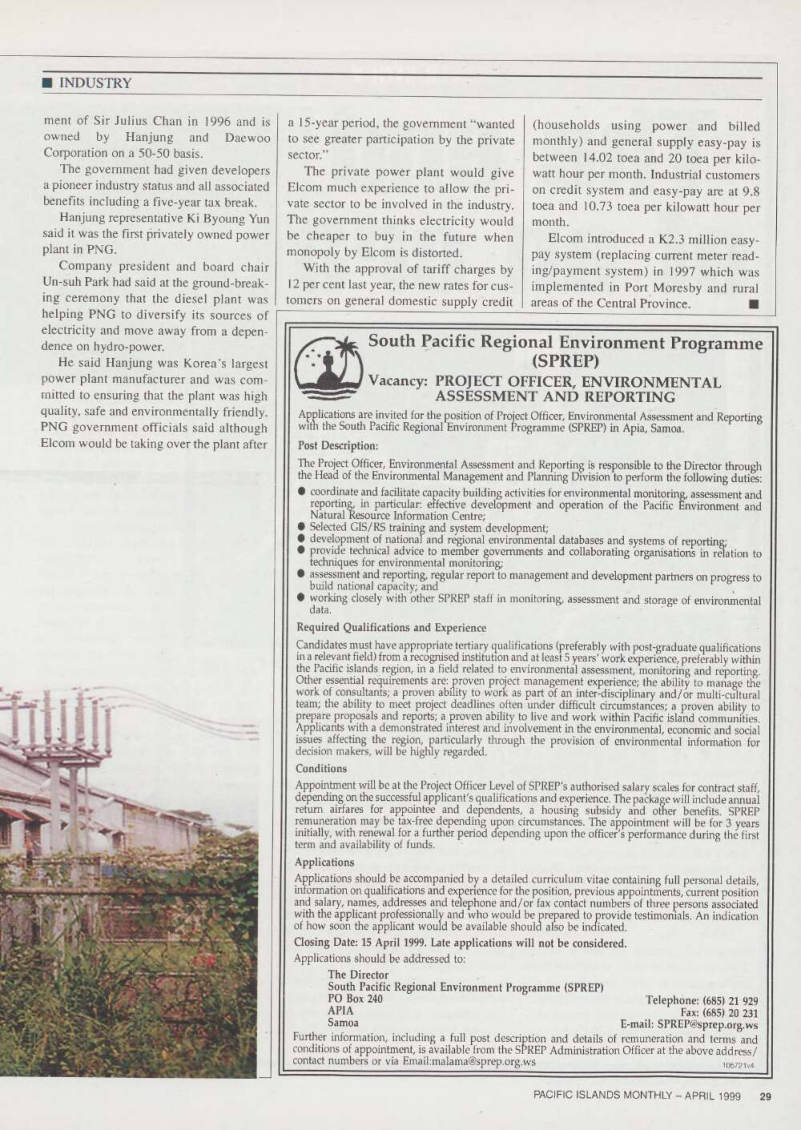
A transformer in Lae, which is part of Elcom’s large PNG network Pic: Sophie Foster Hildebrand
ment of Sir Julius Chan in 1996 and is owned by Hanjung and Daewoo Corporation on a 50-50 basis.
The government had given developers a pioneer industry status and all associated benefits including a five-year tax break.
Hanjung representative Ki Byoung Yun said it was the first privately owned power plant in PNG.
Company president and board chair Un-suh Park had said at the ground-break ing ceremony that the diesel plant was helping PNG to diversify its sources of electricity and move away from a depen dence on hydro-power.
He said Hanjung was Korea’s largest power plant manufacturer and was com mitted to ensuring that the plant was high quality, safe and environmentally friendly.
PNG government officials said although Elcom would be taking over the plant after
a 15-year period, the government “wanted to see greater participation by the private sector.”
The private power plant would give Elcom much experience to allow the pri vate sector to be involved in the industry.
The government thinks electricity would be cheaper to buy in the future when monopoly by Elcom is distorted.
With the approval of tariff charges by 12 per cent last year, the new rates for cus tomers on general domestic supply credit
(households using power and billed monthly) and general supply easy-pay is between 14.02 toea and 20 toea per kilo watt hour per month. Industrial customers on credit system and easy-pay are at 9.8 toea and 10.73 toea per kilowatt hour per month.
Elcom introduced a K 2.3 million easy pay system (replacing current meter read ing/payment system) in 1997 which was implemented in Port Moresby and rural areas of the Central Province. ■