Controversial CNMI
p. 20 · Read in the full issue
bill will limit residency
CONTROVERSIAL legisla
tion seeking to limit to three consecutive years the maximum allowable period for non-residents to work in the Northern Marianas has been signed into law by CNMI governor Pedro Tenorio despite strong opposition from businessmen.
The new measure is designed to curb the influx of alien workers and reduce the island economy’s depen dence on foreign labor. It mandates that all guest workers exit the Commonwealth periodically before they are allowed to seek re-employ ment - a provision that employers described as impractical, costly and a detriment to business.
Under Public Law 11-69, nonresi dent employees must leave the islands at the end of three years of employment and stay outside CNMI for a period of not less than six months.
However, foreign workers holding
professional or executive positions and
whose annual salaries are at least $30,000 or $14.42 per hour are exempt from the three-year limit.
“We all recognize that we need non resident workers to supplement our work force. But it is imperative to our social and economic survival that the CNMI begin working toward a future where we are not as dependent upon nonresident workers,” Tenorio wrote to legislators in early March.
The implementation of the law is expected to draw sharp criticism from executives who already are burdened by restrictions against bringing in alien workers.
The Saipan Chamber of Commerce and the Hotel Association of Northern Mariana Islands have opposed the mea sure. It fears it would result in addi tional expenses while profits are declining, and disrupt their business operations.
“I sympathize with and understand the positions of all parties. However, I believe the advantages of this bill out
weigh the negatives. . . In the long run, such action will serve to benefit our island community,” the Governor said.
He promised to explore financial incentives to encourage employers to tap the local labour pool.
There are approximately 28,000 to 30,000 foreign workers in the Northern Marianas, holding more than 90 per cent of the jobs in the private sector.
Their growth in numbers on the islands has worried federal officials due to a string of social and economic problems arising from their presence.
Local employers prefer to hire for eigners, mostly from impoverished Asian countries, because of the lack of available skilled workers locally, as well as the relatively low salaries paid.
High pay and better benefits attract the indigenous population to work in the government, but with the adminis tration’s streamlining policy, due to shrinking revenues, locals now are forced to seek jobs in the private sec tor. (Saipan Tribune) ■
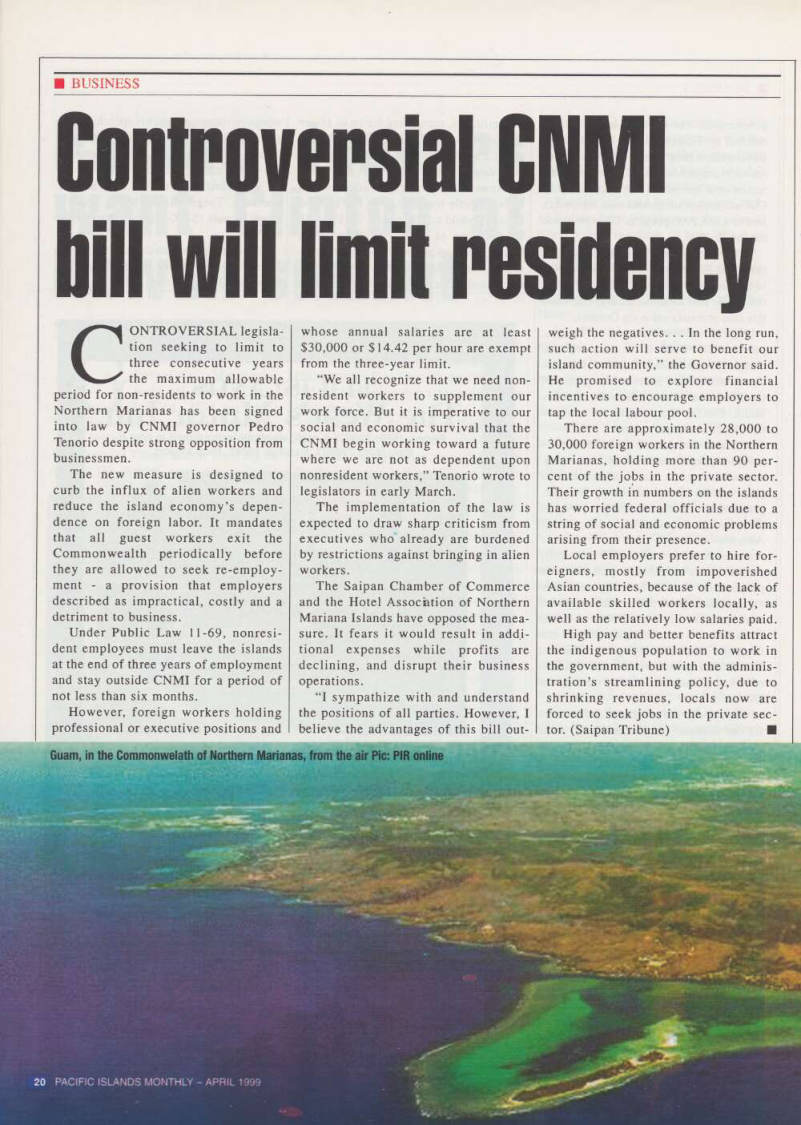
Guam, in the Commonwelath of Northern Marianas, from the air Pic: PIR online