Pacific leaders
pp. 18-19 · Read in the full issue
want Clinton at Hawaii summit
By Ed Rampell
Government chiefs of
Polynesia, Melanesia,
and Micronesia have invited US president Bill Clinton to a summit at Honolulu.
This follows the US-Pacific Joint Commercial Commission meeting to which the States sent junior level
bureaucrats.
The Pacific Island Conference of Leaders approved an official summit with Clinton at the East-West Center during the full PICL meeting that takes place once every three years.
Clinton will fly to New Zealand in September for the annual Asia Pacific Economic Cooperation meeting. The Pacific pow-wow between Clinton and his
Oceanic counterparts could take place either before or after the president’s trip to New Zealand.
Details as to who-invited-whom to Honolulu for the proposed summit are unclear, but according to Brenda Lei Foster, governor Ben Cayetano’s Executive Assistant for National and International Affairs, the White House is giving “serious attention” to the pro posal.
The most dramatic moment in the oth erwise dry, diplomatic proceedings came during a reception for the US- Pacific JCC and PICL at the Ala Moana Hotel.
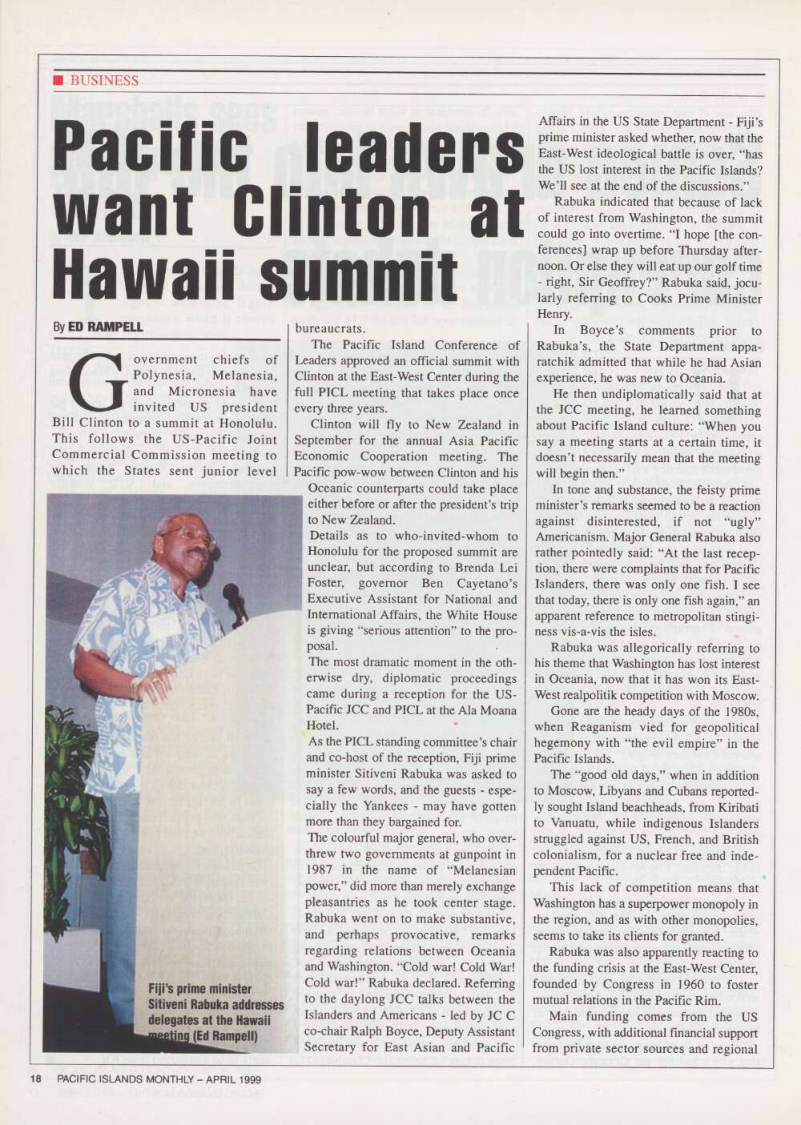
As the PICL standing committee’s chair and co-host of the reception, Fiji prime minister Sitiveni Rabuka was asked to say a few words, and the guests - espe cially the Yankees - may have gotten more than they bargained for.
The colourful major general, who over threw two governments at gunpoint in 1987 in the name of “Melanesian power,” did more than merely exchange pleasantries as he took center stage.
Rabuka went on to make substantive, and perhaps provocative, remarks regarding relations between Oceania and Washington. “Cold war! Cold War!
Cold war!” Rabuka declared. Referring to the daylong JCC talks between the Islanders and Americans - led by JC C co-chair Ralph Boyce, Deputy Assistant Secretary for East Asian and Pacific
Affairs in the US State Department - Fiji’s prime minister asked whether, now that the East-West ideological battle is over, “has the US lost interest in the Pacific Islands?
We’ll see at the end of the discussions.”
Rabuka indicated that because of lack of interest from Washington, the summit could go into overtime. “I hope [the con ferences] wrap up before Thursday after noon. Or else they will eat up our golf time - right, Sir Geoffrey?” Rabuka said, jocu larly referring to Cooks Prime Minister Henry.
In Boyce’s comments prior to Rabuka’s, the State Department appa ratchik admitted that while he had Asian experience, he was new to Oceania.
He then undiplomatically said that at the ICC meeting, he learned something about Pacific Island culture: “When you say a meeting starts at a certain time, it doesn’t necessarily mean that the meeting will begin then.”
In tone and substance, the feisty prime minister’s remarks seemed to be a reaction against disinterested, if not “ugly”
Americanism. Major General Rabuka also rather pointedly said: “At the last recep tion, there were complaints that for Pacific Islanders, there was only one fish. I see that today, there is only one fish again,” an apparent reference to metropolitan stingi ness vis-a-vis the isles.
Rabuka was allegorically referring to his theme that Washington has lost interest in Oceania, now that it has won its East- West realpolitik competition with Moscow.
Gone are the heady days of the 1980 s, when Reaganism vied for geopolitical hegemony with “the evil empire” in the Pacific Islands.
The “good old days,” when in addition to Moscow, Libyans and Cubans reported ly sought Island beachheads, from Kiribati to Vanuatu, while indigenous Islanders struggled against US, French, and British colonialism, for a nuclear free and inde
pendent Pacific.
This lack of competition means that Washington has a superpower monopoly in the region, and as with other monopolies, seems to take its clients for granted.
Rabuka was also apparently reacting to the funding crisis at the East-West Center, founded by Congress in 1960 to foster mutual relations in the Pacific Rim.
Main funding comes from the US Congress, with additional financial support from private sector sources and regional
Fiji’s prime minister Sitiveni Rabuka addresses delegates at the Hawaii meeting (Ed Rampell)
governments. The EWC, in turn, provides much of the financing of the Pacific Island Development Programme. The Center was set-up to project American influence in the region (and has been subject to numerous CIA infiltration allegations over the years), just as CINCPAC projects US power into the Pacific Rim.
While there is much talk in Hawaii that the Aloha State is the “hub of the Pacific” in the so-called “Pacific century,” PIDP is one of the few local institutions that takes this idea seriously vis-a-vis Oceania.
PIDP Director Halapua, a Tongan, pointed out: “PIDP is the only regional Oceanic organisation based on US soil.
The South Pacific Forum and University of the South Pacific are based in Fiji. The South Pacific Community is in New Caledonia,” a French colony.
Halapua enunciated the 50th State’s unique regional role: “Hawaii is the natur al link between the Pacific Islands and the USA. Hawaii has a dual identity. It is geo graphically and culturally part of [Polynesia]. Politically, it is part of America.”
Nevertheless, when the US drastically cut the EWC’s budget in the post-Cold War period, PIDP went unfunded by the Center for up to three years. Of late, its budget has been restored by the EWC to about $300,000 a year. Halapua added that Congress also directly grants “almost $400,000 a year for about 23 Islander scholarship students to study through the
Ewc.
They study at the Center and are sent for one semester [to the continent]. Some have internships in Washington, DC”.
During the EWC budget crisis, there was a move to relocate PIDP to French Polynesia. In addition to France, which is a big colonial power in the region, Japan, too, is a major Pacific player. On February 24, Tokyo’s Consul General in Hawaii, Gotaro Ogawa, presented its usual annual donation to PIDP: $363,000. Since 1978, it has donated $3,639,000 to the EWC, most of it earmarked for PIDP. PIDP’s future budget is uncertain now.
Although the US seems uncertain of Oceania’s economic importance, in Hawaii alone, top businesses and employers such as Hawaiian Airlines, Outrigger Hotels, and the Bank of Hawaii transact substan tial amounts of business in Polynesia, Micronesia, and Melanesia. Bank of Hawaii has a presence in 14 Pacific nations
and territories, accounting for up to 16 per cent of the assets of the bank’s parent com pany, Pacific Century Financial Corp., according to Bankoh Exec. V.P. Karl Pan.
Those who consider the Pacific Islands to be of little importance to the US and Hawaii should consider this: On Feb. 20, US Secretary of Defense William Cohen was in Oahu to attend a change-in-com mand ceremony for the US Pacific Command (which forward bases 304,000
troops in the region). In his speech, Cohen said: “The Pacific [is an] important region to us... by virtue of its... strategic location [it] will remain high on our agenda.”
The prime ministers of Fiji (Sitiveni Rabuka), Tonga (Baron Vaea), and the Cook Islands (Sir Geoffrey Henry) were there.
So too were Vanuatu deputy prime min ister Willie Jimmy, and French Polynesian president Gaston Flosse. ■