widespread In Pacific
p. 14 · Read in the full issue
EPIRBs save lives but not widespread In Pacific
By Michael Field
FRENCH yachtswoman
Isabelle Autissier is alive today thanks to a tele phone book sized piece of technology that takes the “search” out of “search and rescue”.
Emergency Position Indicating Radio Beacons (EPIRBs) have saved 8000 lives
at sea - but very few of them have been Pacific Islanders because mariners from there do not carry them.
There are two models the earlier version sends a distress signal automatically to any passing ship or plane and the 406 MHz does that as well as communicating with the French led COSPAS SARSAT maritime rescue satellites. It also sends details of the distressed vessel and details of next-of-kin.
Last month Madame Autissier was leading the Around Alone yacht race.
Suddenly her yacht capsized near the world’s most distant point from land - and an area of ocean five million square kilometres larger than
Russia. Only fellow competitors were near enough to help.
She had a 406 MHz and its signal was immediately picked up by satellite and routed to the Wellington and Nadi Rescue Co-ordination Centres. On the first pass the satellite gave her position with a 97 percent accuracy. On the second pass, 20 minutes later, her position was known pre
cisely.
Once the position was known it was fed by satellite to the on-board computer of fellow competitor Giovanni Soldini who was able to sail directly to her yacht and
rescue her. As it turned out, he was able to see her. But if he had got there and could not see, Autissier had a Search and Rescue Radar Transponder which is a middle dis tance distress signal.
Royal New Zealand Air Force No 5 Squadron Wing Commander Mike Yardley says EPIRBs are “the living or dying” of modem searching. “The EPIRB, especially if it is a 406 beacon, to have it captured,
the information given to us; we arrive on the scene, do our brief search and find them within half an hour, usually.”
Time is spent monitoring the ship wrecked until a ship arrives. “Everyone else takes their chances.”
In New Zealand an EPIRB costs around $2200. In the Pacific people tend not to have them, or if they have them they risk having them stolen. It was never clear if Wasawasa, which sank in Fijian waters with 12 aboard, had an EPIRB. There were suggestions it did, but it was stolen.
The squadron’s awesome Orions have a
big array of electronics aboard and if peo ple cannot carry EPIRBs Yardley says the next alternative is a radar reflector, a home made triangular piece of metal.
“Radar is our best bet after the electron ic direction finding, it is better than dyes in the water even. It would be pretty much parallel with flares.”
Orions can also hunt with infra-red.
However, as with the case of the three
Frenchmen last month, the longer people are on the water in non-radar reflecting fabric life-rafts, the closer their temperature come to the sea temperature. Then infra red cannot pick up a differ ential.
Often in the Pacific life and death ends up being down to the human eye-ball.
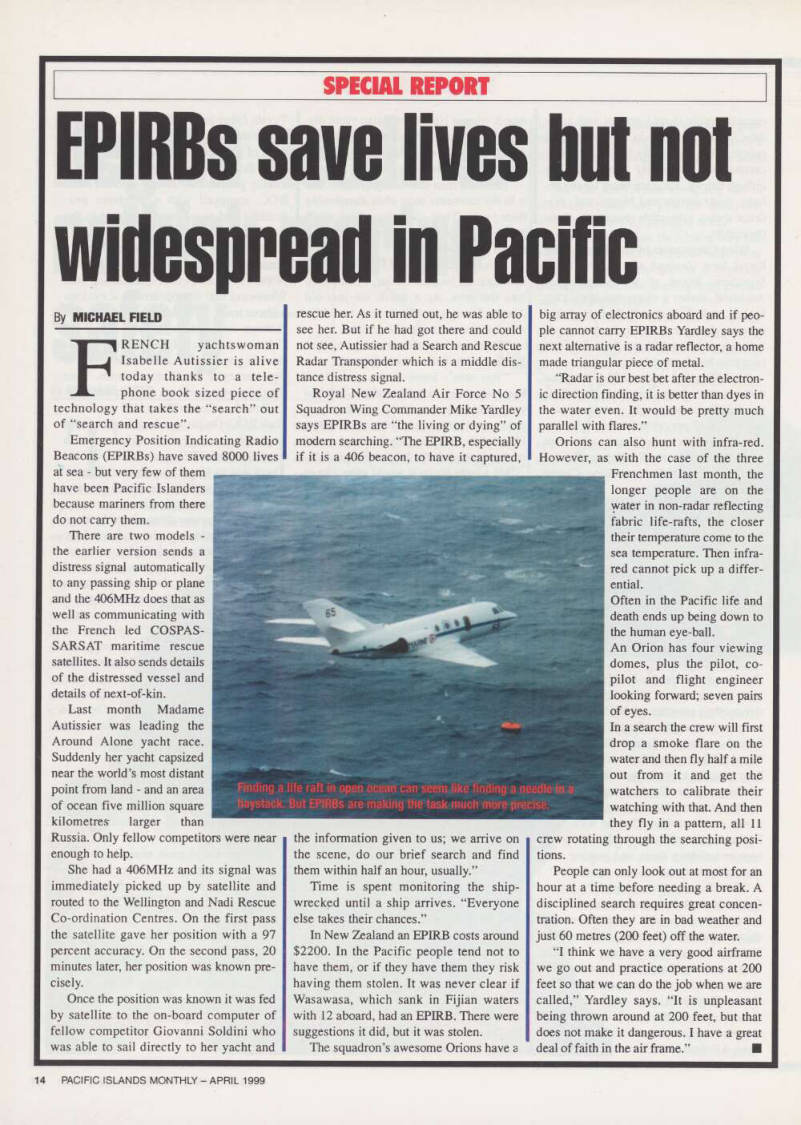
An Orion has four viewing domes, plus the pilot, co pilot and flight engineer looking forward; seven pairs of eyes.
In a search the crew will first drop a smoke flare on the water and then fly half a mile out from it and get the watchers to calibrate their watching with that. And then they fly in a pattern, all 11
crew rotating through the searching posi tions.
People can only look out at most for an hour at a time before needing a break. A disciplined search requires great concen tration. Often they are in bad weather and just 60 metres (200 feet) off the water.
“I think we have a very good airframe we go out and practice operations at 200 feet so that we can do the job when we are called,” Yardley says. “It is unpleasant being thrown around at 200 feet, but that does not make it dangerous. I have a great deal of faith in the air frame.” ■
Finding a life in open Ocean can seem like finding a needle in a haystack, But EPIRB are making the task much more precise.