safety
pp. 12-13 · Read in the full issue
Special Report
Region needs to rethink marine safety
By Michael Held
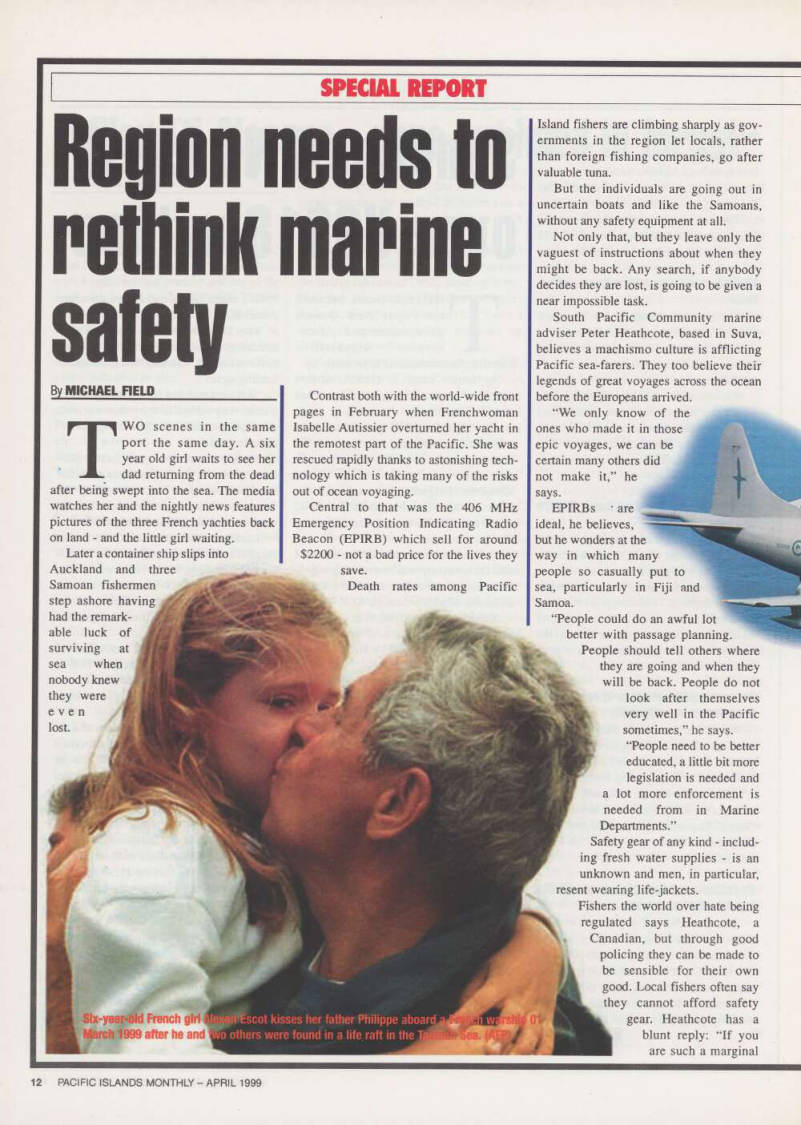
TWO scenes in the same port the same day. A six year old girl waits to see her dad returning from the dead after being swept into the sea. The media watches her and the nightly news features pictures of the three French yachties back on land - and the little girl waiting.
Later a container ship slips into Auckland and three ...
Samoan fishermen step ashore having had the remark- A able luck of m surviving at IH sea when nobody knew y 1 they were Jbi even lost. W
Contrast both with the world-wide front pages in February when Frenchwoman Isabelle Autissier overturned her yacht in the remotest part of the Pacific. She was rescued rapidly thanks to astonishing tech nology which is taking many of the risks out of ocean voyaging.
Central to that was the 406 MHz
Emergency Position Indicating Radio
Beacon (EPIRB) which sell for around $2200 - not a bad price for the lives they save.
Death rates among Pacific
Island fishers are climbing sharply as gov ernments in the region let locals, rather
than foreign fishing companies, go after
valuable tuna.
But the individuals are going out in uncertain boats and like the Samoans, without any safety equipment at all.
Not only that, but they leave only the vaguest of instructions about when they might be back. Any search, if anybody decides they are lost, is going to be given a near impossible task.
South Pacific Community marine adviser Peter Heathcote, based in Suva, believes a machismo culture is afflicting Pacific sea-farers. They too believe their legends of great voyages across the ocean
before the Europeans arrived.
“We only know of the ones who made it in those epic voyages, we can be certain many others did not make it,” he says.
EPIRBs are ideal, he believes, but he wonders at the way in which many people so casually put to sea, particularly in Fiji am Samoa.
“People could do an awful lot better with passage planning.
People should tell others where they are going and when they will be back. People do not look after themselves very well in the Pacific sometimes,” he says. - “People need to be better educated, a little bit more legislation is needed and a lot more enforcement is needed from in Marine Departments.”
Safety gear of any kind - includ ing fresh water supplies - is an unknown and men, in particular, resent wearing life-jackets.
Fishers the world over hate being t regulated says Heathcote, a * Canadian, but through good policing they can be made to jjk be sensible for their own iZA good. Local fishers often say they cannot afford safety gear. Heathcote has a ;, blunt reply: “If you are such a marginal
Six-year-old French giral Alexan Escot kisses her father Philippe aborard a French warship 01 March 1999 after he and two others were found in life raft in the Tasman Sea. ( AFP )
operation you should go out and grow dalo.” The tuna boom in Samoa has seen people using the locally built aluminium
catamarans, originally designed for
inshore fishing. They are being locally re built, made longer and bigger and, evi dence shows, vulnerable to cracking down the middle.
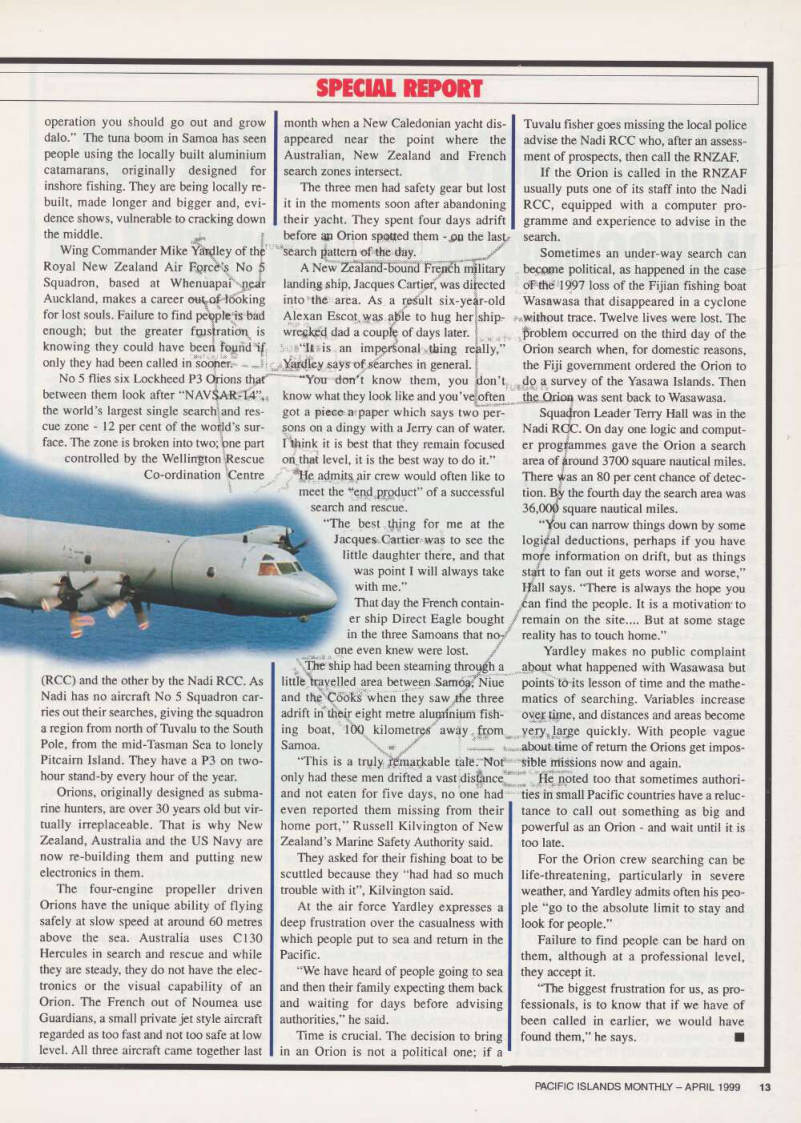
Wing Commander Mike Yardley of the Royal New Zealand Air Fprcd’s No Squadron, based at Whenuapai pear Auckland, makes a career looking for lost souls. Failure to find people is bad enough; but the greater frustration is knowing they could have been found if only they had been called in sooner. ~1 No 5 flies six Lockheed P 3 Orions that between them look after “NAVSAR-14”,:: the world’s largest single search;and res cue zone - 12 per cent of the world’s sur face. The zone is broken into two; one part controlled by the Wellington Rescue Co-ordination Centre
(RCC) and the other by the Nadi RCC. As Nadi has no aircraft No 5 Squadron car ries out their searches, giving the squadron 3 region from north of Tuvalu to the South Pole, from the mid-Tasman Sea to lonely Pitcairn Island. They have a P 3 on two hour stand-by every hour of the year.
Orions, originally designed as subma rine hunters, are over 30 years old but vir tually irreplaceable. That is why New Zealand, Australia and the US Navy are now re-building them and putting new electronics in them.
The four-engine propeller driven Orions have the unique ability of flying safely at slow speed at around 60 metres above the sea. Australia uses Cl3o Hercules in search and rescue and while they are steady, they do not have the elec tronics or the visual capability of an Orion. The French out of Noumea use Guardians, a small private jet style aircraft regarded as too fast and not too safe at low level. All three aircraft came together last
month when a New Caledonian yacht dis appeared near the point where the Australian, New Zealand and French search zones intersect.
The three men had safety gear but lost it in the moments soon after abandoning their yacht. They spent four days adrift before an Orion spotted them - ,pn the last
search pattern of the day. /
A New Zealand-bound French military landing ship, Jacques Cartier) was directed into the area. As a result six-yeir-old Alexan Escot was able to hug heriship wrecked dad a couple of days later. I “It is an impersonal thing really,”
Yardley says of searches in general. \ "“You don’t know them, you don’t know what they look like and you’vc often got a piece a paper which says two per sons on a dingy with a Jerry can of water.
I think it is best that they remain focused on that level, it is the best way to do it.” *He admits air crew would often like to meet the “end product” of a successful
search and rescue.
“The best thing for me at the Jacques Cartier was to see the little daughter there, and that lili| was point I will always take with me.”
That day the French contain er ship Direct Eagle bought in the three Samoans that no-' one even knew were lost.
The ship had been steaming through a little travelled area between Samoa, Niue and the Cooks when they saw the three adrift in their eight metre aluminium fish ing boat. 100 kilometres away from
Samoa. \ - *
“This is a truly remarkable tale. Not only had these men drifted a vast distance and not eaten for five days, no one had even reported them missing from their home port,” Russell Kilvington of New Zealand’s Marine Safety Authority said.
They asked for their fishing boat to be scuttled because they “had had so much trouble with it”, Kilvington said.
At the air force Yardley expresses a deep frustration over the casualness with which people put to sea and return in the Pacific.
“We have heard of people going to sea and then their family expecting them back and waiting for days before advising authorities,” he said.
Time is crucial. The decision to bring in an Orion is not a political one; if a
Tuvalu fisher goes missing the local police advise the Nadi RCC who, after an assess ment of prospects, then call the RNZAF.
If the Orion is called in the RNZAF usually puts one of its staff into the Nadi RCC, equipped with a computer pro gramme and experience to advise in the search.
Sometimes an under-way search can become political, as happened in the case of the 1997 loss of the Fijian fishing boat Wasawasa that disappeared in a cyclone without trace. Twelve lives were lost. The problem occurred on the third day of the Orion search when, for domestic reasons, the Fiji government ordered the Orion to do a survey of the Yasawa Islands. Then the Orion was sent back to Wasawasa.
Squadron Leader Terry Hall was in the Nadi RCC. On day one logic and comput er programmes gave the Orion a search area of around 3700 square nautical miles.
There was an 80 per cent chance of detec tion. By the fourth day the search area was 36,000 square nautical miles.
“You can narrow things down by some logical deductions, perhaps if you have mofe information on drift, but as things start to fan out it gets worse and worse,”
Hall says. “There is always the hope you can find the people. It is a motivation to remain on the site... But at some stage reality has to touch home.”
Yardley makes no public complaint about what happened with Wasawasa but points tb its lesson of time and the mathe matics of searching. Variables increase over time, and distances and areas become very large quickly. With people vague about time of return the Orions get impos sible missions now and again.
Ile noted too that sometimes authori ties in small Pacific countries have a reluc tance to call out something as big and powerful as an Orion - and wait until it is too late.
For the Orion crew searching can be
life-threatening, particularly in severe
weather, and Yardley admits often his peo ple “go to the absolute limit to stay and look for people.”
Failure to find people can be hard on them, although at a professional level, they accept it.
“The biggest frustration for us, as pro fessionals, is to know that if we have of been called in earlier, we would have found them,” he says. ■