Economic change
pp. 36-39 · Read in the full issue

Advertising Feature
Economic change for Samoa
SINCE Independence, on January
1, 1962, Samoa has concentrated on developing a modem economy based on traditional village agriculture and
primary products.
Subsistence agriculture still supports around 75 per cent of the population. The primary sector employs more than half the workforce and accounts for 50 per cent of
GDP and about 80 per cent of export earn ings.
About 30 per cent of the workforce is employed by the government. Despite huge investments in agriculture and forestry, however, there has been a contin uing decline in the export of primary prod ucts and, at the same time, a rise in imports.
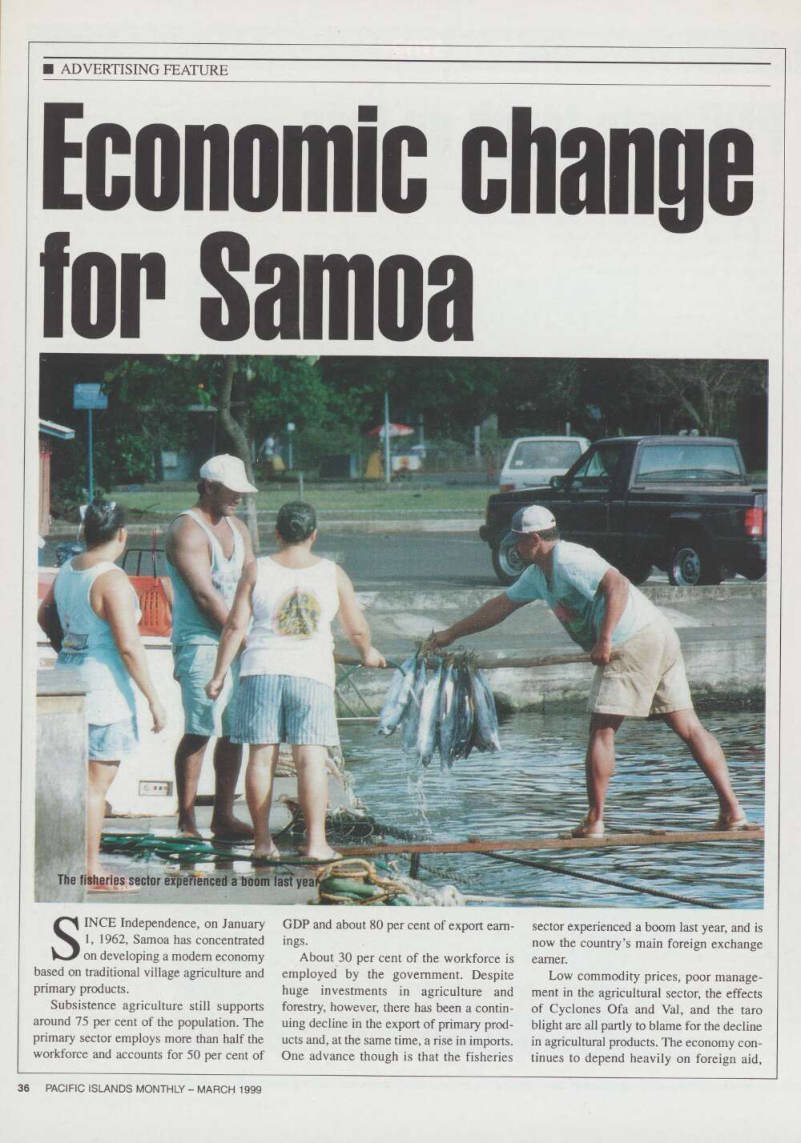
One advance though is that the fisheries
sector experienced a boom last year, and is now the country’s main foreign exchange earner.
Low commodity prices, poor manage ment in the agricultural sector, the effects of Cyclones Ofa and Val, and the taro blight are all partly to blame for the decline in agricultural products. The economy con tinues to depend heavily on foreign aid,
provided by New Zealand, Australia, the European Economic Community, Japan and China. Remittance from Samoans working overseas is another important source of foreign exchange.
Emigration to Australasia and North America remains high, and though this pro vides much-needed foreign exchange, it also results in a loss of skilled workers.
Those who leave often find it difficult to adjust to the stress of living in a fast-paced, materialistic society.
Wages in Independent Samoa are extremely low relative to local living costs; the minimum legal wage for employees of private companies is STS2.SO per hour. It is understandable then that many Samoan workers find it difficult to resist trading their professional jobs for drudgery work at the tuna canneries in American Samoa or an unsettling life in the fast lanes of New Zealand, Australia or the USA.
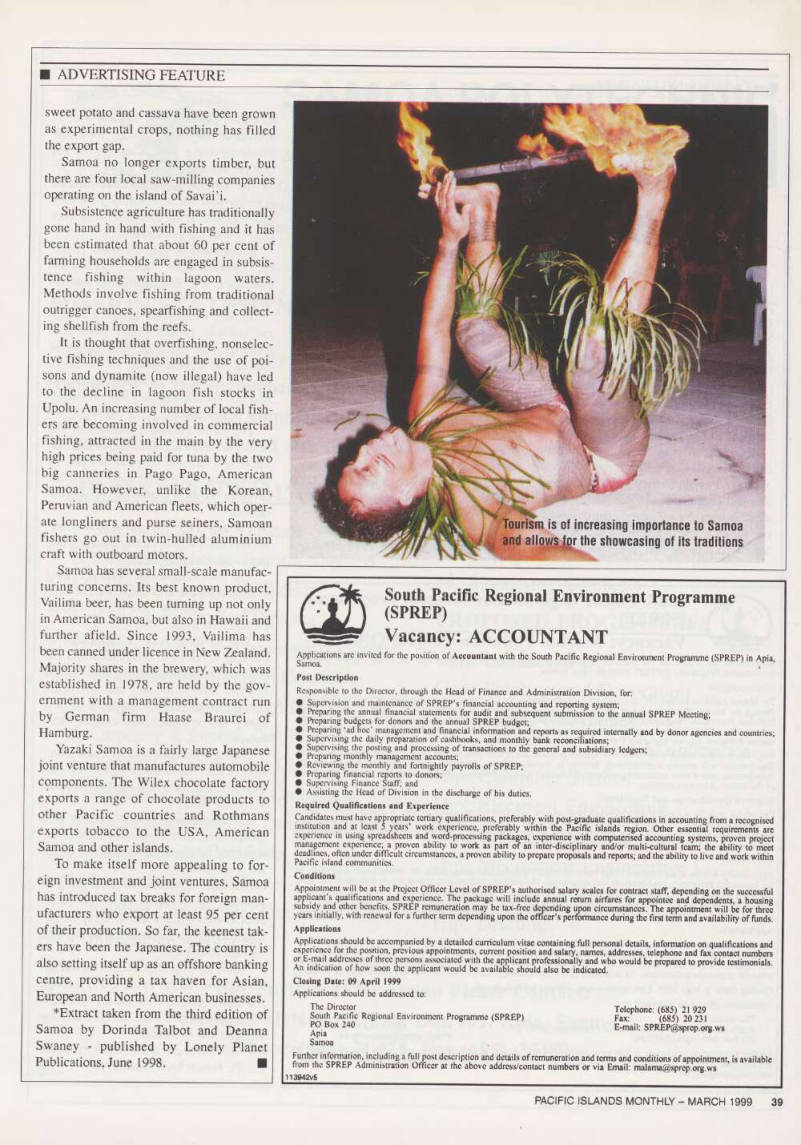
Tourism is of increasing importance to the economy of Samoa and in recent years
the government has promoted the devel opment of light manufacturing industries.
Coffee, bananas and copra have histor ically been the most important export crops and for a while, cocoa was the star on Samoa’s economic horizon. In 1980, US$5 million worth of cocoa was pro duced and throughout the 1980 s, the export amount increased steadily every year.
In the 19905, cyclone damage, coupled with a waning enthusiasm for this crop, caused exports to plummet. Plantations still cover parts of Savai’i but most of the cocoa (which is said to be the best in the world) is for domestic consumption.
Samoa’s banana export business, which was decimated in the late 1950 s by disease, cyclone damage, mismanage ment and competition from Latin America, was revived somewhat in mid -1993 when the 12-hectare plantation of the Agricultural Store Corporations began exporting four container loads to New Zealand each month. Bananas are still exported to New Zealand but growers cannot produce enough to satisfy demand.
Currently, the African tree snail, first noticed in Apia three or four years ago, poses a threat to banana plantations.
Coconuts and small quantities of coconut oil are exported to Australia and elsewhere. Until recently, the largest coconut plantation in the southern hemi sphere was at Mulifanua, 40km west of Apia. The government-controlled Samoa Land Corporation has since bought much of the land and is in the process of selling and leasing it as private land.
Samoa has traditionally been one of the world’s largest producers of taro niue (a tasty and easily stored strain of taro), exporting ST$6.9 million worth of the root crop annually, mainly to expatriate populations in New Zealand, Australia and the USA.
In July 1993, however, a virulent fun gal blight, Phytophthora colocasiae, was discovered in the Samoas. (This infesta tion is a close cousin of the infamous potato blight that destroyed Ireland’s potato crops in the 19405, leading to the starvation of almost one-third of the coun
try’s population.)
By the end of 1994, it had wiped out crops throughout Upolu and Savai’i. Taro crops have still not recovered and taro must now be imported. Though ta’amu, or ‘big taro’, is grown in place of taro, and
sweet potato and cassava have been grown as experimental crops, nothing has filled the export gap.
Samoa no longer exports timber, but there are four local saw-milling companies operating on the island of Savai’i.
Subsistence agriculture has traditionally gone hand in hand with fishing and it has been estimated that about 60 per cent of farming households are engaged in subsis tence fishing within lagoon waters.
Methods involve fishing from traditional outrigger canoes, spearfishing and collect ing shellfish from the reefs.
It is thought that overfishing, nonselec tive fishing techniques and the use of poi sons and dynamite (now illegal) have led to the decline in lagoon fish stocks in Upolu. An increasing number of local fish ers are becoming involved in commercial fishing, attracted in the main by the very high prices being paid for tuna by the two big canneries in Pago Pago, American Samoa. However, unlike the Korean, Peruvian and American fleets, which oper ate longliners and purse seiners, Samoan fishers go out in twin-hulled aluminium craft with outboard motors.
Samoa has several small-scale manufac turing concerns. Its best known product, Vailima beer, has been turning up not only in American Samoa, but also in Hawaii and further afield. Since 1993, Vailima has been canned under licence in New Zealand.
Majority shares in the brewery, which was established in 1978, are held by the gov ernment with a management contract run by German firm Haase Braurei of Hamburg.
Yazaki Samoa is a fairly large Japanese joint venture that manufactures automobile components. The Wilex chocolate factory exports a range of chocolate products to other Pacific countries and Rothmans exports tobacco to the USA, American Samoa and other islands.
To make itself more appealing to for eign investment and joint ventures, Samoa has introduced tax breaks for foreign man ufacturers who export at least 95 per cent of their production. So far, the keenest tak ers have been the Japanese. The country is also setting itself up as an offshore banking centre, providing a tax haven for Asian, European and North American businesses. taken from the third edition of Samoa by Dorinda Talbot and Deanna
Swaney - published by Lonely Planet
Publications, June 1998. ■
Tourism is of increasing importance to Samoa and allows for the showcasing of its traditions