PNG gets tough on tuna
p. 35 · Read in the full issue
By Sam Vulum
PAPUA New Guinea may have done well so far within its miner al, petroleum, agriculture and tim ber resources, but it not been doing too well with its fisheries’ resource.
This is despite claims that one of PNG’s best-kept secrets is the size and potential of its fisheries.
But PNG is yet to reach its full potential wealth ion developing the resource. PNG’s area for resource exploitation, including the islands and atolls, is claimed to be amongst the largest in the world.
The waters of PNG, like its Pacific neighbours, is rich with fisheries resource.
Among the most talked about fish in PNG is tuna. PNG has all the four main species of tuna - skipjack, yellowfin, bigeye and albacore.
World production of tuna is around 3.2 million tonnes per year. About 1.2 million comes from the Pacific of which 240,000 tonnes comes from PNG waters with its highest catch reaching more than 350,000 in some years.
The potential value to PNG of harvest ing all of this fish is K 1 billion per year.
This compares with the total value of exports of agricultural and logging products of K 1.2 billion in 1997 and minerals and petroleum at around Kl.B billion in the same year. During the period 1981-1994,
the total value of marine exports ranged from KB - million and there was no tuna exported.
In 1997, the value of all marine products exported was reported to be about K9O million and it is believed that this may have grown to Kl2O-130 million in 1998.
This shows that PNG has a long way to go to reach its full potential wealth.
PNG has about 118,000 tonnes of skipjack and 30,000 tonnes of yellowfin
passing through its waters
every month and it has
about 400,000 tonnes of skipjack and 140,000 tonnes of yellowfin that live per manently in its waters.
There is, however, some promising news for the country after the launching of the Tuna Management Plan in December 1998, which is designed to bring the tuna fisheries back to PNG shores.
The plan requires the involvement of long line vessels. Each vessel is estimated to earn about K 100,000 per year directly for the State and each purse seiner about K 1 million per year.
There will also be hundreds of jobs cre ated on the shore as people have to fix the boats and the equipment and provide food and other provisions.
There would be 80 long line vessels (out of a possible 100) worth K 8 million and 30 purse seiners (out of a possible 100), worth K3O million per year to the country, based in PNG.
Meanwhile, the country has reaffirmed its intention to pursue its sovereign rights as a coastal state in fisheries management within the context of a proposed western and central Pacific convention governing the sustainable use of tuna stocks.
This stand was made known in a major international fisheries conference in Honolulu, Hawaii on February 11.
Ambassador Lucy Bogari, the director general for economic affairs of the depart ment of foreign affairs and trade, who led a
PNG delegation to the conference, said: “Since the last conference in Tokyo, Papua New Guinea has adopted a new Fisheries Management Act which establishes an up to-date legal framework intended to bal ance the use and conservation of all PNG’s living marine resources and in doing so, it has allowed us to finalise and implement our own in-zone conservation and manage ment measures through a tuna fishery man agement plan”.
She said following the adoption of the Act by parliament last November, PNG has been able to finalise and implement its own in-zone conservation and management measures through the management plan which was launched by the minister of fish eries, Sir Mekere Morauta in December 1998.
Bogari said applying in-zone conserva tion and management measures are provid ed for under the United Nation’s implemen tation agreement on conservation and man agement of straddling fish stocks and high ly migratory fish stocks which PNG is a signatory to since its adoption by the UN in 1995.
“We are being responsible in pursuing in-zone conservation and management measures for tuna stocks in our fisheries waters as allowed for under international law and are confident that other Pacific Island states will also do the same,” she said. Bogari said UN agreement calls on, coastal and distant water fishing states to cooperate in conserving and managing tuna
and other highly migratory fish species,
taking into account the sovereign rights of coastal states to apply measures within their
own economic exclu sive zones as well as
negotiating compatible
arrangements for the high seas area.
She said the central and western Pacific region is characterised by having a significant number of enclosed and semi-enclosed pockets of high sea enclaves that are nor mally productive in tuna catches. The con ference, which began in 1995, has held a num ber of sessions in vari ous countries of the region. ■
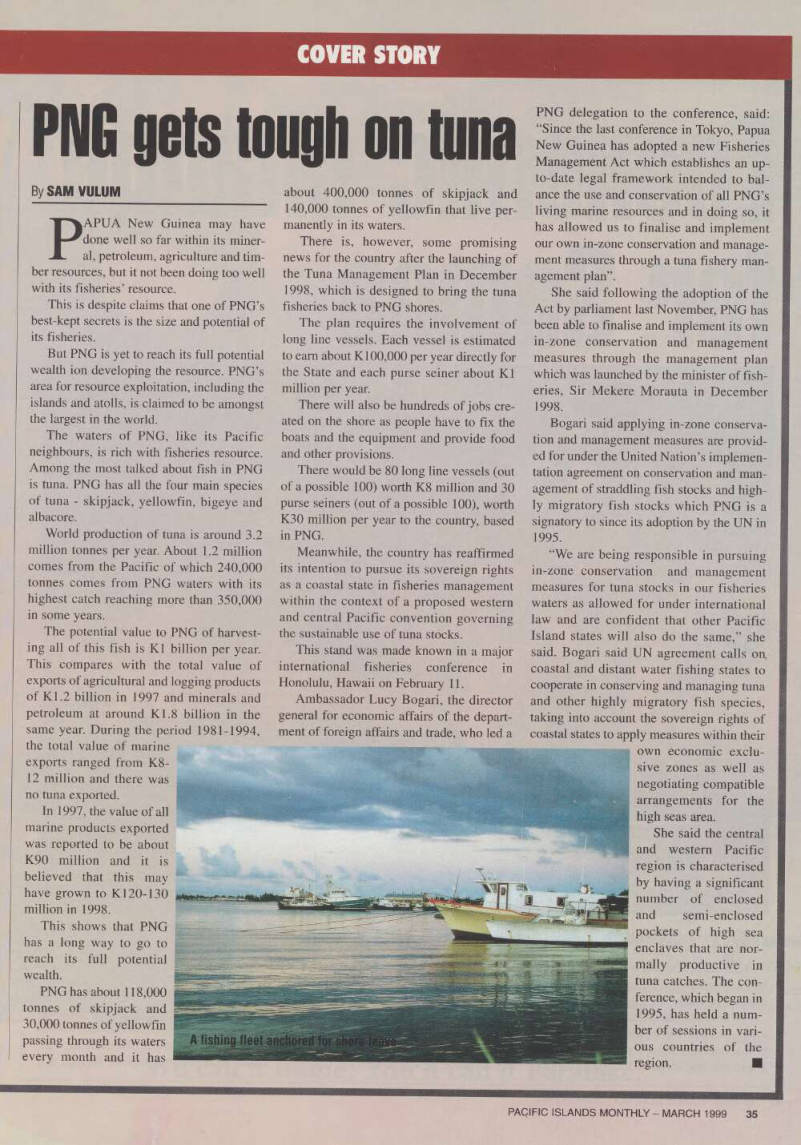
A fishing fleet anchored for shore leave