Waitangi anniversary
p. 29 · Read in the full issue
sees hope for racial harmony
BACK in the 1970 s Donna Awatere scared the hell out of white New Zealanders. There she was in Cuba, apparently learning the arts of the AK47 and Revolution and she even had a published manifesto,
“Maori Sovereignty”. Now she sits in Parliament, representing the right wing, pro choice and free market Act Party although her strong voice and clear vision make it abundantly clear she is a slave to
no ideology.
Little wonder then her book “My Journey” became a best-seller as Donna Awatere Huata, as she is now, is a deeply fascinating, brilliant character, daughter of an awesome Maori war hero and a sign of the extraordinary racial change seen in New Zealand in 20 years. In those Cuba
days Awatere Huata, who near ly became an opera star to rival Kiri Te Kanawa and instead became an educational psy chologist by training, wrote a revolutionary thesis called
Maori Sovereignty.
She reckons now she got it wrong back then; racial change in New Zealand did not need violence or the gun. “The words ‘white hatred’ were wrong, quite wrong,” she says in My Journey. “There is a sense of fairness deep in the New Zealand mentality... New Zealanders are essentially decent, they have a sense of
justice. Information changes the way they view the world”.
On February 6, New Zealanders mark Waitangi Day, the national day that com memorates the signing at Waitangi in 1840 of a treaty between representatives of the British Crown of Queen Victoria and Maori chiefs, mainly from what is now the Northland region of the country.
Waitangi Day used to be a day of protest, of embarrassment and of shame in New Zealand; these days it is still a tense time when the injustices of the past are recognised.
But there is also much to celebrate as the Government makes peace with various Maori tribes.
It offers hope here that New Zealand’s vision of racial harmony might have valid ity, although there is little doubt that there
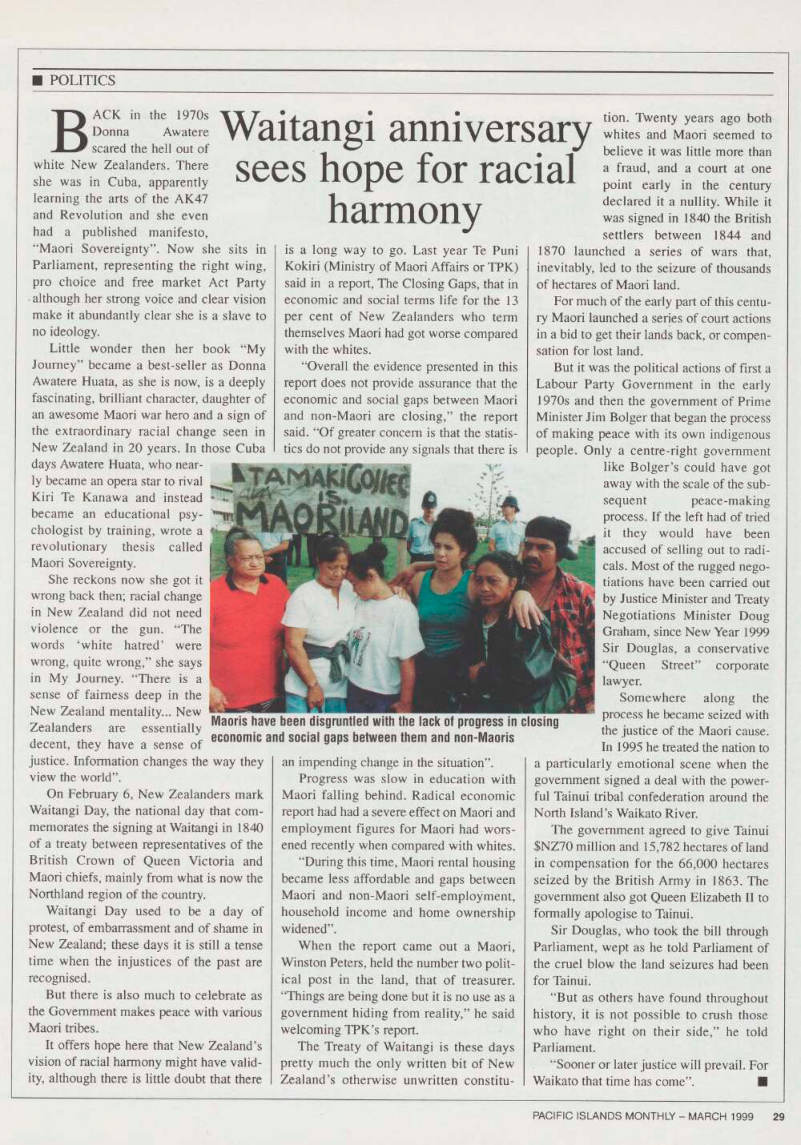
is a long way to go. Last year Te Puni Kokiri (Ministry of Maori Affairs or TPK) said in a report, The Closing Gaps, that in economic and social terms life for the 13 per cent of New Zealanders who term themselves Maori had got worse compared with the whites.
“Overall the evidence presented in this report does not provide assurance that the economic and social gaps between Maori and non-Maori are closing,” the report said. “Of greater concern is that the statis tics do not provide any signals that there is
an impending change in the situation”.
Progress was slow in education with Maori falling behind. Radical economic report had had a severe effect on Maori and employment figures for Maori had wors ened recently when compared with whites.
“During this time, Maori rental housing became less affordable and gaps between Maori and non-Maori self-employment, household income and home ownership widened”.
When the report came out a Maori, Winston Peters, held the number two polit ical post in the land, that of treasurer.
“Things are being done but it is no use as a government hiding from reality,” he said welcoming TPK’s report.
The Treaty of Waitangi is these days pretty much the only written bit of New Zealand’s otherwise unwritten constitu
tion. Twenty years ago both whites and Maori seemed to believe it was little more than a fraud, and a court at one point early in the century declared it a nullity. While it was signed in 1840 the British settlers between 1844 and
1870 launched a series of wars that, inevitably, led to the seizure of thousands of hectares of Maori land.
For much of the early part of this centu ry Maori launched a series of court actions in a bid to get their lands back, or compen sation for lost land.
But it was the political actions of first a Labour Party Government in the early 1970 s and then the government of Prime Minister Jim Bolger that began the process of making peace with its own indigenous people. Only a centre-right government
like Bolger’s could have got away with the scale of the sub sequent peace-making process. If the left had of tried it they would have been accused of selling out to radi cals. Most of the rugged nego tiations have been carried out by Justice Minister and Treaty Negotiations Minister Doug Graham, since New Year 1999 Sir Douglas, a conservative “Queen Street” corporate lawyer.
Somewhere along the process he became seized with the justice of the Maori cause.
In 1995 he treated the nation to
a particularly emotional scene when the government signed a deal with the power ful Tainui tribal confederation around the North Island’s Waikato River.
The government agreed to give Tainui SNZ7O million and 15,782 hectares of land in compensation for the 66,000 hectares seized by the British Army in 1863. The government also got Queen Elizabeth II to
formally apologise to Tainui.
Sir Douglas, who took the bill through Parliament, wept as he told Parliament of the cruel blow the land seizures had been for Tainui.
“But as others have found throughout history, it is not possible to crush those who have right on their side,” he told Parliament.
“Sooner or later justice will prevail. For Waikato that time has come”. ■
Maoris have been disgruntled with the lack of progress in closing economic and social gaps between them and non-Maoris