Bougainville accounts for two-thirds of SI debt problem
p. 28 · Read in the full issue
Politics
UP to two-thirds of the Solomon Islands’ debt problem is a result of the Bougainville crisis, according to Solomons’ prime minister Bartholomew Ulufa’alu.
He said that the Bougainville war blew a hole in that country’s debt servicing pro gramme.
“We spent more than SSIIOO million dealing with the crisis and our debt arrears are SSI 170 million, so you could say that up to two-thirds of our debt problem is due to the conflict on Bougainville,” he said.
The prime minister made the comments in the latest edition of the ACP-EU Courier.
Ulufa’alu said the Bougainville war had also created social problems in the Solomon Islands, including drug traffick ing, arms smuggling and organised crime.
“Now we have all three. I fear they may become permanent features of our society, and it will certainly take a lot of resources to rid ourselves of the problem,” he said.
The Solomons prime minister said that although the Solomon Islands has had crime before, it was never on an organised level as it is now.
The country is also facing a growing drug problem, with dealers from Asia using the Solomon Islands as a transfer point for
trafficking. During the nine-year
Bougainville war, drugs also started to be
grown in the Solomons. However, Ulufa’alu added that it was fortunate that none of the country’s public authorities had been drawn into the emerging social prob lems.
“So there is still a possibility that we can stamp out the problem. But we have to tackle it quickly, before people start to believe it is a good way of making money,” he said.
Although the Bougainville war has exacerbated the debt problem in the Solomons, Ulufa’alu said the main chal lenge was that the economy and its resources had been mismanaged over the last decade.
“While the country was experiencing a higher growth rate, none of the gains were put aside in any kind of reserve, nor were they used to service debt commitments. So the debt was allowed to accumulate over the last five years,” he said.
The Solomons PM said that it had “reached a point where the owners of the assets were asking very serious questions about the capability of the government to service its debt, let alone its commitments in terms of supply of goods and services to run the country”.
Another factor that has affected the country’s debt servicing ability is the Asian currency crisis, which blew a hole in the
Solomons’ foreign exchange earnings.
“About 50 per cent of our national income is derived from the logging indus try, and this is also the source of about 40 per cent of government revenue. With the collapse of the round log market in Asia, especially Japan and Korea, the effect is quite severe. This is compounding a diffi cult situation in an economy that is already debt-driven,” he said The Solomon Islands is pushing for help to implement a structural reform pro gramme aimed at creating a sustainable economic base.
The programme, in four parts, targets macro-economic stabilisation, right sizing the public service, privatisation and good governance with possible reform of the political system.
The programme will be painful, Ulufa’alu said, but the country’s large sub sistence sector (informal sector) is expect ed to act as a cushion through the econom ic crisis.
“It is a blessing in disguise, as people can always go back to that level of eco nomic activity and ensure their livelihood.
However, we must not work on the assumption that the subsistence economy will always exist in its current form. That attitude, in itself, can be a hindrance to advancement. So we have to embark on a policy of improving the informal sector,”
Ulufa’alu said. ■
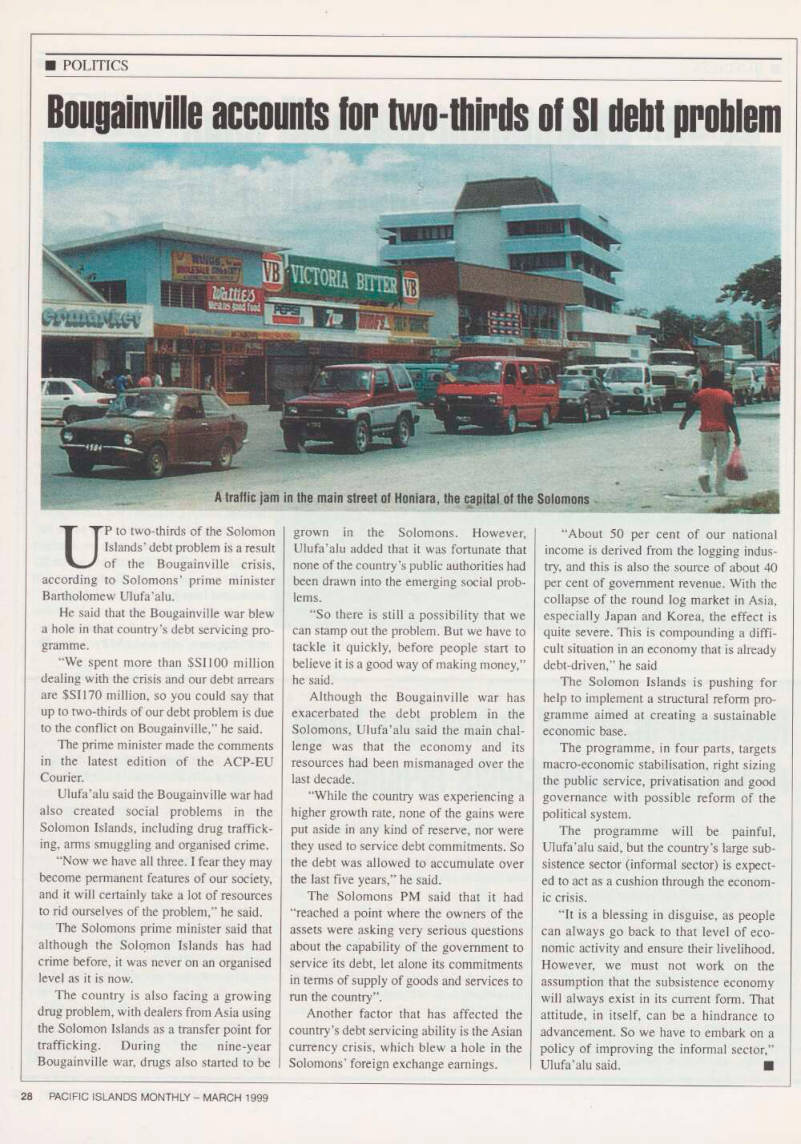
A traffic jam in the main street of Honiara, the capital of the Solomons